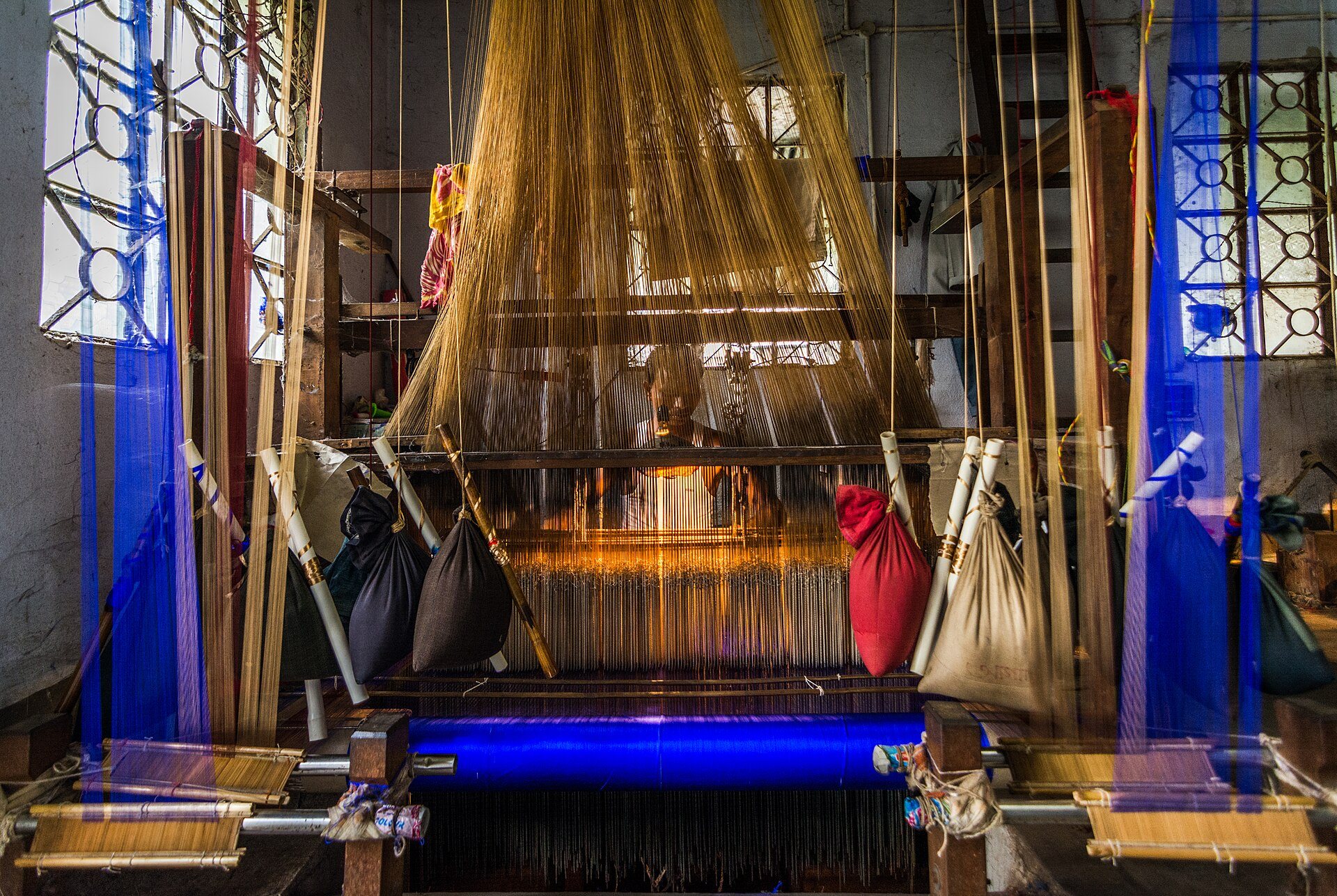
Bengal's textile year does not begin in January and it does not follow the agricultural calendar, which is what you would expect of a craft this old. It runs on a festival.
The clay for the Durga idols comes out of the Ganga in the months before the Puja, and in those same months the looms of Bishnupur, Santipur, Dhaniakhali, Phulia and Nadia are running flat out. In 2019, Bishnupur's weavers sold roughly ten thousand sarees between April and September — the Puja run — with demand intensifying as the festival approached. Tantuja, the West Bengal State Handloom Weavers' Cooperative Society, took about five thousand of them that year through its eighty-four showrooms.
The year that shape describes is one of the largest craft economies anywhere, and West Bengal is its centre by a distance most people do not expect.
The scale, which is the first surprise
The Fourth All India Handloom Census, conducted in 2019-20 by the Office of the Development Commissioner for Handlooms under the Ministry of Textiles, counts 2,673,891 handloom weavers and 848,621 allied workers across India — about 3.52 million people in total.
West Bengal is first among the states, with 366,656 weavers and 264,791 allied workers. That is 631,447 people, close to eighteen per cent of the national handloom workforce, in one state.
Most visitors arrive in India expecting the textile story to be Varanasi and Rajasthan, and we have written about Varanasi elsewhere because the Banarasi tradition deserves it. But by headcount, Bengal is the handloom heartland of the country, and the fact is almost entirely absent from how India presents itself to travellers.
Fifty-five days
The number that makes the craft comprehensible is not a national one. It is the time a single Baluchari takes.
About fifty-five days, with weavers at the loom more than twelve hours a day. The finished sarees sell between roughly ₹6,000 and ₹1.5 lakh. A master weaver might earn around ₹50,000 a month; a less experienced one about ₹20,000.
Hold that against the idol-makers at Kumartuli, who build a goddess in weeks and watch it dissolve in the Hooghly, and you have the two halves of the Bengali creative year: one thing made to last fifty years and one made to last five days, both commissioned in the same months, both financed by the same festival.
The looms themselves have changed, and the change is documented rather than nostalgic. Baluchari's figurative pallu was historically produced on a jala loom; the twentieth-century revival brought in jacquard, which cut the weaving time and allowed two weavers to work the same loom in shifts. In the early 1990s Bishnupur had around fourteen hundred working looms. By 2019 it had about six hundred, worked by roughly two thousand weavers. The craft has consolidated, not collapsed — fewer looms, run harder, by more people.
Baluchari, and the move nobody planned
Baluchari is named for Baluchar, in Murshidabad district, where it originated in the eighteenth century under the Bengal Nawabs. Its earliest pallus depicted the life of that court — women smoking hookahs, nawabs in horse carriages — and the figurative panel has been the saree's signature ever since. Today the scenes are usually drawn from the Ramayana and the Mahabharata.
Production is no longer in Murshidabad. It is in Bishnupur, in Bankura district, and the honest position is that the standard account of when and why it moved is thinner than it is usually presented. What is documented is the revival: in the first half of the twentieth century the artist Subho Thakur took up the cause of recultivating the tradition, and worked with Akshay Kumar Das, a master weaver of Bishnupur, who learned jacquard weaving. That is where the present craft comes from.
Bishnupur is worth the journey for reasons beyond the looms. It was the capital of the Malla kings, and its terracotta temples — built in brick because there was no stone — are among the most distinctive religious architecture in India. A weaving visit and a temple visit are the same afternoon.
The Geographical Indications, and what they tell you
Baluchari was registered as a Geographical Indication in 2011, on application number 173, for West Bengal. At that point it joined only two other Bengal sarees with the protection: Santipur and Dhaniakhali.
A GI is a dull-sounding instrument that does something genuinely useful for a traveller: it fixes a name to a place and a method, which means a Baluchari bought as a Baluchari has a legal definition behind it rather than a marketing one. For anyone intending to buy — and Bengal is a very good place to buy — the GI list is the shopping list.
The Jamdani question needs care, because it is the most commonly mangled fact in Indian textiles. UNESCO inscribed the traditional art of Jamdani weaving on the Representative List of the Intangible Cultural Heritage of Humanity in 2013, as element 00879, submitted by Bangladesh. UNESCO's description places the craft around Dhaka. That inscription is Bangladesh's, not India's. Bengal has its own living Jamdani tradition on the Indian side of the border, in Nadia and the Phulia belt; it is not what UNESCO inscribed, and conflating the two does the Indian weavers no favours.
Where the silk comes from
The other half of the year is upstream of the loom. Murshidabad — the district Baluchari is named after — is Bengal's silk district, and the mulberry rearing cycle is what actually sets the rhythm of supply.
We will be careful here, because we could not retrieve the Central Silk Board's own regional rearing calendar: its Murshidabad technical pages would not load, and we are not going to invent a crop schedule. What we can say is that mulberry sericulture in the eastern plains runs multiple rearings a year rather than a single harvest, which is why Bengal silk supply is continuous rather than seasonal, and why a weaver's constraint is loom time rather than yarn.
If you want the detail, the people to ask are at the Weavers' Service Centre or the state Directorate of Textiles, and they are generally delighted to be asked. We will update this piece when we have the calendar from a source we trust.
What a visit actually looks like
The honest answer is that this is a two-day proposition from Kolkata and it is better in the months before the Puja than during it.
August and September are when the looms are loaded and the orders are out, and when a workshop visit shows you work in progress rather than an empty shed. During the Puja itself the stock has gone to the showrooms and the weavers are, reasonably enough, at the festival.
Bishnupur is about a hundred and thirty kilometres from Kolkata and deserves an overnight rather than a day trip — the temples in the morning light, the looms in the working day. Santipur and Phulia, in Nadia, are closer and make a good single long day with the cotton tant tradition rather than the silk one. Murshidabad, with Hazarduari and the Nawabi sites, is a different trip again and a historically richer one than its visitor numbers suggest.
Tantuja's showrooms — there are a good many across the state and one in Delhi — are the straightforward way to buy with the cooperative structure behind it. The more interesting way is to buy from the weaver, which takes a day and an introduction, and which is what we arrange.
A word on what to expect of the buying. A fifty-five-day saree is not a souvenir, and the price reflects fifty-five days of someone's labour rather than a brand. Guests who understand that before they walk in have a far better conversation, and tend to come home with one good thing rather than four indifferent ones.
Fragen, beantwortet
How long does a Baluchari saree take to make?
Around fifty-five days on the loom, with weavers working more than twelve hours a day. Prices run from roughly ₹6,000 to ₹1.5 lakh depending on the work.
Which Bengal textiles have a GI tag?
Baluchari received its Geographical Indication in 2011 on application number 173. At that time the only other Bengal sarees registered were Santipur and Dhaniakhali. Several more Bengal products have been registered since; we would check the current GI Registry list before relying on any particular name.
Is Jamdani Indian or Bangladeshi?
Both traditions are alive, but the UNESCO inscription is Bangladesh's. 'Traditional art of Jamdani weaving' was inscribed on the Representative List of the Intangible Cultural Heritage of Humanity in 2013, element 00879, submitted by Bangladesh, and UNESCO's description places the craft around Dhaka. India's Bengal Jamdani tradition continues in Nadia and the Phulia belt and is a separate thing.
When is the best time to visit the weaving villages?
August and September, before Durga Puja, when the looms are running for the festival market and there is work to see. During the Puja the stock has moved to the showrooms and the weavers are at the festival.