
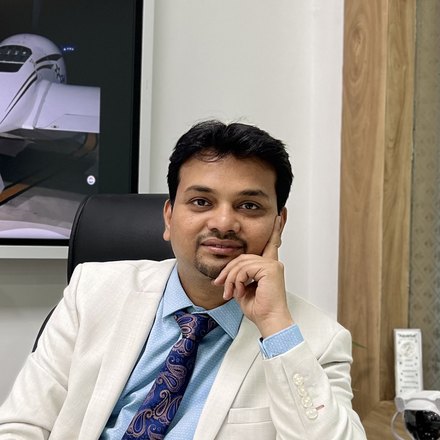
I have spent my working life on a single conviction: that the world’s most discerning travellers hold every great destination to one standard, and that India has too often been offered to them at another. The distance between those two standards is not a shortcoming of India. It is a failure of presentation — and a failure can be fixed. Closing that distance, journey by journey and, I hope, in time as a country, is the work I care about most.
What follows is not a company’s brochure. It is one practitioner’s argument, offered to anyone who shares the stake: that a civilisation the size of a continent is under-represented in the world’s imagination of where to travel, that the cost of this is measurable and large, and that the remedy is known. I have built a company as one proof of it. But the argument is bigger than any company, and it deserves to be made plainly.
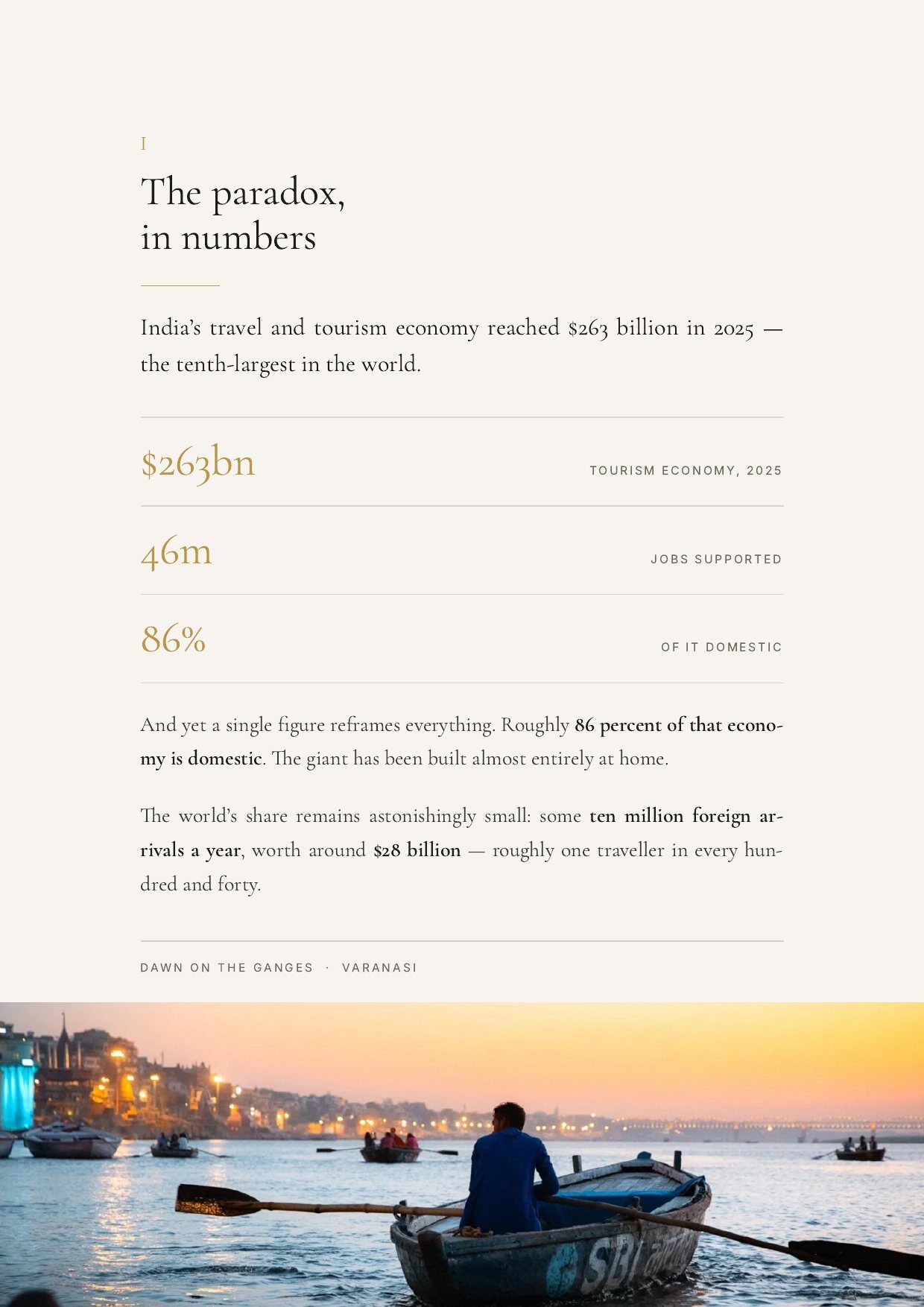
The paradox, in numbers
Begin where the sentiment ends and the evidence starts. India’s travel and tourism economy is now the tenth-largest in the world — some $263 billion in 2025, supporting 46 million jobs, and growing faster than the global average. On current trajectory it nearly doubles by the mid-2030s, to over half a trillion dollars, and rises to the fourth-largest on earth. By any measure, this is a giant.
And yet look closer, and a single figure reframes everything: roughly 86 percent of that economy is domestic. Indians travelling India account for the overwhelming majority of it. The giant has been built almost entirely at home. The world’s share — the foreign traveller, the inbound frontier — remains astonishingly small: on the order of ten million foreign arrivals a year, worth around $28 billion in foreign exchange. In a world that takes some 1.4 billion international trips annually, that is roughly one traveller in every hundred and forty.
Set that against the field and the gap stops being abstract.
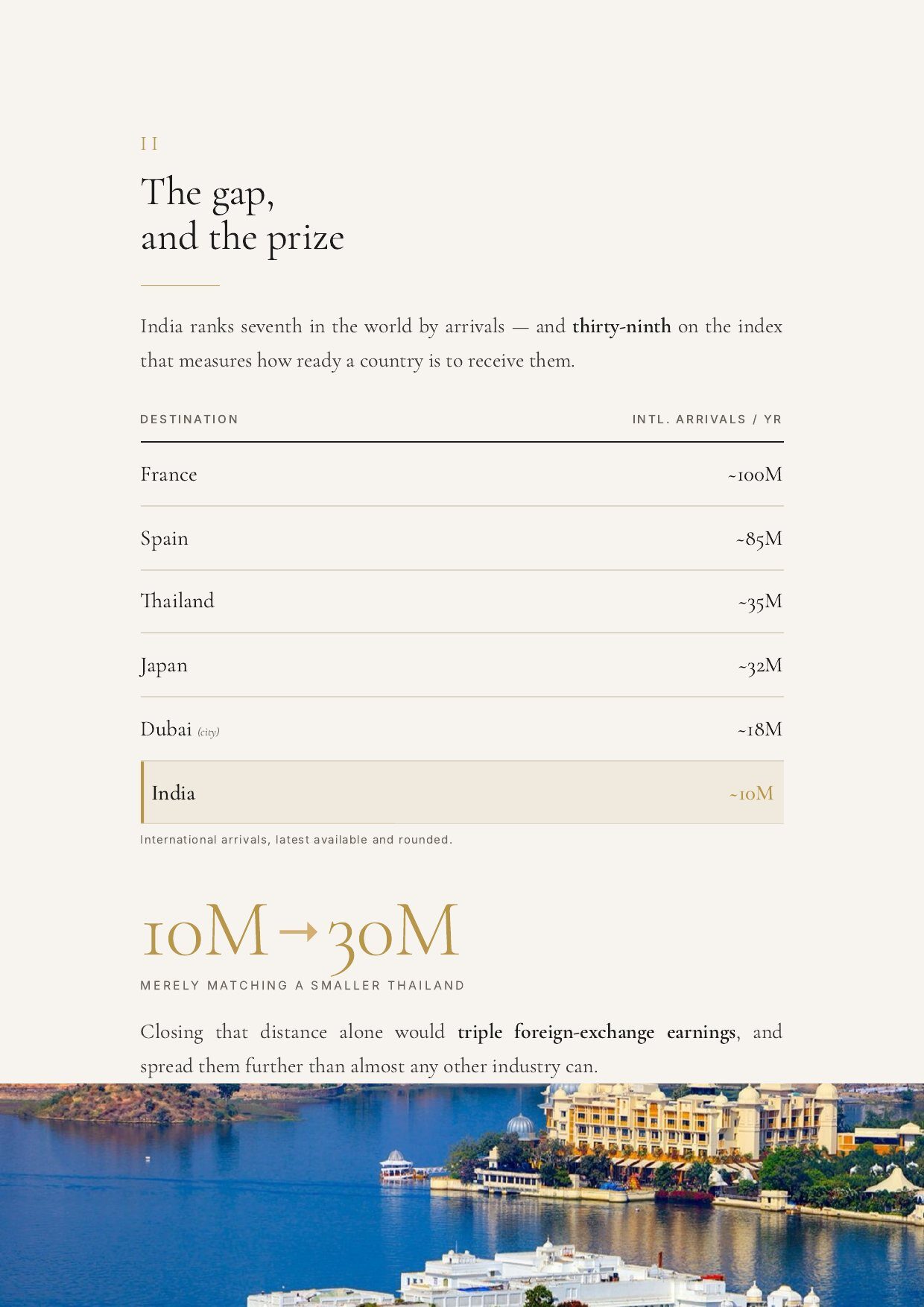
| Destination | Intl. arrivals / yr | |
|---|---|---|
| France | ~100M | The world's most-visited country |
| Spain | ~85M | Nearly nine visitors for every one India receives |
| Thailand | ~35M | A country a fraction of India's size or population |
| Japan | ~32M | Roughly fourfold in a decade, by design |
| Dubai (city) | ~18M | One city, nearly double India's entire inbound |
| India | ~10M | Seventh by arrivals — thirty-ninth by readiness |
International arrivals, latest available and rounded, shown to illustrate the scale of the gap.
France welcomes roughly a hundred million foreign visitors a year; Spain some eighty-five. Thailand — a country a fraction of India’s size and population — receives around thirty-five million. A single city, Dubai, hosts nearly double India’s entire inbound. India ranks seventh in the world by arrivals and yet thirty-ninth on the index that measures how ready a country is to receive them, and tourism contributes under six percent of GDP against a global benchmark nearer ten.
This is not the arithmetic of a country with little to offer. It is the arithmetic of a country whose offering has been under-presented, under-served on the last mile, and under-told to the very people most able to appreciate it. I have come to call this the presentation gap: the distance between how good the experience of India actually is and how good the world believes it to be. India does not have a substance problem. It has a presentation problem — and presentation is a discipline, not a destiny.
“India has built a tourism economy at home. It has not yet claimed its place in the world’s imagination. That frontier is the prize.”
What is at stake
Put a value on the gap and the argument sharpens. India’s own stated ambition is a hundred million foreign arrivals a year by 2047, with tourism at a tenth of the economy — a tenfold rise in inbound. But one need not reach for 2047 to see the prize. Simply closing the distance to Thailand’s arrivals — a country India dwarfs in scale and heritage — would roughly triple the inbound economy within a generation.
Merely reaching the arrivals a smaller Thailand already receives would move India’s inbound from around ten million to thirty million foreign visitors — tripling foreign-exchange earnings, and creating millions of the highest-value, most widely-distributed jobs a developing economy can generate: jobs that reach a village weaver, a mountain guide and a first-generation hotelier alike. The hundred-million ambition is simply the same logic, carried to its horizon.
And these are not ordinary jobs or ordinary dollars. Inbound tourism is among the most equitably distributed forms of economic development known — it pays the guide and the camel-herder as surely as the hotelier, it earns hard currency without extracting a single finite resource, and it does its work in precisely the rural and remote places most other industries never reach. This is why every serious emerging economy now treats inbound tourism not as a leisure sector but as strategic infrastructure. India, uniquely, has the substance to lead and has not yet chosen to.
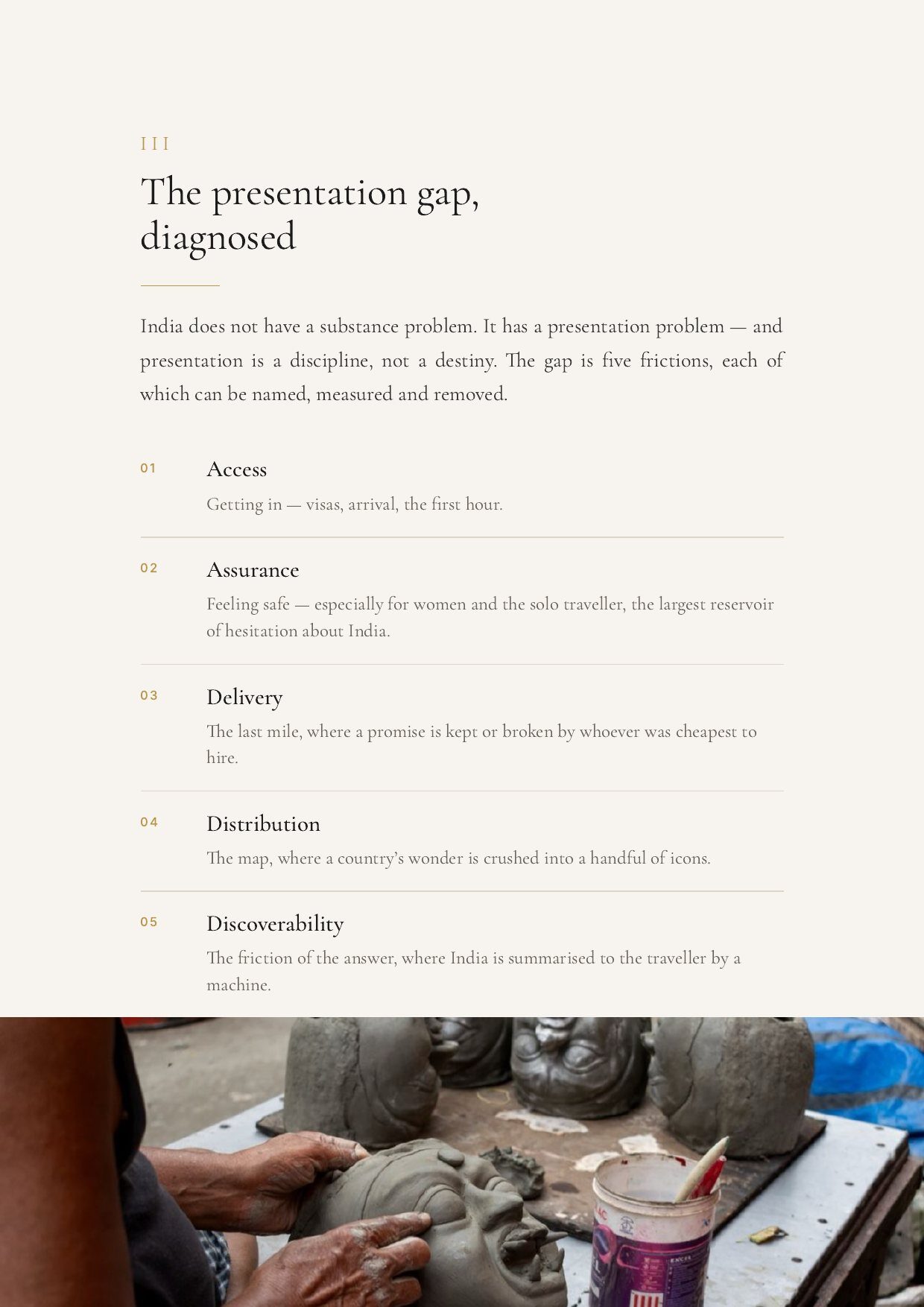
The presentation gap, diagnosed
The gap is not a mystery, and it is not a mood. It is made of five specific, fixable frictions — and naming them precisely is the first act of fixing them.
Access — the friction of getting in: visas, arrival, the first hour. Assurance — the friction of feeling safe, especially for women and the solo traveller, the single largest reservoir of hesitation about India. Delivery — the friction of the last mile, where a promise made in a brochure is kept, or broken, by whoever was cheapest to hire. Distribution — the friction of the map, where a country’s wonder is crushed into a handful of icons while whole regions stand unseen. And Discoverability — the newest friction, the friction of the answer, where India is increasingly summarised to the traveller by a machine, accurately or not.
None of these is a flaw in India. Each is a flaw in the machinery around India — the machinery of access, assurance, delivery, distribution and story. Machinery can be rebuilt. That is the entire optimism of this essay, and every recommendation in it maps to one of these five.
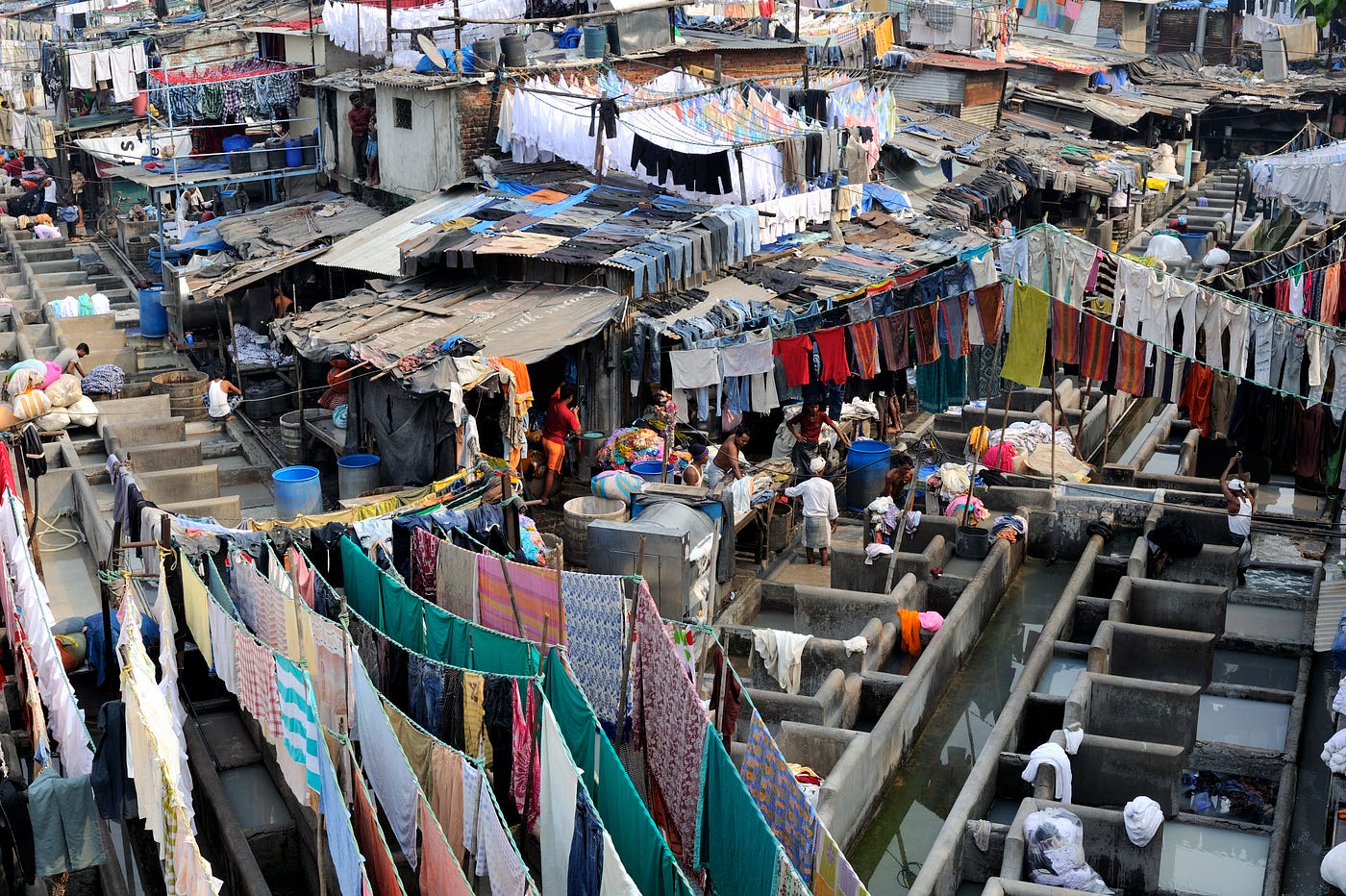
What the world’s comebacks teach
India need not invent this playbook. It has been written, recently and repeatedly, by countries that decided to be visited.
Japan is the clearest case. Through the 2010s it relaxed visa rules for its key Asian markets, invested seriously in branding, and made itself easy to enter and easy to love — and inbound arrivals rose roughly fourfold in a decade, to nearly thirty-two million. Saudi Arabia, from very nearly zero, opened tourist visas and airspace and cultural product under a national strategy and cleared a hundred million visits — a number India, with incomparably greater heritage, has never approached. Thailand built a brand of ease and warmth so durable that a mid-sized nation now out-draws the entire Indian subcontinent.
The pattern in every case is identical, and it is the heart of my argument: national reputation followed deliberate standards, easier access, and a well-told story — in that order. The state made entry frictionless and safety credible; a cadre of excellent operators proved the ceiling of what the experience could be; and the country’s image rose to meet the benchmark that private excellence had set. Reputation is a lagging indicator of standards kept. Which is precisely why standards are where the work begins.
“Reputation is a lagging indicator of standards kept. A country that is not well-described will not be well-visited.”
The thesis: standards as infrastructure
Here is the idea I have staked a company on. When a house holds itself to a standard — the palace door already open, the curator who answers personally, the guide trained a decade ago waiting exactly where he said he would be — it proves, in the only way that finally counts, that India can be experienced at the world’s highest register. Hold that standard privately, over enough years and enough journeys, and something happens: it stops being one house’s promise and starts becoming the market’s expectation. Hotels rise to meet it. Guides train into it. Competitors are pulled upward by it. Standards kept privately, at scale and over time, have a way of becoming standards kept by an industry — and, in time, by a country.
This is not romance; it is how national reputations have always been rebuilt — in the Gulf, in South-East Asia, in Japan. A handful of exceptional operators raised the world’s estimate of what a whole country’s hospitality could be, and the national brand followed the private benchmark, not the other way around. A private house cannot legislate a nation’s tourism, and should not try. But it can build a benchmark visible enough that the market moves toward it, and that policymakers can point to and say: this is what excellent looks like, and it was built here, at home.
My ambition for Elevated India is not merely to run the finest journeys through this country. It is to help move the benchmark for how this country is experienced — until the standards for India are set in India, and consulted everywhere.
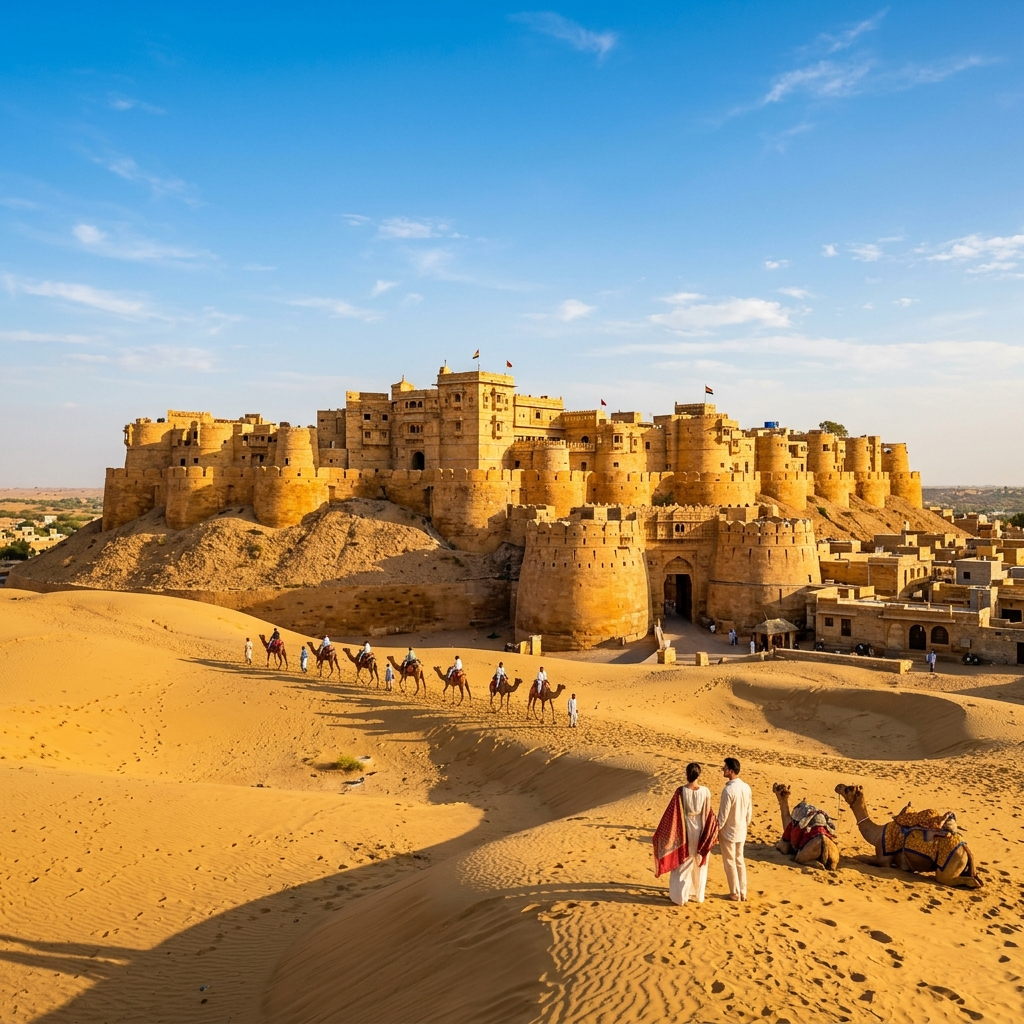
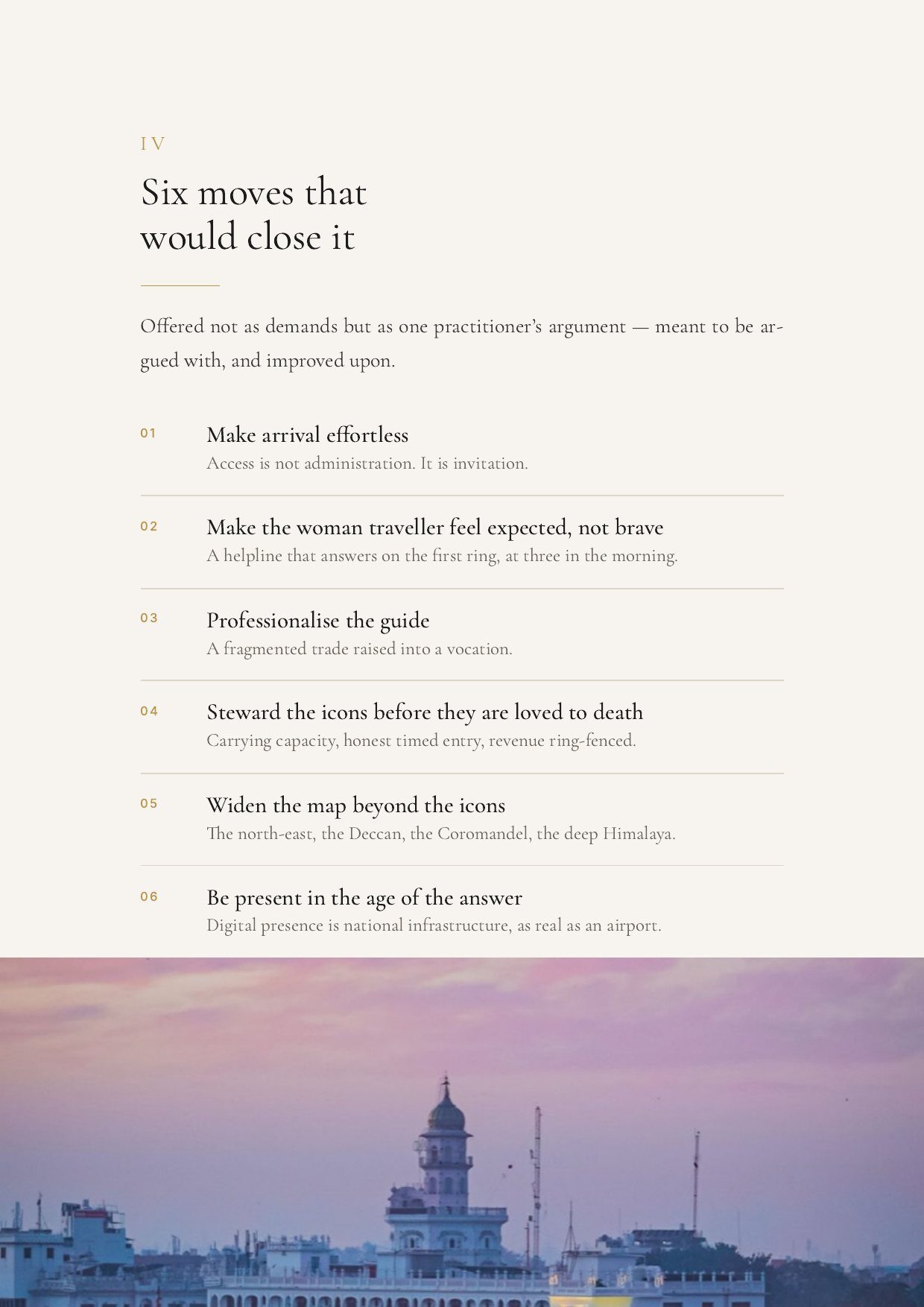
A policy argument — six moves that would close the gap
I offer the following not as demands but as one practitioner’s argument — the moves I believe would do the most to close each friction in the diagnosis and raise India’s share of the world’s travellers. They are meant to be argued with, and improved upon.
Make arrival effortless
The journey should begin the moment a visa is considered, not the moment a queue is joined. Seamless e-visas for every significant source market, biometric fast-track for pre-vetted guests, and one well-designed digital front door would erase the friction that quietly costs India its first impression. This is not theory. When Japan simplified its visas and set about telling its story, inbound arrivals rose roughly fourfold in a single decade, to nearly thirty-two million. Saudi Arabia, from a standing start, cleared a hundred million visits by opening its visas and its skies. Access is not administration. It is invitation.
Make the woman traveller feel expected, not brave
No single perception costs India more than safety — and none more acutely than for women, and for the solo traveller, who together represent the fastest-growing and highest-spending segment of world travel. This is not answered by a campaign; it is answered by lived reality: visible, well-lit, well-staffed tourism corridors; a trained tourist-police presence that is actually present; a helpline that answers on the first ring, in the traveller's language, at three in the morning. It is the single highest-return investment available to Indian tourism, because it converts the largest pool of hesitation on earth into arrivals.
Professionalise the guide
A great guide is the difference between a country seen and a country understood — and understanding is what turns a first visit into a lifelong advocate, and one advocate into ten arrivals. Licensing that means something, continuing education, fair and dignified pay, and real professional status would lift India's guides from a fragmented trade into a vocation the world seeks out by name, and keep the deep knowledge of this civilisation in the hands of the people who carry it.
Steward the icons before they are loved to death
Carrying-capacity limits at the most fragile monuments, honest timed-entry, and the ring-fencing of ticket revenue for conservation are not brakes on tourism — they are what allow it to compound. A site protected is a site that can still silence a child not yet born. The alternative — a wonder degraded by the very love shown to it — is the most expensive mistake a destination can make, because it cannot be undone at any price.
Widen the map beyond the icons
India's arrivals crowd into a handful of images while whole regions of extraordinary substance stand unseen — the north-east, the Deccan, the Coromandel, the deep Himalaya. Targeted air access, a few signature multi-day routes, and honest last-mile infrastructure would disperse both the wonder and the livelihood far more fairly — easing the strain on the icons while widening the country's welcome and the reach of its income.
Be present in the age of the answer
The traveller of this decade asks a question and is handed an answer — increasingly by a machine that reads, ranks and summarises. If India is absent, thin or poorly told in that layer, it is invisible regardless of its beauty. Structured, truthful, richly-told digital presence is no longer marketing; it is national infrastructure, as real as an airport. A country that is not well-described will not be well-visited.
The regenerative condition
Growth without stewardship is not a victory; it is a debt. If a hundred million travellers are to come, the only version worth wanting is one that leaves India’s places better held than it found them and its people better off for the welcome. That is not a constraint on the ambition — it is the condition of the ambition lasting. A monument loved to death, a hill town drowned in its own popularity, an artisan tradition reduced to a photo-stop: these are how tourism consumes the very thing it sells, and they are not hypothetical.
The alternative is deliberate. Route money to the maker, the guide, the village kitchen and the monument’s upkeep rather than away from them. Favour the small and the slow over the high-volume churn. Steer guests toward the parks and sites whose fees fund their own protection. A house that profits from a country’s beauty owes that country’s people and places a share of the keeping — and I would rather build that principle into the work in full than bolt it on as a slogan. It is set out, honestly and without greenwashing, in how we try to travel well.
A decade out
Picture India ten years from now. The arrival is effortless and the first impression is won, not lost. The solo traveller arrives curious rather than cautious, because the country has made her safety visible and ordinary. The guide is a professional the world seeks out by name. The map has widened — the north-east, the Deccan, the deep south and the Himalaya carry their fair share of both the wonder and the livelihood. The most fragile icons are protected enough to still astonish a child not yet born. And when a traveller anywhere asks the question — where should I go to be genuinely moved — India is present, accurate and beautifully told in the answer.
That India is not a fantasy. It is the sum of a great many standards kept — some by government, most by the millions of people who make their living welcoming the world to this country, and a few, I hope, by us. India does not need to become somewhere else to claim its place in world travel. It needs only to be presented, at last, as fully as it already is.
I return, in the end, to that traveller who almost did not come, and to the silence at dawn. My whole endeavour is to make the second experience so reliable that the first hesitation disappears — to close, one journey at a time, the distance between what India is and what the world believes it to be. That distance is the only thing standing between this country and its rightful place in the imagination of the world. I intend to spend my life closing it.
That is the argument for India. Every journey we compose is a footnote to it.
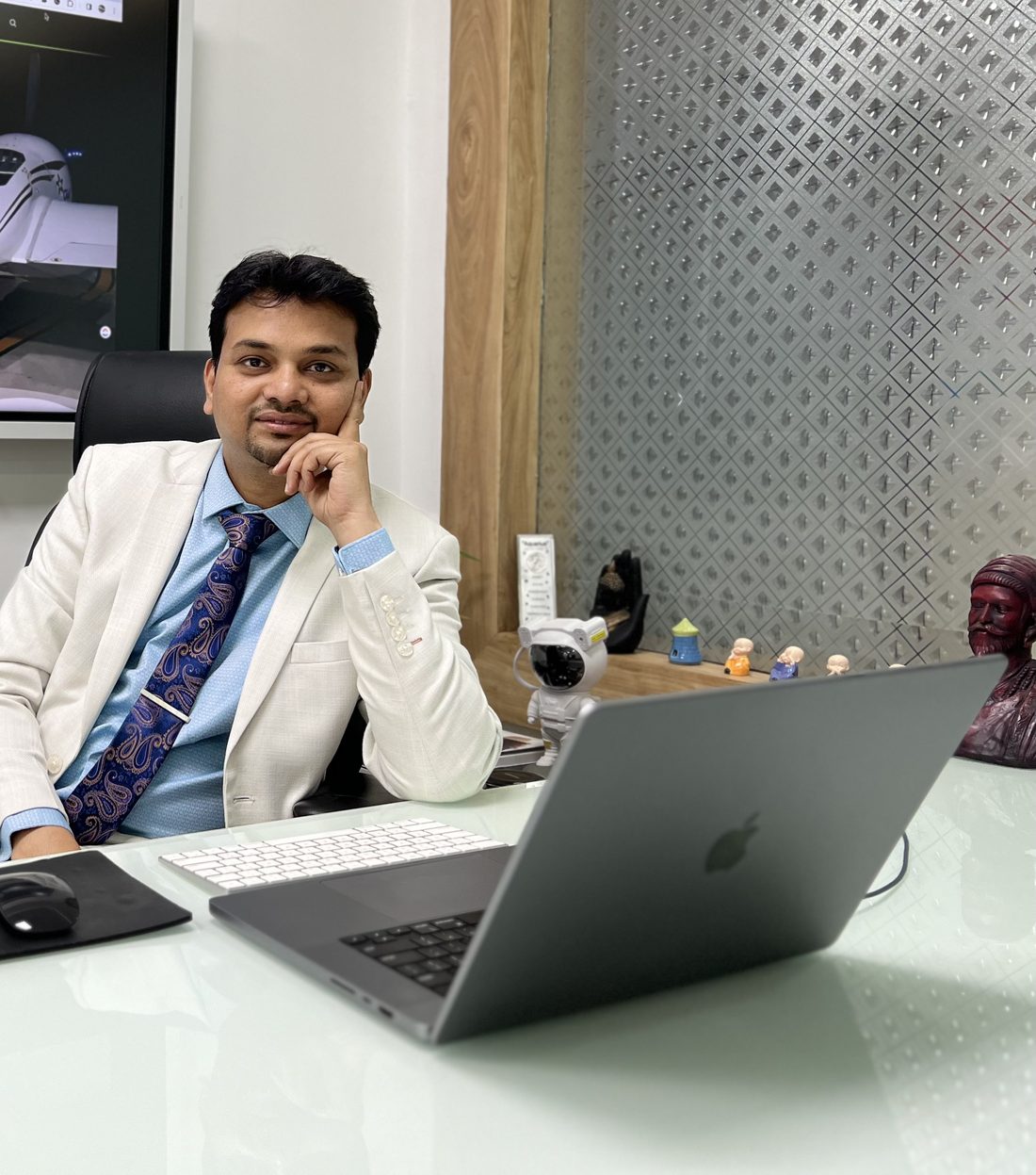
No vision is travelled alone. My deepest thanks to Manu Singh, my co-founder, whose two decades of mastery on the Indian road are written into every journey this house composes. To Raymond Hawkins, my co-founder in Vanishing India and our Chairman Emeritus, whose counsel shaped how I have come to see this country and this work. And to the friends of twenty years and more whose companionship, on the road and off it, has taught me more than any guidebook — the people I am simply lucky to know: Manu of Skyway Tours, Bangalore; Pawan and Lalit of Adiona Travels; and Ravi of Uniglobe MKOV. The argument for India is the stronger for all of you.
Read it here
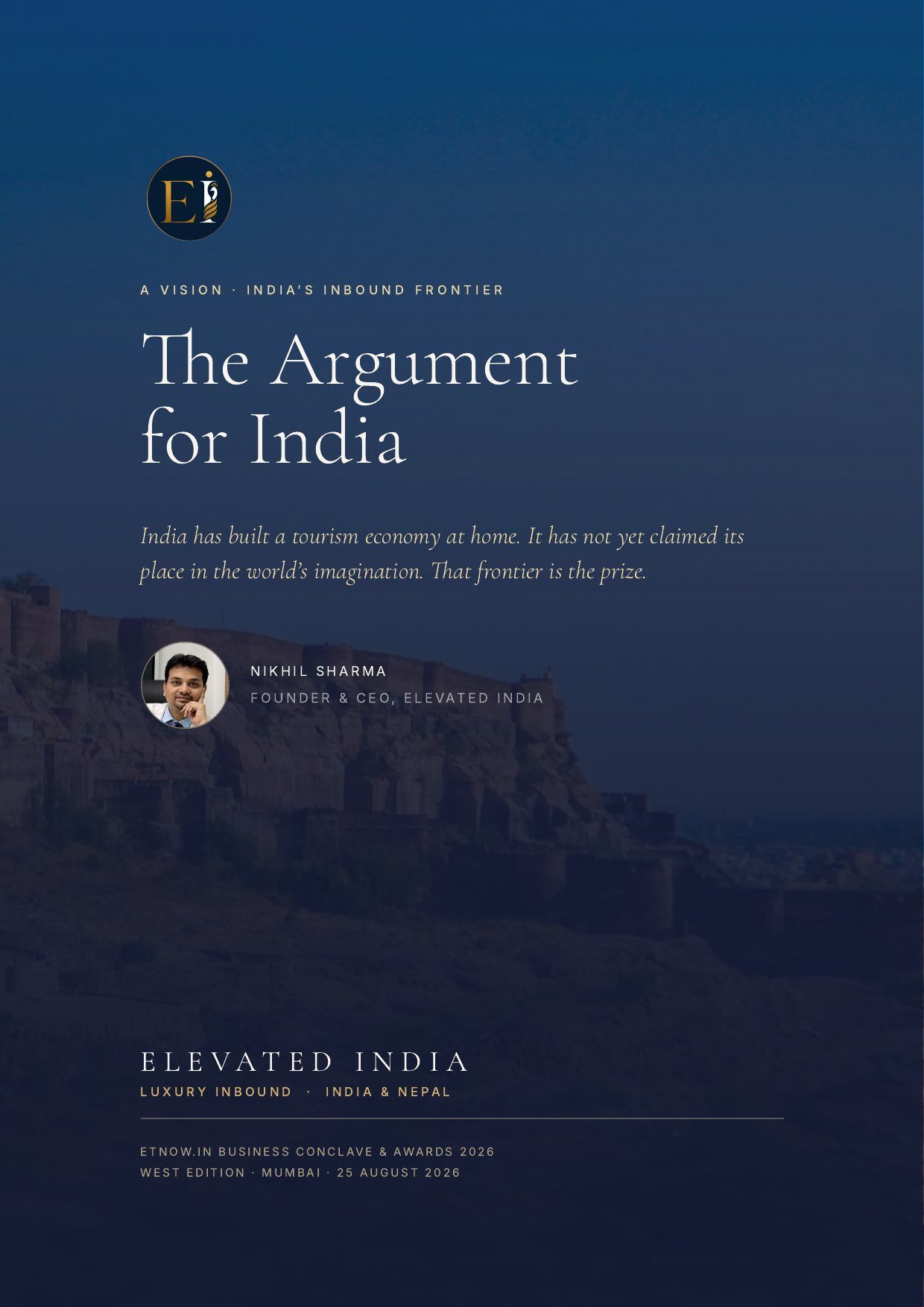
Six pages, as presented at the ET NOW.IN Business Conclave & Awards 2026 in Mumbai. Turn it with the arrows, the buttons, or by clicking either side of the spine.
Prefer it on paper? Get the print-quality PDF — or open it in a new tab.
Take the argument with you
The same six pages as the edition above, print-quality and A4, in a form you can read away from a screen or put in front of someone who needs to see it. Presented at the ET NOW.IN Business Conclave & Awards 2026, Mumbai.