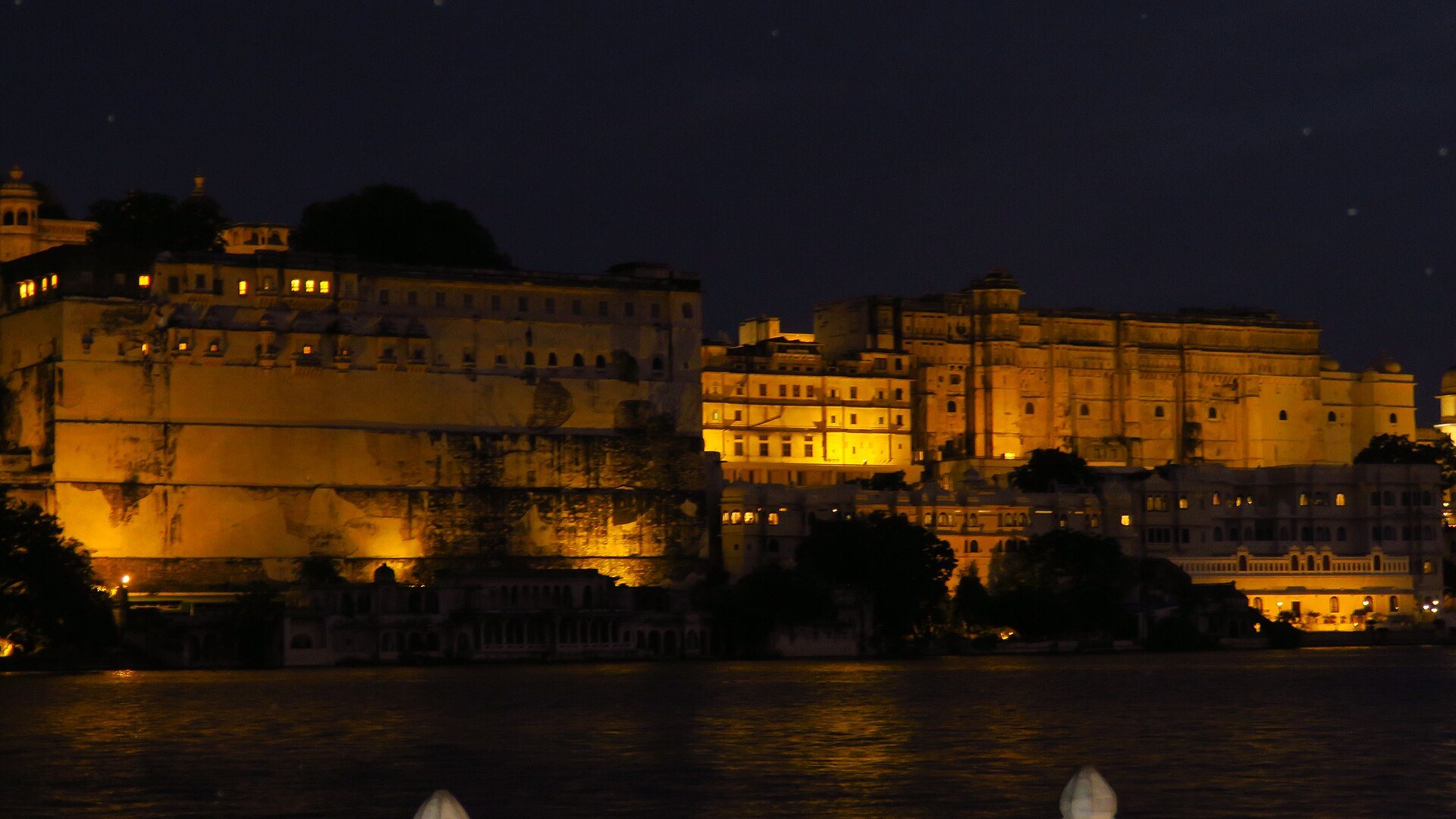
Titelfoto: The City Palace, Udaipur, at night, by Koustave (CC BY-SA 4.0), via Wikimedia Commons
Every year from about September we have the same conversation, and it goes better when it starts with numbers.
The question is whether to travel India over Christmas and the New Year. It is usually framed as a question about weather and atmosphere. It is really a question about commercial terms, and those terms are published — by name, by property, with amounts — and almost nobody reads them before deciding.
So here they are, along with an honest account of what the premium buys, what it does not, and what the alternative actually looks like.
What is actually published
The Oberoi group publishes its festive terms property by property, and they are specific.
The standard clause reads that a mandatory meal supplement is applicable for guests staying on Christmas Eve, 24 December, and New Year's Eve, 31 December, and that this is payable at the hotel directly. Then the amounts, all stated as plus 18 per cent tax per guest, for 2026:
At the Oberoi Amarvilas in Agra, ₹16,000 on 24 December and ₹19,000 on 31 December. At the Oberoi Rajvilas in Jaipur and the Oberoi Udaivilas in Udaipur, ₹14,000 and ₹19,000. At the Oberoi Cecil in Shimla, ₹10,000 and ₹10,000.
Notice the shape. At the leisure palaces New Year's Eve is priced well above Christmas Eve. At the hill station the two are level. That is a demand curve, published, and it tells you precisely which night the market actually wants.
Two things follow that matter more than the amounts. First, the supplement is mandatory and payable at the hotel directly — it is not an inclusion in the rate, which means it is not in the number you compared when you were choosing between properties. Second, it is charged per guest and per night, so a couple across both evenings at Amarvilas owes, on those published figures with tax, ₹18,880 each for the 24th and ₹22,420 each for the 31st. That is ₹82,600 for two people for two dinners, before a single night of accommodation.
We set that out as arithmetic on the hotel's own published figures, because it is the sort of thing people discover at check-out.
There are four chargeable occasions, not two
This is the detail that catches people, and it comes from Taj's own group-level terms rather than from us.
Those terms state that some hotels may apply additional supplemental charges during Christmas Eve on the 24th, Christmas Day lunch on the 25th, New Year's Eve on the 31st, New Year's Day lunch on the 1st, Easter brunch, and some festive dates.
Christmas Day lunch and New Year's Day lunch. Four priced sittings across the fortnight, not two, and the two nobody budgets for are the ones in the middle of the day when you had assumed you were simply having lunch at your hotel.
Taj also states that blackout dates are defined by each participating hotel and are not published centrally, and that offers may carry minimum stay restrictions. Which is the honest position: the group sets the frame and the individual palace sets the terms, so the only reliable answer is the one you get from the property for your dates.
The deposit is the premium
If you take one thing from this piece, take this one, because it is the cost that is invisible until it is irreversible.
The Oberoi Vanyavilas at Ranthambhore publishes the whole ladder in one place, which makes the structure unmistakable. From 10 April to 30 September 2026, 30 days' notice. From 1 October 2026 to 31 March 2027, excluding the holiday dates, 45 days. From 21 December 2026 to 3 January 2027, 90 days. In each case the penalty for cancelling inside the window is the accommodation charge for the entire length of stay.
The same 90-day festive rule applies at Amarvilas, Rajvilas and Udaivilas, there stated over 19 December 2026 to 3 January 2027. Udaivilas and Rajvilas add that a charge equivalent to the originally booked stay will be levied for any early departure, and Rajvilas and Amarvilas suspend the children's room discount across the same window. Advance purchase rates are non-refundable at every property, with no date restriction.
Now the comparison that makes the point. The Oberoi in Gurgaon — a city hotel serving corporate demand — publishes a cancellation notice of two days, for the whole year, with no festive exception.
Two days against ninety. The 90-day rule is not an Oberoi policy. It is a leisure-palace-at-New-Year policy, and the same group runs both.
What this means in practice is simple and worth saying plainly. Book a 25 December arrival and your money stops being yours at about the end of September. Not the rooms running out — the money. Everything after that date is a commitment, and the question is not how far ahead you need to book but after what date you are no longer able to change your mind.
The state charges it too, and says by how much
A useful corroboration, because it comes from a government and is stated as a percentage rather than buried in a policy page.
The Palace on Wheels tariff, published on a Government of Rajasthan domain, states that ten per cent additional shall be charged on the trips having Christmas and New Year.
The same page sets out terms in the same spirit as the hotels'. Twenty-five per cent on booking, the balance sixty days before departure with a twelve per cent penalty for paying late. Cancellation deductions of ten per cent between 120 and 90 days out, 25 per cent between 89 and 60, fifty per cent between 59 and 30, and nothing refunded inside 29 days. A minimum occupancy of 50 per cent for a departure to run at all. And charter bookings, which require fifty passengers, are not permitted over the Christmas and New Year periods.
Ten per cent is the cleanest single figure available for the festive premium, because a state tourism corporation has published it rather than an operator estimating it.
Why the premium exists
Three things coincide, and only one of them is about India.
The Ministry of Tourism publishes foreign tourist arrivals by month. For 2025: December 1,081,977. January 956,988. February 915,713. November 954,217. The low is May at 474,308.
So December is the peak month of the Indian year, at almost exactly twelve per cent of annual arrivals against the 8.33 per cent an even twelfth would give. It ran about thirteen per cent above January, eighteen per cent above February and more than double the May low.
On top of that sits Indian domestic travel, which peaks over the same fortnight for the same reasons of school holidays and weather. And on top of that, the international Christmas break, which is when a large share of the world can travel at all.
Three demand curves landing on the same two weeks, against a fixed number of palace rooms. That is the whole explanation and there is nothing sinister in it.
One nuance worth having, because it corrects a lazy claim. Nationally, December is not India's strongest rate month. The hotel analysts' figures for December 2025 show pan-India average rates softening month on month from November, because corporate demand collapses over the holidays even as leisure demand peaks. The festive premium is a leisure-segment, specific-property phenomenon. It is not a national rate spike, and anyone telling you Indian hotel rates go up in December is describing the wrong market.
What the premium buys, and what it does not
It buys genuinely excellent weather on the northern circuits, and the Meteorological Department's own normals bear that out. At Agra, December runs a mean daily maximum of 24.5°C against a minimum of 7.8°C; January is 22.7 and 7.5. At Jaipur, December is 24.4 and 9.1; January 22.5 and 7.8. Rainfall is negligible in both months.
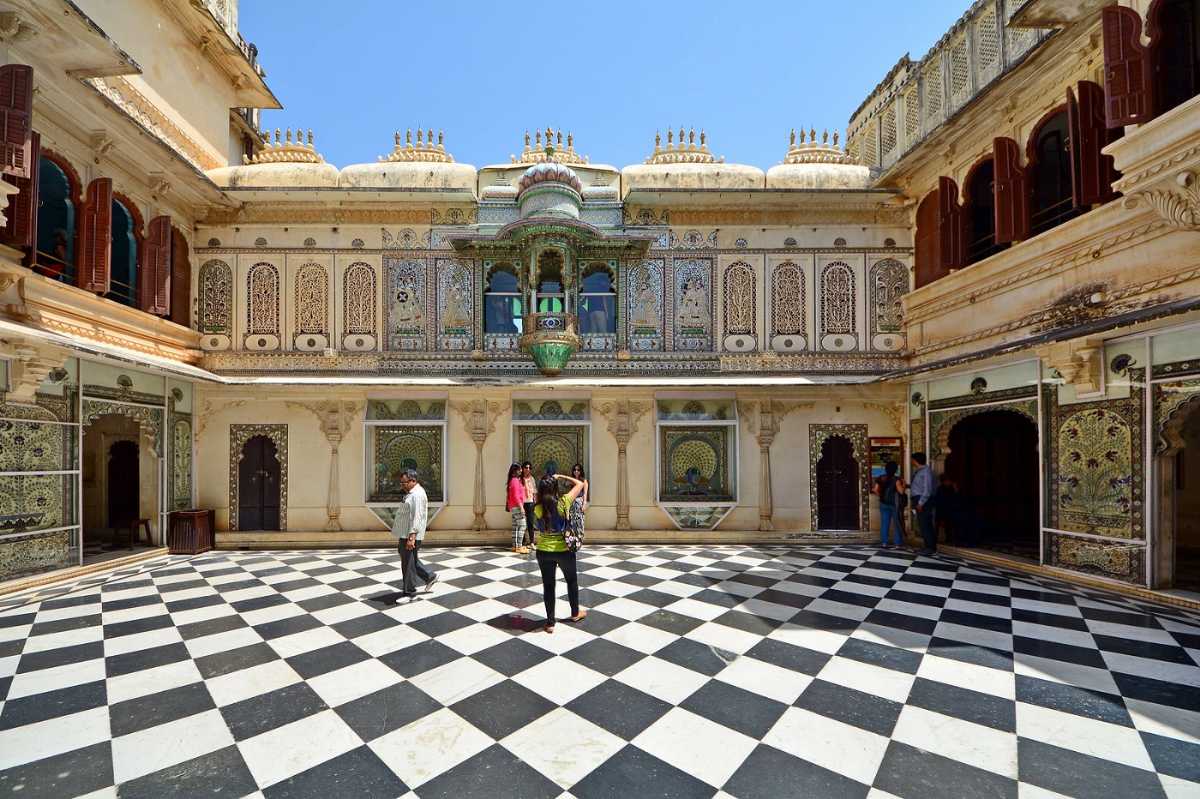
It buys a palace at its most theatrical, and we will not pretend that does not matter. A Rajasthani courtyard on the thirty-first of December is a real thing to have done.
What it does not buy is clear skies in the mornings. This is the counter-fact most people never see, and it is the Meteorological Department's own.
At Delhi's Palam station, on the current thirty-year normals, the mean number of days with fog is 15.4 in December and 20.7 in January. Twenty-point-seven. Two mornings in three in January, at the airport that most itineraries depart from and beside the road that most of them drive to Agra.
By February it falls to 13.1 and by March to 6.0.
So the premium fortnight sits in the middle of India's foggiest season, and the thing it is sold on — the best weather of the year — is true of the afternoons and not of the mornings. A dawn at the Taj in late December is a real possibility and it is also a real gamble, and the honest version is to say so when the trip is designed rather than at six in the morning on the day.
On whether the gala dinner is distinctive or a surcharge for a buffet, we cannot tell you from any published source, because the terms describe the charge and never the event. What we can observe is that the charge is priced on the date rather than the content — the same group charges ₹19,000 for the 31st and ₹14,000 for the 24th at Rajvilas, and ₹10,000 for both at Shimla — and that the lunches are chargeable too. Draw your own conclusion. Ours is that some of these evenings are among the best things that happen in Indian hospitality all year, and some are a buffet with a band, and the difference is the house rather than the date.
The honest case for February
The conventional advice is to move to mid-January. We think February is the better answer and the data supports it more cleanly.
On weather: at Agra, February's mean daily maximum of 26.0°C is higher than December's 24.5 and January's 22.7, with warmer nights at 9.9 against 7.8 and 7.5. Jaipur shows the same shape. And Delhi's fog days fall from 20.7 in January to 13.1 in February. February is warmer, feels drier and is markedly less foggy than January.
On commercial terms: at Vanyavilas the published notice period outside the holiday window but inside the same season is 45 days against 90. The alternative dates halve the deposit exposure and remove the mandatory supplements entirely — which are the two concrete, published costs of the festive fortnight.
On crowds, we will be honest in a way that most of this advice is not. Moving to January or February does not buy you an empty country. They are the second and third busiest months of the Indian year, and which of them is second flips between years — February in 2024, January in 2025. December leads by a modest margin, not a dramatic one.
If genuine quiet is the objective, the months are May, June and September, and they are quiet for weather reasons we would not pretend away.
So the case for February is not that India empties. It is that you get warmer days, fewer foggy mornings, no mandatory gala supplements and half the deposit exposure, in exchange for not being in a palace courtyard on New Year's Eve. For a great many travellers that is an obviously good trade. For some it is obviously not, and those are the people who should book December with their eyes open.
How we would actually decide it
Three questions settle it in most cases.
Is the occasion the point? If the trip exists because it is a milestone birthday or a first Christmas as a family and the date is the reason, book the fortnight, accept the terms and stop optimising. The premium is buying something real and you know what it is.
How firm are your dates? The 90-day rule is the whole risk. If there is any chance of the trip moving — a health question, a work question, a child's exam timetable — then a non-refundable commitment from late September is a bad shape, and February is not a compromise but a better instrument.
Which part of India? The fog argument bites hardest on the Delhi–Agra–Jaipur axis and on early flights out of Delhi. It bites far less in the south and on the coast, where the festive fortnight is a more straightforward proposition and the weather case is stronger.
And whichever you choose, ask for the festive terms in writing before you confirm. Not the rate — the terms. The supplements by date, the minimum stay, and the exact day after which the money is no longer refundable. Any good property will give you all three without hesitation, and the ones that hesitate have told you something.
A note on our sources
The gala supplements, cancellation ladders and festive windows are from the Oberoi group's own published property policy pages, read on 6 October 2026. The four chargeable occasions are from Taj's published group terms. The ten per cent festive charge and the payment schedule are from the Palace on Wheels tariff on a Government of Rajasthan domain. The monthly arrivals figures are from the Ministry of Tourism's Annual Tourism Snapshot 2025; we checked that the twelve months sum to the published annual total, and they do. The weather normals are the Meteorological Department's own, and we have given the station in each case because the normal periods differ between stations.
Three things we could not establish and have not asserted. Any verifiable figure for air capacity or fares into India over the period. Any monthly visitor count for individual monuments, which would be the only honest way to compare December crowding against January — the published figures are annual. And any data on how far ahead properties actually sell out, which is why this piece talks about deposit deadlines instead of lead times.
Hotel policy pages are live and change without notice. Every figure above should be re-checked against the property for your own dates.
Reisen, die Sie dorthin bringen
Weiterlesen