Titelfoto: Hirumon / Wikimedia Commons (CC BY 3.0)
“Small-group luxury travel to India” is a phrase that means two very different things depending on who is selling it. For most of the industry it describes a scheduled departure: a set date, a fixed itinerary, and a dozen strangers sharing a guide and a coach. For a private travel house it means something else entirely — your own group, however it is composed, travelling together on a journey built around the people in it. This piece is about the second kind, because it is the one a discerning traveller almost always wants once the distinction is clear.
The appeal is simple. A family across three generations, a handful of couples marking a birthday, a few old friends finally taking the trip they have talked about for years — these are small groups, and they want the control and comfort of private travel without splitting into separate trips. India is unusually well suited to it.
Private group, not a scheduled departure
The first thing to settle is whether the trip is yours. On a scheduled small-group tour you buy a seat; the date, the route and the pace are fixed, and you travel with whoever else booked. On a private small-group trip you charter the whole thing: the dates are yours, the itinerary is designed for your party, and the only people on it are the ones you chose to bring.
For a luxury traveller the private version is almost always the right answer. It keeps the two things that make India travel work — a guide who answers to you alone and a car and driver dedicated to your party — while spreading their cost across more people. The result is often the best value in luxury India travel: the service level of a private trip, at a per-person figure the group size brings down.
How many people is a small group?
In practice, six to sixteen. Below six, the trip is simply a private family or couples journey and runs on a single car and guide. From roughly eight to ten upward, a second vehicle appears — India's roads and the comfort of the party both argue against cramming everyone into one bus when two SUVs move more pleasantly — and a second guide is often added so the group can split by interest when it wants to.
Above sixteen, a trip stops being a small group and starts being an event, with its own logistics, a tour manager travelling throughout, and properties chosen for their ability to absorb the whole party at once. That is a different piece. The sweet spot for the kind of travel described here — intimate, flexible, genuinely luxurious — sits in the eight-to-twelve range.
What a group unlocks that a couple cannot
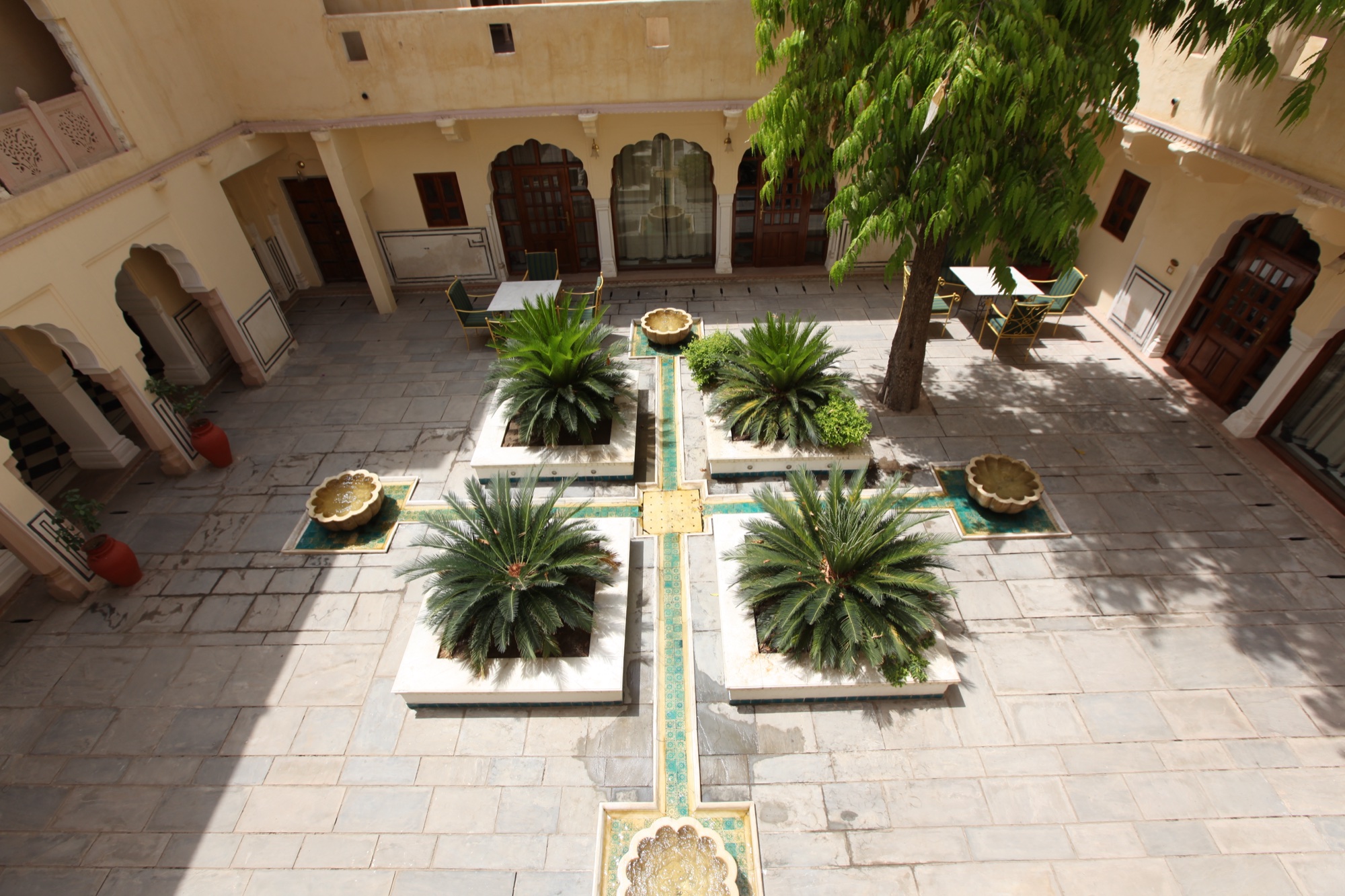
The best reason to travel India as a group is access to whole properties. A great deal of the country's most characterful lodging is small — nine-room heritage havelisHaveliA traditional townhouse or mansion built around one or more internal courtyards.Read in the glossary, converted hunting lodges, backwater houseboats, tented camps of a dozen suites — and these can be taken in their entirety by a group. Exclusive use turns a hotel into a private house for the week: your own staff, your own dining, the pool and the courtyards yours alone.
The arithmetic is the part that surprises people. Per-room, these houses can look expensive; taken whole by a party of ten or twelve, the per-person cost frequently falls below what the same travellers would pay for individual rooms at a comparable hotel, because the fixed cost of the house is shared. Add private dinners cooked for the group, a chartered boat on the backwaters, a musician in the courtyard, a cooking session the whole party joins — experiences that are awkward or impossible for two and natural for twelve.
How the cost actually works
The single most useful thing to understand about pricing a group trip is that the bill splits into two kinds of line. Some costs are bought by the party and do not change much with its size: the private guide, the car and driver, the house taken on exclusive use, a chartered boat. Spread across more people, these fall per head — which is why larger groups often pay less per person for the private, bespoke parts of a trip.
Other costs are bought by the head and scale directly with numbers: international and internal flights, national-park and monument entry, per-person hotel rates where exclusive use is not taken, and anything priced per guest. These do not fall with group size. A good operator itemises the two clearly, so you can see exactly where adding a couple to the party saves money and where it simply adds a ticket — and so no single figure hides the trade-offs.
Designing a trip that holds a group together
Groups travel best when the itinerary is built for the fact that not everyone wants the same thing at the same time. The grandparents may skip the fort climb; two of the party may want the extra morning safari; the teenagers may want the cooking class rather than the temple. A well-designed private group trip has a shared spine — the places, the hotels, the big set-piece experiences everyone does together — with optional branches each day, run by the second guide, so the group can breathe without fragmenting.
The practical shape is the same advice that serves every India trip, only more so: fewer places, longer stays. Moving a group of twelve is slower than moving two, so three or four well-chosen bases over two weeks beats a restless circuit. Give each place enough time that the logistics disappear and the trip becomes what it should be — a shared journey, privately run, that none of the party could have built alone.
Fragen, beantwortet
Is small-group luxury travel to India private or a scheduled group tour?
With a private travel house it is private. Rather than buying a seat on a fixed departure with strangers, your own party charters the whole trip: the dates, the itinerary and the pace are yours, and the only people travelling are the ones you brought. It keeps a dedicated guide and car while spreading their cost across the group.
How many people make up a small group in India?
In practice six to sixteen. Below six it is simply a private family or couples trip on a single car and guide; from eight to ten upward a second vehicle and often a second guide are added; above sixteen it becomes an event with its own logistics. The most comfortable range for intimate luxury travel is eight to twelve.
Does travelling India as a group cost less per person?
Often, for the private parts of the trip. Costs bought by the party — the guide, the car, a house taken on exclusive use, a chartered boat — fall per head as the group grows. Costs bought by the head — flights, park and monument fees, per-guest hotel rates — do not. A good operator itemises both so you can see exactly where group size helps.
Can a group take over a whole hotel or villa in India?
Yes, and it is one of the best reasons to travel as a group. Many of India's finest small properties — heritage havelis, backwater houseboats, tented camps, converted lodges — can be taken on exclusive use. For a party of ten or twelve the per-person cost of a house taken whole is frequently lower than individual rooms at a comparable hotel.
Reisen, die Sie dorthin bringen

Weiterlesen