Nobody argues about which three cities. Delhi, Agra, Jaipur — the case for each is settled, and a house that spent a column relitigating it would be wasting your morning. What goes unexamined is the comma. The route is almost always written as a sentence with a fixed word order: Delhi, then Agra, then Jaipur, then back to Delhi. Say it that way often enough and the order begins to look like a property of the places rather than a decision somebody made.
It is a decision, and it was not made for you. Three points joined by three roads is a shape, and a shape can be entered at any corner and read in either direction. The received order is one of several available readings, and it is the one that suits a vehicle leaving a Delhi depot on a fixed morning — a real constraint, and somebody else’s.
What the sentence quietly fixes
Four things, none of them announced: where the journey begins, which way round it runs, where Agra falls in the sequence, and that it ends at the airport it started from.
None of those consequences is small. The received reading puts the Taj Mahal on the second morning, which for a guest who landed thirty-six hours earlier from Europe or the east coast of America means meeting the most demanding building in India at the worst hour of their body clock. It puts Jaipur — the richest of the three, and the one most improved by an unhurried day — at the end, where the return is already pressing. And it finishes with the leg that closes the triangle, which exists for no reason except that the aircraft home leaves from Delhi.
The monument keeps its own calendar
There is a plainer reason to stop treating the order as settled: the Taj Mahal is not available on demand. It is closed to visitors every Friday, which the monument’s own official site states plainly, and no operator can arrange otherwise. Night viewing is admitted on five nights a month — the full moon and the two nights either side — and not on a Friday, nor during Ramzan.
So the single fixed point in the whole route is a building with a closed day and a lunar window. A five-day sentence that happens to run its Agra morning into a Friday has to be rewritten, and the usual repair is to see the Taj on the afternoon before instead, which is close to the worst hour available. Begin from the shape and the problem never forms: find the morning the Taj is open and good, then let the other two cities arrange themselves around it.
That is not a concession to a technicality. It is putting the one thing that cannot move at the centre of the plan, and moving the two things that can.
The legs are not the gaps between the cities
The second cost of the sentence is that it names only the corners, so everything between them becomes transfer — hours to be endured, or at best broken.
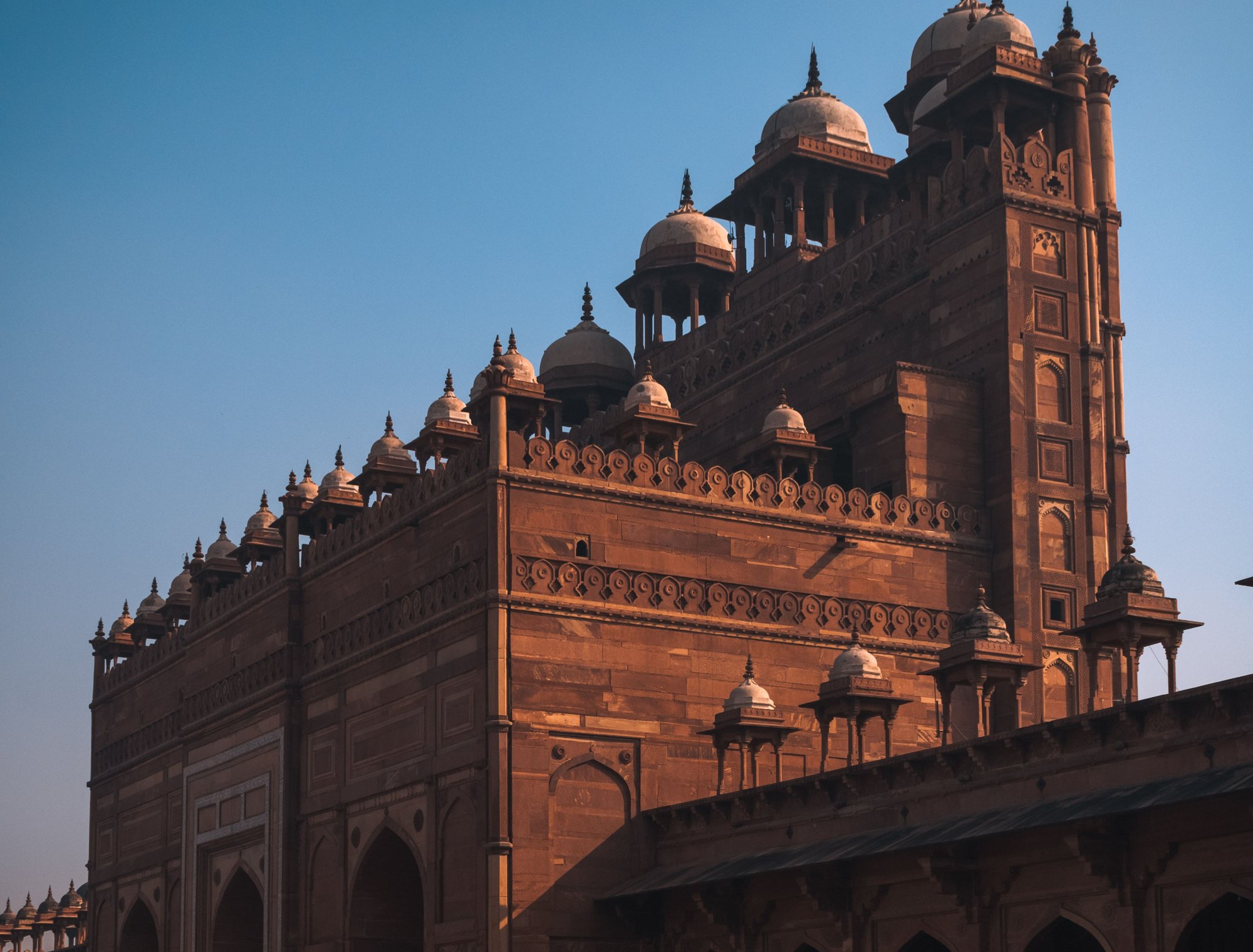
The legs are not equal, and that asymmetry is the most useful fact about the route. The road from Agra to Jaipur carries Fatehpur Sikri: Akbar’s capital, raised in red sandstone in the 1570s, abandoned within a generation and never built over, which is why it survives as the most complete Mughal city anywhere. UNESCO inscribed it in 1986. It stands an hour outside Agra, directly on the way, and itineraries routinely describe it as a stop en route — a World Heritage site demoted to a comfort break because the sentence had no room for it. We put it on that leg deliberately, and early enough that the sandstone is still warm rather than blinding.
The leg that closes the triangle is the opposite case. It carries the least and is driven the most, because it returns you to the airport you arrived at. Of the three roads it is the only one whose argument is purely logistical — which makes it the first to question and the easiest to remove.
Reading it the other way round
Run the same three cities in reverse — Delhi, Jaipur, Agra — and several things change at once.
The Taj arrives at the end rather than near the beginning. A guest who has already spent days among Rajput palaces and Mughal forts reads it differently from one who meets it jet-lagged on the second morning; they have acquired, without being taught, the vocabulary the building is written in. Jaipur gets its unhurried day early, when nobody is counting hours back to a flight. And the last road of the journey is the short run from Agra to Delhi rather than the long one from Jaipur.
The trade is real, and we would rather name it than discover it. Ending in Agra means the final morning is an early one, and if the flight home leaves in the middle of the day, the Taj at dawn and the drive to the airport compete for the same hours. For some guests that settles it the other way round. The point is not that one direction is correct. It is that the direction is a question — one whose answer depends on the flights, the sleep and what the guest came for — and that in the received version nobody asks it.
Entering at a different corner
The last thing the sentence fixes is the entry point, and it is the least examined of the four. Jaipur takes international flights, though not long-haul ones: its scheduled international network is regional, so a guest from London or New York arriving that way still does it through a hub or on a short domestic connection. That makes it a genuine option rather than a universal improvement — and the same connection, taken at the end instead of the beginning, is what removes the closing leg altogether.
None of this is exotic. It is the ordinary business of noticing that a route with three corners has more than one reading, and that the reading everybody uses serves a vehicle more neatly than it serves a traveller.
Where we actually start
Not with the conventional reading, and not with a template. We establish what is genuinely immovable — the Taj’s open morning, the moon if a moonlight viewing matters, the two flights at either end — and let the order of the cities follow from those. Sometimes the answer is the familiar one, and we run Delhi, Agra, Jaipur because for that guest, on those dates, it is right. The difference is that it is then a decision rather than a habit.
The three cities were never the question. A shape can be read in either direction; a sentence can only be recited.
Fragen, beantwortet
What order should you do the Golden Triangle in?
There is no single correct order, which is the point. Delhi–Agra–Jaipur is the convention; Delhi–Jaipur–Agra puts the Taj Mahal at the end, when a guest has the architectural vocabulary to read it, and shortens the last drive. What should decide it is the Taj’s open morning, the arrival and departure flights, and how much road the guest wants on the final day.
Is the Taj Mahal closed on any day of the week?
Yes — it is closed to visitors every Friday, and that applies to everyone. Night viewing is permitted on only five nights a month, the full moon and the two nights either side, and not on a Friday or during Ramzan. Both constraints need to be designed into the order of a Golden Triangle route rather than met on arrival.
Do you have to start and finish the Golden Triangle in Delhi?
No. Delhi is the usual entry because that is where most long-haul flights land, but Jaipur takes international flights too, albeit regional ones rather than long-haul. The more useful change for most guests is at the other end: a short flight out of Jaipur removes the leg that closes the triangle, which is the one stretch of road on the route that carries nothing but the journey back to the airport.
Is it better to see the Taj Mahal at the start or the end of the trip?
At the end, for most guests — days among Mughal forts and Rajput palaces change how the building reads, and nobody meets it on a second-day body clock. The cost is that the last morning becomes an early one, and a midday flight home turns the Taj at dawn and the drive to the airport into competitors. Where that clash is real, seeing it earlier is the better answer.