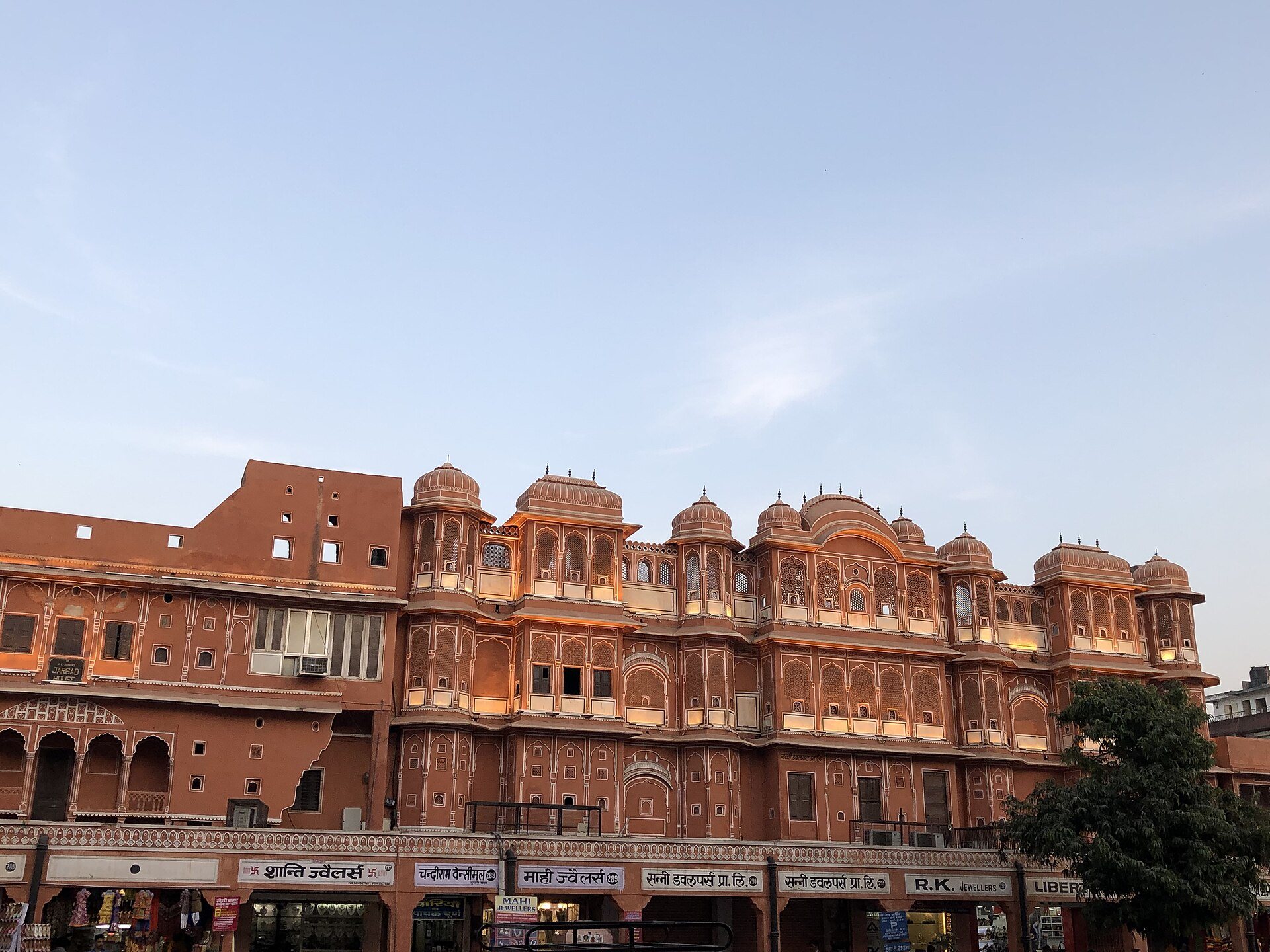
Fotografía de portada: A bazaar facade in the walled city of Jaipur, by Yamen (CC BY-SA 4.0), via Wikimedia Commons
By the third visit the problem is not what to see. It is that the city has been handed to you twice as a sequence of four buildings, and you have begun to suspect there is more to it, which there is.
What follows is the Jaipur we would build for somebody who has done Amber, the City Palace, Hawa Mahal and Jantar Mantar and would now like the city itself. It involves a certain amount of correcting the record, which is unavoidable, because Jaipur has accumulated more confident misinformation than anywhere else we work.
Three inscriptions, three dates, and almost nobody gets them right
Start here, because it reorganises the whole city in your head and it takes two minutes.
Jantar Mantar was inscribed as a World Heritage Site in 2010, under criteria (iii) and (iv), as a set of some twenty main fixed instruments of the early eighteenth century.
The Hill Forts of Rajasthan were inscribed in 2013, under criteria (ii) and (iii) — a serial property of six forts: Chittorgarh, Kumbhalgarh, Ranthambore, Gagron, Amber and Jaisalmer. Amber is the Jaipur-district component of that listing.
Jaipur City was inscribed in 2019, under criteria (ii), (iv) and (vi). The property is 710 hectares with a buffer zoneCore zone & buffer zoneThe two parts of an Indian tiger reserve: a strictly protected core, where no one lives, ringed by a buffer in which limited human activity is permitted.Read in the glossary of 2,205 hectares, and its boundary follows the line of the original city wall.
So: Amber is not part of the Jaipur World Heritage Site. It belongs to a different inscription, made six years earlier, alongside five forts in other districts, and it sits eleven kilometres outside the inscribed boundary. And Jantar Mantar is a World Heritage Site in its own right, standing inside another World Heritage Site. Both of these are routinely got wrong, including by people being paid to explain the city.
What the 2019 property actually consists of is worth knowing, because it is the itinerary. The grid-iron town plan, drawn from the Prastara plan of the Vastu Shastra. Nine rectangular sectors — chowkris — each roughly 800 metres by 800. Three main public squares: Badi Chaupar, Choti Chaupar, Ramganj Chaupar. Twelve bazaar areas along the axial streets. The walls and nine surviving gates. The havelisHaveliA traditional townhouse or mansion built around one or more internal courtyards.Read in the glossary and the haveli temples. The living crafts. And four named iconic buildings: the Govind Dev temple, the City Palace, Jantar Mantar and Hawa Mahal.
UNESCO's own language for why is unusually good: an exceptional urban example in indigenous city planning and construction in South Asia, conceived and developed in a single phase between roughly 1727 and 1731.
The evaluation body said no
This is the thing we find most useful and we have never seen it in a guidebook.
ICOMOS, the advisory body that evaluates nominations, recommended that Jaipur City be deferred rather than inscribed. The World Heritage Committee inscribed it anyway.
ICOMOS's objections, in its own words, are a better brief for a third visit than anything written for visitors. It found that the attributes identified by the State Party reflect only part of the urban form of the city, in particular excluding the inner areas of the chowkris and the old havelis. It cited development pressures and unauthorised constructions, found that conservation measures were not adequate to address the whole of this large property with its many attributes, and described widespread violations of building bylaws going unabated and a management system that was uncoordinated.
Read that first sentence again. The inner areas of the chowkris and the old havelis. An international conservation body is telling you, in a public document, that the officially celebrated Jaipur is the street-facing shell and that the thing it leaves out is the inside of the blocks.
That is where we would spend the third visit. Not because it is secret — it is not, people live there — but because it is the part the city's own nomination under-describes.
And this is live rather than historical. In 2025 the World Heritage Committee recorded concerns about demolition of historic houses and lack of enforcement, and about major projects advancing with incomplete heritage impact assessments. India is required to report again by 1 December 2026. If you want to understand why a particular street looks the way it does, that argument is the reason.
The stepwells, which is the genuinely new thing
Jaipur sits on a system of baoris — stepwellsStepwellA well reached by a long descending staircase, so that water can still be drawn as the water table falls.Read in the glossary — that most visitors see exactly one of, photograph from the top, and leave.
A substantial conservation programme is now under way. The funders are the TCS Foundation with World Monuments Fund India, at ₹6.20 crore over three years, within the World Heritage property. Nine stepwells were originally proposed. Following a meeting with the Jaipur municipality's heritage wing in August 2023, four different ones were substituted at the city's request: Gaitore ki Bawri, Parshuram Bawdi, Kala Hanuman ki Bawdi and Bengali Baba ki Bawdi.
We would rather be precise about what that does and does not mean. It means money is committed and work is happening. It does not mean any of these are open to visitors, and we are not going to tell you they are. If you are in Jaipur and interested, ask us to find out the current state of each before the trip rather than turning up at a gate.
It also sits inside the UNESCO argument. The 2025 decision names this very project among those the Committee is seriously concerned about, precisely because it is proceeding while the heritage impact assessment is incomplete. Which is a genuinely difficult situation rather than a scandal: the alternative to restoring them imperfectly has mostly been letting them fill with rubbish.
Panna Meena ka Kund, the one everybody does see, is open sunrise to sunset with no entry fee on the government's own page. Beyond that we are going to be honest: its date, its builder, its step count and whether descent is permitted are all things we could not verify from any official or scholarly source, and the architect the government tourism page credits it to probably did not exist as described. We will tell you what is known when we are there. We are not going to recite the numbers everybody else recites.
What the craft register actually says
Jaipur's crafts are the reason the city was inscribed under criterion (vi) — it housed the chattis karkhanas, thirty-six industries, with a specified street and market designed for each craft. Eleven of those survive.
The Geographical Indications register is the place to check which of them are protected, and it rewards reading. Three findings.
Sanganer and Bagru are two separate registrations, not one tradition. Sanganeri Hand Block Printing was filed in December 2008; Bagru Hand Block Print in August 2009. Travel writing treats them as a single thing with two villages. The register treats them as distinct protected goods, which is also how the printers themselves see it.
Blue Pottery of Jaipur is registered, filed in August 2006, with a separate logo registration from 2015.
And there is no Geographical Indication for Jaipur meenakariMeenakariThe art of enamelling metal, usually gold, in brilliant opaque colours.Read in the glossary, Jaipur kundanKundanA jewellery technique in which uncut gemstones are set into frames of hammered pure gold foil.Read in the glossary, Jaipur gems or Jaipur jewellery. We went through the whole national register. The only meenakari GI in India is Banaras Gulabi Meenakari, which is Uttar Pradesh.
That last one is worth sitting with. The craft most associated with Jaipur in the luxury imagination, the one that fills the vitrines and the magazine spreads, carries no geographical protection at all — while block printing from two villages outside the city carries two. That tells you something about who has organised and who has not, and it is a better conversation to have in a workshop than the usual one.
Four buildings for a third visit
Not a list of hidden gems, which we distrust. Four places with something specific to say.
The Albert Hall Museum. Designed by Samuel Swinton Jacob, commissioned by MaharajaMaharajaA ruling Indian prince — literally 'great king'; a maharani is his queen, or a princess ruling in her own right.Read in the glossary Sawai Ram Singh II in 1868, its foundation stone laid by the Prince of Wales in 1876, opened to the public by Sawai Madho Singh II in 1887. Everybody goes for the Egyptian mummy, which is genuinely there and is dated by the museum portal to 322 to 30 BC. We would go for the Persian Garden Carpet, which a government source names as one of the two headline holdings and which is barely mentioned anywhere. We have not been able to verify its date, origin or dimensions and we are not going to invent them — but it is the object in that building we would want half an hour alone with.
Jawahar Kala Kendra. Charles Correa's arts centre, free to enter, open ten to nine and closed on Mondays. The plan is nine squares after the navagraha, mirroring the square grid of the city itself, with the library in the Jupiter section because that planet is associated with knowledge. Six exhibition galleries, an open-air theatre, a permanent gallery called the Alankar Museum, and Shilpgram, a nine-and-a-half-acre rural complex with six huts for Braj, Hadauti, Tribal, Desert, Shekhawati and Centre. It is the only building in Jaipur that argues with the city plan rather than decorating it.
Gaitore. The royal cremation ground of the Kachhwaha rulers, from 1733 onwards, with cenotaphs for Sawai Ram Singh, Sawai Madho Singh and Jai Singh II — the last in white marble with peacock motifs. One ruler, Ishwari Singh, was cremated at the City Palace instead. It is quiet, it is beautiful, and it has one of the four stepwells now under conservation sitting beside it.
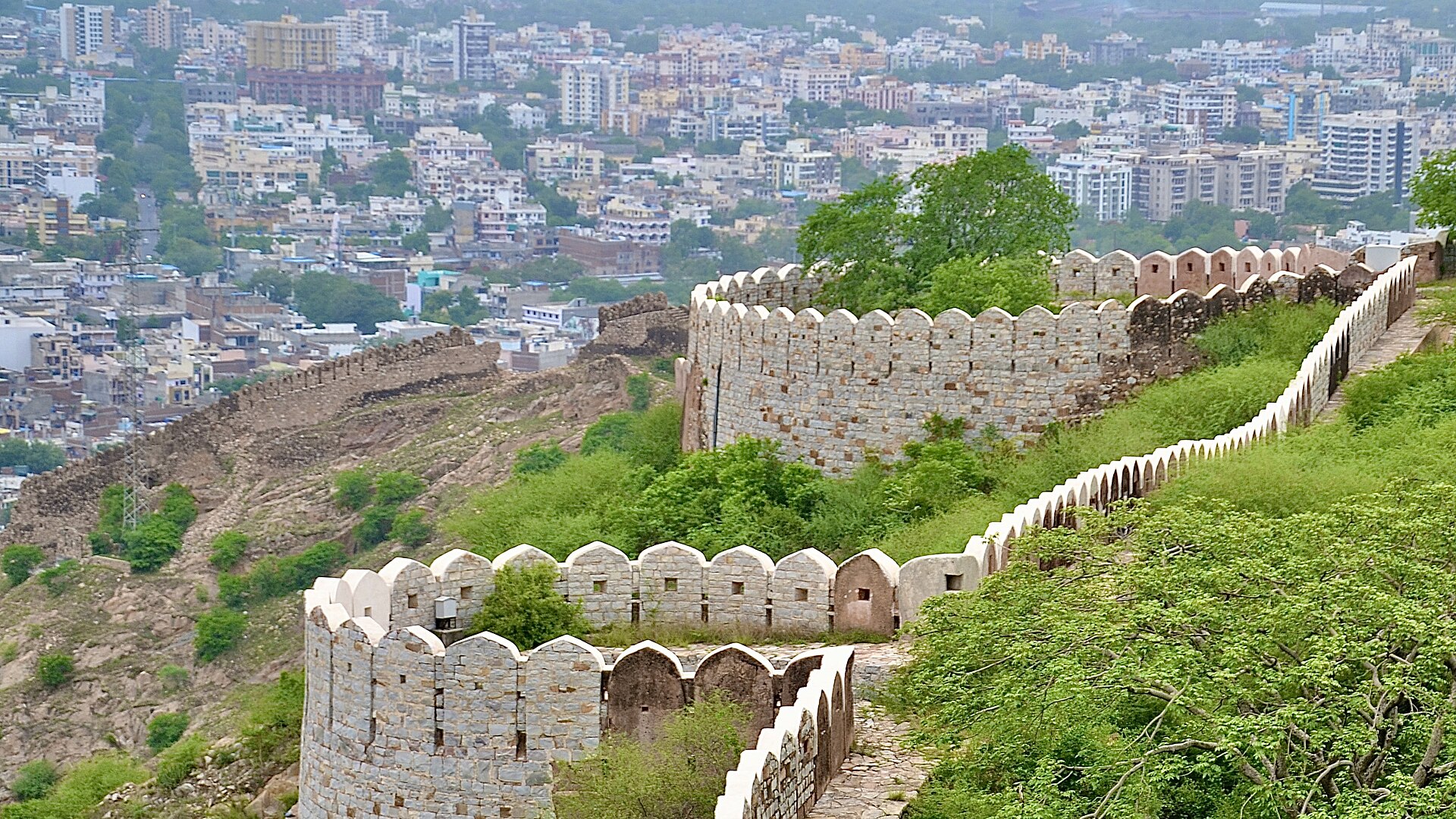
Jaigarh. Commissioned in 1726 by Jai Singh II, and the fact worth having is not the cannon's tonnage — every figure attached to Jaivana failed verification when we chased it, and the test-firing range is given variously as eleven, twenty-two, thirty-five and forty kilometres in sources that all cite each other. The fact worth having is that Jaigarh was a working foundry. A fort that made its own artillery, on site. That is a stranger and better thing than a record.
Four corrections
Each of these is repeated daily in Jaipur by people who believe it.
The city was not painted pink for the Prince of Wales. The visit is real — he came in 1876 and laid the Albert Hall foundation stone — but the repainting story is rejected by both of the best sources, and they then disagree with each other. ICOMOS's official evaluation places the colour change in the nineteenth century as a shift from a lemon-coloured lime wash to one the colour of red sandstone, and mentions no royal visit at all. A curator at the City Palace museum rejects the story explicitly and attributes the colour not to paint but to material: a terracotta geru shade from locally found quartzite, because most buildings were rubble construction rather than dressed stone. These are not wholly incompatible, but they are different claims, and neither is the one in the guidebook.
Jantar Mantar's great sundial is not demonstrably accurate to two seconds. The claim almost certainly comes from the fact that the quadrant scales are graduated at two-second intervals — which tells you the instrument's resolution, not its accuracy. Accuracy would also depend on the penumbral blur at the shadow's edge, the precision of the masonry, three centuries of settlement and the restoration history. We could find no measured accuracy figure from any primary or peer-reviewed source. UNESCO, carefully, says only that some of the instruments are the largest ever built in their categories. The thing actually worth understanding is the mechanism: it is an equatorial sundial built at architectural scale, its hypotenuse pointing at the celestial pole.
The Elephant Festival. It appears nowhere in Rajasthan Tourism's own 2024 to 2030 fairs and festivals calendar, and it is not on the department's fairs-and-festivals landing page either — while commercial operators continue to sell tickets to it. We have no official statement of discontinuation and will not assert a reason. But the state's own seven-year calendar does not schedule it, and we are not going to tell a guest it runs.
And Hawa Mahal's windows. The famous number appears on a government page. We could not find a count from anyone who had done the counting.
The difficult parts
Written straight, because a third visit deserves it.
Amber is crowded, and we could find no official footfall or carrying-capacity figure for it, so we are not going to give you one. What we can say from working there is that the morning window before the coaches is real and narrow, and that the fort rewards being walked backwards — starting high and coming down — more than almost any other in Rajasthan.
On the elephants. There is no ban. As of August 2025 there were around eighty animals between Amer and Haathi Gaon. The government has withdrawn individual elephants on health grounds more than once — ten testing positive for tuberculosis in June 2018, twenty found medically unfit in February 2021 out of ninety-eight inspected in a central inspection. And the Ministry of Tourism's own page for Amber Fort still invites visitors to make a royal entrance by choosing an elephant ride. We do not arrange them. We are telling you the regulatory position accurately rather than implying a prohibition that does not exist, and the decision is yours.
Traffic in the walled city is genuinely bad, and the honest answer is that the chowkris are walked rather than driven. A car in Badi Chaupar at five in the afternoon is a way of experiencing Jaipur's congestion, not its plan.
And the gap between the photographs and the place is wider in Jaipur than anywhere else in India. The façades are extraordinary and the inside of the blocks is a working city with the ordinary difficulties of one. If you want the photograph, we can get you the photograph. If you want the city, the two are not the same errand and it helps to say which you are on.
Dates worth knowing
The Jaipur Marathon's eighteenth edition is on Sunday 14 February 2027, confirmed by both the organiser and the international marathon association. It closes roads and fills hotels.
Rajasthan Tourism's official calendar gives Teej on 4 and 5 August 2027, Gangaur on 9 and 10 April 2027, and a Kite Festival on 14 January 2027. One caveat we will not paper over: that document has no location column, so it establishes the state calendar dates and not that these are the Jaipur observances specifically. We check the city attribution separately before we build a trip around one.
The Jaipur Literature Festival's twentieth edition has been reported in the press for 14 to 18 January 2027. We could not confirm it on the festival's own site, which did not yield dates to us, so treat that as press reporting until the organisers publish it.
A note on our sources
The inscriptions, criteria, areas and ICOMOS evaluation are from UNESCO's World Heritage Centre, including the decision texts and the advisory body evaluation. The stepwell programme is from India's own state of conservation report, the 2025 Committee decision and the funder's published announcement. The Geographical Indications are from the Controller General of Patents, Designs and Trade Marks' register of registered GIs. The museum, fort and monument details are from the Ministry of Tourism's portal and the Museums of India portal. The pink-city accounts are ICOMOS's evaluation and a City Palace museum curator writing under her own name. The festival dates are Rajasthan Tourism's published multi-year calendar, and the marathon date is from the organiser and from the Association of International Marathons and Distance Races.
Opening hours at Rajasthan monuments change seasonally and by government order. The ones referred to here were read on 6 October 2026 and we re-check them before every trip rather than relying on a page.
A number of things we chased did not survive and are therefore absent: every figure attached to the Jaivana cannon; the identity and provenance details of the Albert Hall mummy beyond its date; the construction and inauguration dates of Jawahar Kala Kendra, which the Rajasthan government's own pages do not give; Panna Meena ka Kund's date, builder and protection status; and whether the royal women's cenotaphs are a visitable site, for which we could find no official page at all.
Los viajes que le llevan allí
Leer a continuación