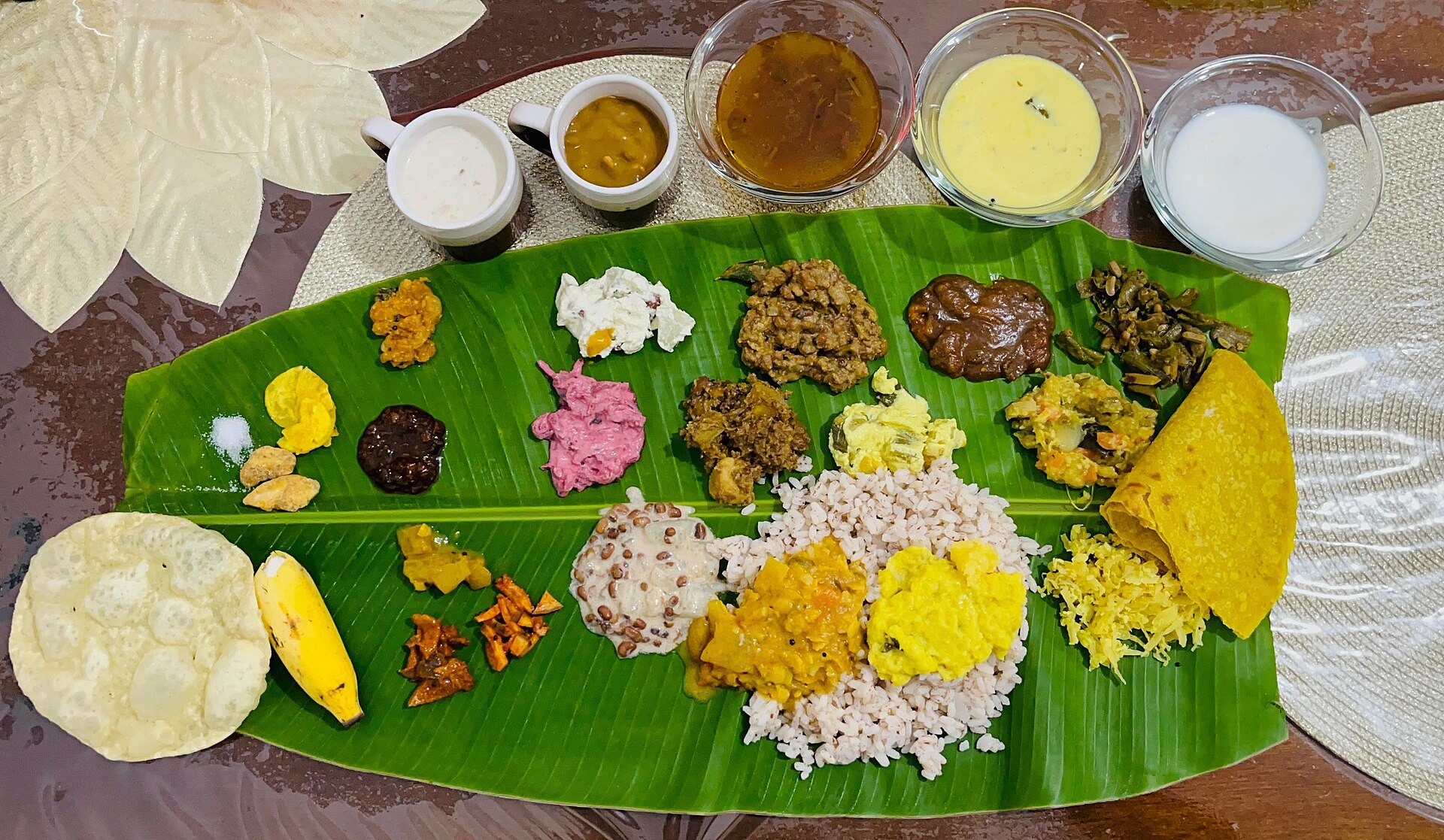
Fotografía de portada: Onam Sadhya — Onam Spread, by Hana Elizabeth George (CC BY 4.0), via Wikimedia Commons
There is a figure in the Kerala excise accounts that explains Onam better than any amount of description. In the first eight days of the 2026 Onam sale window, 18 to 25 August, the state's liquor corporation took ₹771.29 crore, against ₹694.96 crore in the same window of 2025. The single biggest day was Uthradam, 25 August — ₹126.31 crore in one day. Uthradam is the ninth of the ten days. It is the day before Thiruvonam.
And on Thiruvonam itself, the shops close. Bars excepted, the state's retail liquor outlets shut on the feast day. Everyone stocks up the day before and the festival day is dry by design.
That arrangement tells you where Onam happens. It is not a street festival that spills into houses. It is a house festival that occasionally spills into the street, and the difference matters enormously to anyone trying to travel to it.
The shape of the ten days
Onam runs for ten days, each named for a nakshatra: Atham, Chithira, Chodhi, Vishakam, Anizham, Thriketa, Moolam, Pooradam, Uthradam, Thiruvonam. In 2026 Atham fell on Sunday 16 August and Thiruvonam on Wednesday 26 August.
It was made Kerala's state festival in 1961, which is more recent than most visitors assume and which is the reason it is observed across religious lines in a way that a temple festival would not be. The government gazetted four holidays for 2026 — First Onam on 25 August, Thiruvonam on the 26th, Third Onam on the 27th and Fourth Onam on the 28th. One of those, 27 August, is a public holiday without being a bank holiday under the Negotiable Instruments Act, which is the sort of detail that catches a trip out when a transfer needs a bank draft.
It is worth resisting the phrase that gets used about this. Kerala does not shut down for Onam. What is documented is four gazetted holidays, liquor retail closed on one day, and labour-law establishments working to a separate list under the Kerala Industrial Establishments Act of 1958. Hotels run, airports run, and the backwaters run. What thins out is everything that depends on somebody's household staff being at work rather than at home, which over four days is a great deal.
The sadya, accurately described
The sadyaSadyaKerala's ceremonial vegetarian feast, served on a banana leaf in a fixed order of some two dozen dishes.Read in the glossary is a vegetarian feast served on a banana leaf and eaten seated, with the right hand, without cutlery. It is a single course rather than a sequence of plates — everything arrives on the leaf and the eating order is the diner's business, not the kitchen's. The placement is not decorative: pickles go to the top left, bananas to the bottom left, so that a server moving down a row of leaves can see at a glance who needs what.
In central Travancore the progression starts with chips and pickles, carries buttermilk near the end, and closes with payasam. The leaf is folded at the finish, and the direction of the fold carries meaning.
On the number of dishes, the honest answer is that there isn't one. The traditional form is given as nine courses. Published descriptions give twenty-four to twenty-eight. Hotel and temple sadyas run to around thirty. The valla sadya at Aranmula goes past sixty-four. The figure of twenty-six that circulates in food writing is not fixed by any state tourism board, government department or scholarly source we could find. Two dozen or more, on a banana leaf, is the defensible description.
Aranmula deserves its own sentence because it is routinely described wrongly. It is not a boat race with a lunch attached. The vessels are consecrated temple boats and the organisers and the press frame the event as a temple ritual with competitive heats inside it. The 2026 season ran to 16 September with 565 bookings recorded, and the Ashtamirohini valla sadya fell on 4 September.
What there is to actually see
The public events are real, documented and in some cases spectacular. They are also scattered across the state and across the ten days, which means seeing more than two of them requires planning the trip around the festival rather than adding the festival to the trip.
Athachamayam at Thripunithura opens the ten days — in 2026, on Atham, 16 August. It is a procession of folk art forms, musicians and caparisoned elephants, with the king carried in a palanquin in veeralipattu and a gold crown, descending from Thripunithura's role as the Cochin MaharajaMaharajaA ruling Indian prince — literally 'great king'; a maharani is his queen, or a princess ruling in her own right.Read in the glossary's capital. It was halted in 1949 when the kingdoms merged and revived in 1961; it now begins near a school ground rather than at the Hill Palace. Priests of different temples attend, and the event is framed explicitly as a symbol of religious unity.
The flower carpets, pookalam, are laid daily and grow through the ten days. The verifiable large one in 2026 was a sixty-two-foot athapookalam laid in front of the Vadakkunnathan Temple at Thrissur on Atham day, two feet wider than the previous year's, using roughly two thousand kilograms of flowers and about a hundred and fifty volunteers — the eighteenth consecutive year its organisers have laid it. We would not repeat the record claims that circulate about Kerala's largest pookalam; the ones we found rest on commercial record books and brand-sponsored installations rather than any verified record.
Pulikali at Thrissur is the one unambiguous spectacle. Men painted as tigers in oil-based paint over a kerosene base, in papier-mâché masks, dancing to chenda, thakil and udukku. In 2026 it was held on Saturday 29 August from four in the afternoon at Swaraj Round, expected to run to ten at night, with nine teams of between thirty-five and fifty-one performers each, including women and children. The Thrissur Corporation funded each team at ₹3.5 lakh plus the kerosene. The tradition is traced to roughly two centuries ago as a street dance. Note the date: the Ministry of Tourism's own description places Pulikali on the fourth day of the festivities, and the government gazetted Fourth Onam as Friday 28 August — but it was actually held on the 29th. The rule is not the schedule.
If you go, go knowing that Thrissur runs a city-wide traffic plan for it. Parking is banned around Swaraj Round, buses are diverted, restrictions begin at two in the afternoon, and thirty designated parking areas absorb the rest. A car cannot be dropped at the edge of the crowd.
Kerala Tourism's own programme
The state runs an official Onam Week, and in 2026 it ran from 24 to 30 August, inaugurated in Thiruvananthapuram on the 24th. The main venue was the Nishagandhi at Kanakakunnu Palace, with performances from six to seven each evening, a festival zone laid out between Kowdiar and Manacaud, and a concluding procession on 30 August.
This is the easiest version of Onam to attend, and it is also the most curated. It is a festival programme in a capital city, which is a different thing from a harvest festival in a village, and worth being clear-eyed about. It does not include Athachamayam, Pulikali or the boat races — the official Onam Week release makes no mention of any of them.
The boat race problem
The Nehru Trophy Boat Race is regularly sold as the Onam boat race. It is not calendar-linked to Onam at all. In 2026 it ran on 22 August, which happened to fall inside the ten days. In 2024 it ran on 28 September, entirely outside them. It is a fixed-date event whose date moves between years, and there is no published rule — not even the second-Saturday-of-August rule that gets repeated — on the official race site or anywhere else we could check.
The practical consequence is that a trip built to catch both Thiruvonam and the Nehru Trophy may be building around a coincidence. Check the year's actual date before committing the itinerary to it.
Getting there, and the honest difficulty
The inbound surge is real and the state plans for it. KSRTC ran additional interstate services from 18 August to 2 September 2026 — eight Bengaluru–Kozhikode trips, four Bengaluru–Kannur, four Bengaluru–Ernakulam, three Bengaluru–Malappuram, two Mysuru–Kannur, and single super-deluxe runs from Bengaluru and Chennai to Thiruvananthapuram among others. That is Malayalis going home, and it is the clearest signal of what the festival is for.
Which brings us to the difficulty. The thing a guest most wants at Onam — a sadya in a family house, served properly, in the middle of a family's own festival — is the thing hardest to arrange honestly. There are hotel sadyas, and the good ones are very good; there are heritage homestays whose owners will host a guest at their own table, and we know several. But a commercially arranged invitation into a stranger's Onam is a performance of hospitality rather than hospitality, and we would rather say so than sell it.
What we do instead, when a guest wants Onam specifically, is build the trip around the public events and the places where the festival is genuinely open — Thripunithura on Atham, Thrissur for Pulikali, a temple sadya rather than a private one — and be honest that the most important four days of the Kerala year are, for a visitor, largely spent watching a state be quietly at home. Which is its own kind of thing to see. It is simply not the thing the photographs promise.
If you are planning for next year
Onam moves with the Malayalam calendar, so next year's Thiruvonam will not be in the last week of August. Fix the date from the Kerala government holiday list for the year rather than from a festival-calendar site, because the gazetted holidays are what actually determine what is open.
Book the hill and backwater properties early, not because of foreign demand but because of domestic demand — this is the Kerala family holiday of the year. And if the trip can be moved two weeks later instead, the second half of September is one of the most underrated windows in the south: the rain has eased, the state has gone back to work, and the hills are as green as they get.
Los viajes que le llevan allí
Leer a continuación