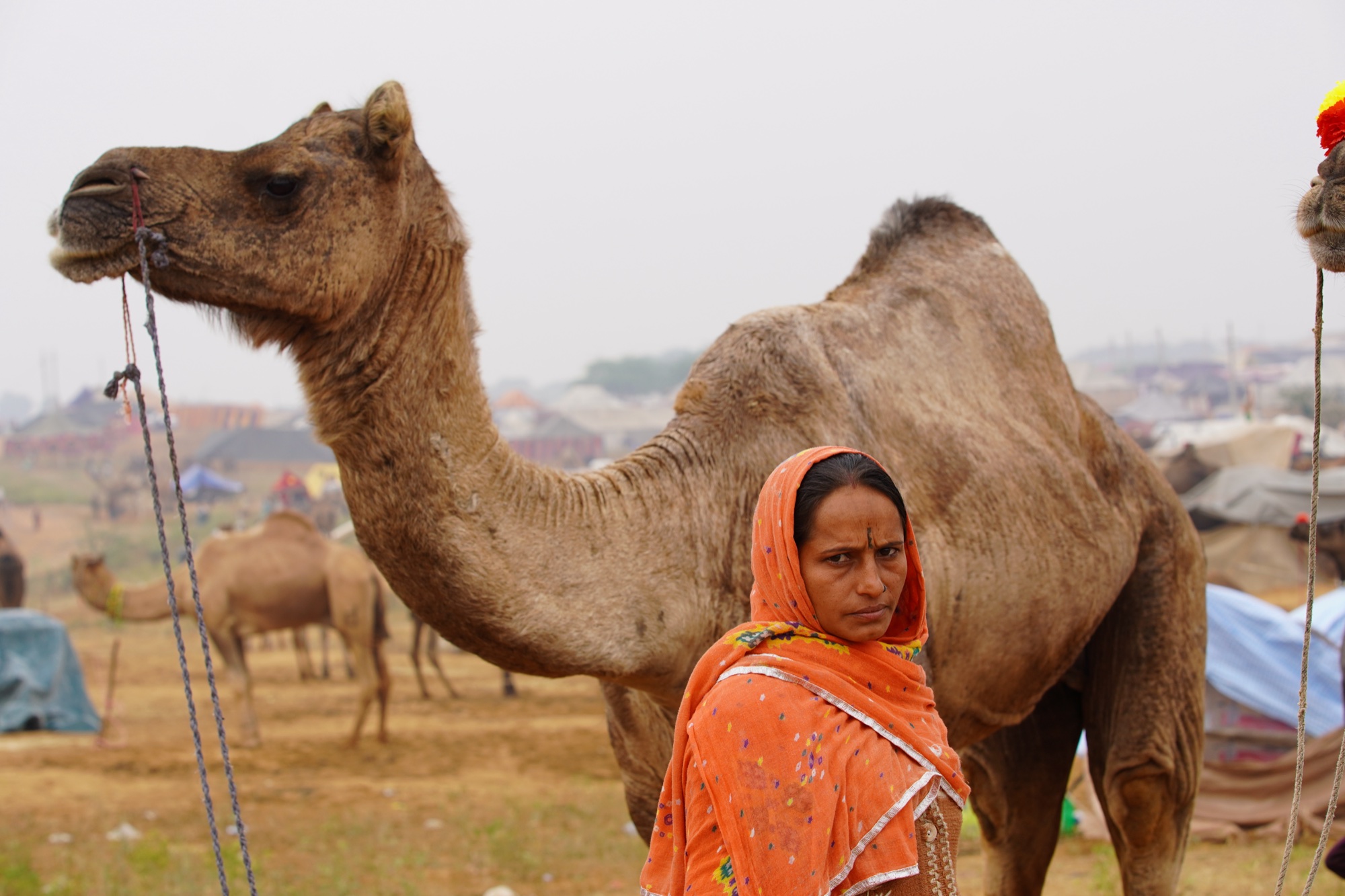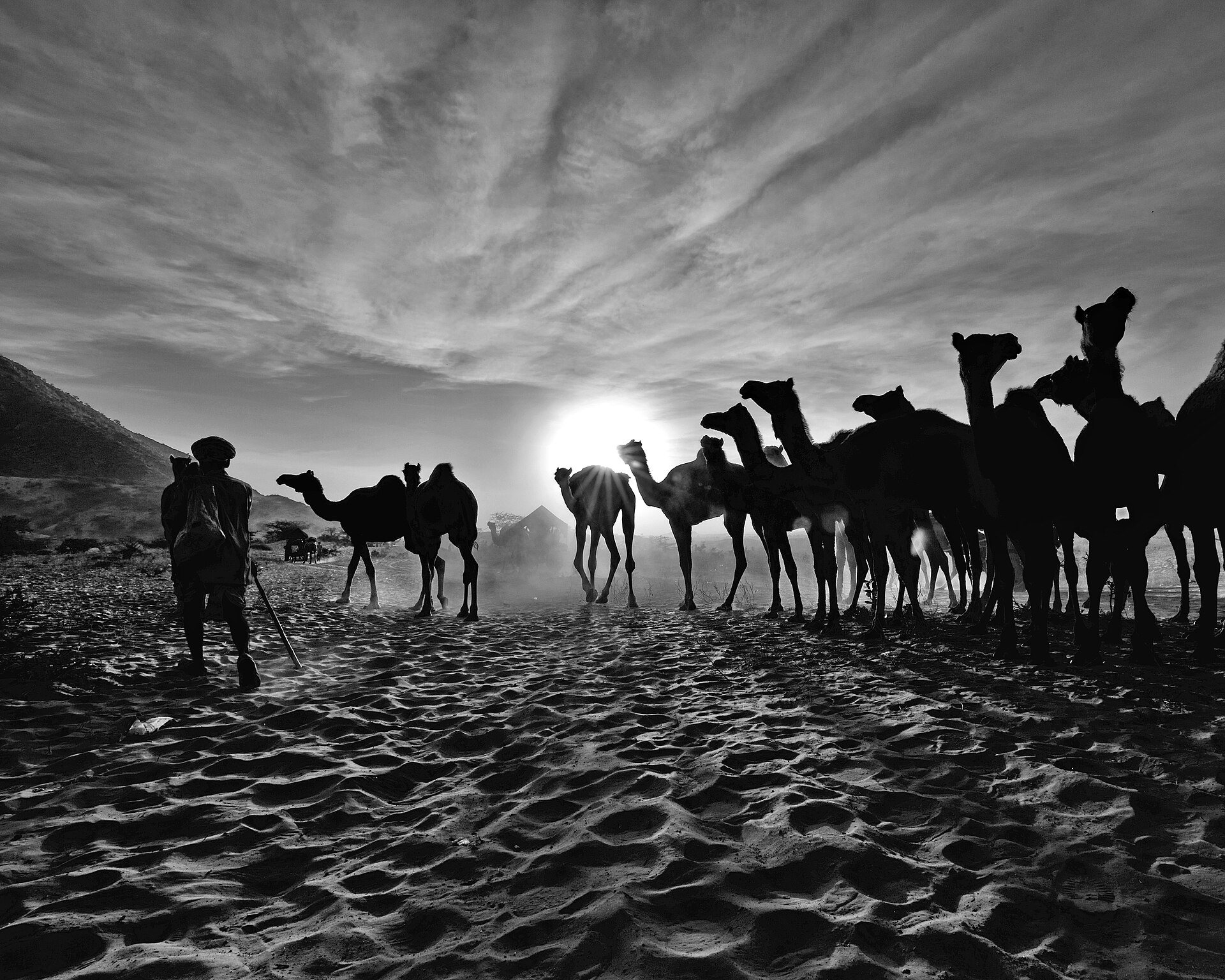
Fotografía de portada: Camels of Pushkar Camel Fair (2015), by Sudipta Dutta Chowdhury (CC BY-SA 4.0), via Wikimedia Commons
We have written separately about the Pushkar Fair itself — what it is, when it is, how the week divides. This piece is about something narrower and, we think, more useful: the fact that the best days to be there are not the days the fair is advertised for, and that where you sleep matters more than at Pushkar than almost anywhere else in Rajasthan.
The short version: come early, stay out of town, and let the full moon be your departure rather than your arrival.
What fixes the date, and why last year's dates are useless
The fair runs on the Hindu lunar calendar. It builds through the month of Kartika and ends on Kartik Purnima, the full moon, which in 2026 falls on 24 November.
That is the anchor, and it is the only date we would put in print without a notification in hand. The cattle-fair and ritual-fair days around it are notified by the state administration and the exact spread varies — we check the notification for the specific year rather than working from a festival-calendar website, because the most common error in Indian festival planning is taking last year's dates and incrementing the year. We have corrected that mistake in our own pages more than once.
It is worth knowing what else falls on the same full moon, because it bears on a north India itinerary. Kartik Purnima is Dev Deepawali at Varanasi, when the ghatsGhatA flight of steps leading down to a river or tank, used for bathing, worship and cremation.Read in the glossary are lit end to end with earthen lamps, and it is widely observed as Guru Nanak Gurpurab. A guest who wants Pushkar and Varanasi's lamps in the same trip is choosing between two things on one night, several hundred kilometres apart.
The fair front-loads, and this is the whole point
The images that sell Pushkar — thousands of camels on open sand, men asleep against their animals, trading at dawn in low dust — are from the beginning of the fair, not the end.
The traders come to do business, and business is done in the first days. As the religious fair builds and the pilgrim crowd arrives, the livestock ground empties. By the full moon the camels that remain are largely the ones kept for visitors, and the ones that have sold have walked home.
So the itinerary that lands two days before Kartik Purnima — which is what most of them do, because that is where the published dates point — arrives for the crowd and misses the market.
Our recommendation is to be on the ground in the first half of the fair window, which in a normal year means roughly the week before the full moon, and to spend the mornings on the livestock side and the afternoons away from it. The religious fair and the bathing on the full moon are then a thing you can choose to stay for, with the knowledge that it is the single busiest day of the Pushkar year.
What the camel numbers mean for what you are looking at
There is a reason to see this fair now rather than in ten years, and it is not a pleasant one.
At the twentieth livestock census Rajasthan had 213,000 camels, down from 746,000 in 1992 — a fall of seventy-one per cent. Nationally the camel population declined by about thirty-seven per cent in the eight years to that census and about seventy-five per cent since 1992. Around eighty-five per cent of India's camels are in Rajasthan, so Rajasthan's decline is India's decline.
The mechanism is economic rather than sentimental. A camel earned its keep as transport and traction, and tractors and trucks do that better. And in a development that is worth stating carefully because it is counter-intuitive: the Rajasthan Camel Act of 2014, which prohibited slaughter and regulated the animal's movement out of the state, has been reported as contributing to the decline rather than arresting it — by leaving the animal without a market outside Rajasthan, it removed the residual value that made keeping a herd viable.
We are not going to take a position on that legislation in a travel piece. What we will say is that the men you will meet on that ground are managing the decline of their own livelihood, that the Raika and other herding communities have been doing it for a generation now, and that this changes how it feels to photograph them. A guest who understands the economics asks different questions and takes better photographs.
On visitor numbers we are more cautious than most. The figures in circulation range from over two hundred thousand for the fair to five or six hundred thousand across the festival period, and we have not found an official source that would let us choose between them. The scale is unmistakable on the ground; the number is not something we would quote.
Where to stay, which is the decision that matters
Pushkar is a small town with a sacred lake at its centre, and during the fair it is at several times its normal population. The accommodation inside town ranges from basic to adequate, and the tented camps that spring up on the fairground range from genuinely good to very poor indeed, at prices that bear no relation to either.
The honest answer for a guest who wants comfort is to not sleep in Pushkar. Ajmer is fourteen kilometres away. More usefully, the estates and forts of the Ajmer-Jaipur-Jodhpur triangle put you within a drive of the fairground with a proper house to come back to, and the drive in at five in the morning is part of the experience rather than a cost.
We generally build it as a base of two or three nights at a property an hour or so out, with two early starts on the fairground and the middle day spent somewhere else entirely. That is a far better trip than three nights in a tent on a dust bowl, and it costs less.
If a guest specifically wants to sleep on the ground — and some do, and we understand why — we will arrange it, with the caveat said plainly: it is a camp in a field with a crowd, in November, and the nights in that part of Rajasthan get genuinely cold.
The week after, which nobody books
Here is the part of this piece that we think is the actual recommendation.
The last week of November and the first fortnight of December in Rajasthan is as good as the state gets. The fair has gone, the dust has settled, the cold has arrived properly, the light is at its best, and the great winter season has not yet filled the hotels. The gap between Pushkar and the Christmas rush is a genuine window and it is largely unsold.
For a guest who is not specifically fair-driven, we would rather put them in Rajasthan in the first week of December than in the fair week. They get the same light, better rooms, no crowd, and an entirely different relationship with the places they visit.
And for a guest who is fair-driven, the obvious move is to do both: the fair at the front of the trip, then move south and west into the quieter part of the season — Jawai, Deogarh, the Aravalli estates, Udaipur in the second week of December — while everyone who flew in for the camels flies out.
Practicalities we have learned the hard way
Start at five. The fairground between first light and about eight is the only time it is both active and bearable. By ten it is hot, crowded and flat-lit.
Budget two mornings, not one. The first morning you are orienting; the second you know where to stand.
Take a guide who knows traders rather than monuments. The value on that ground is in being able to talk to people, and the difference between a guide who can and one who cannot is the entire visit.
Expect road congestion on the approaches and build an hour into every transfer in that week. The roads around Ajmer and Pushkar during the fair are not the roads at any other time.
And do not plan anything unmissable on the full-moon day. Kartik Purnima at Pushkar means a very large number of people wanting to reach the same water at the same time, and the town becomes impassable to vehicles. It is extraordinary to witness and it is not a day on which a schedule survives.
Los viajes que le llevan allí
Leer a continuación