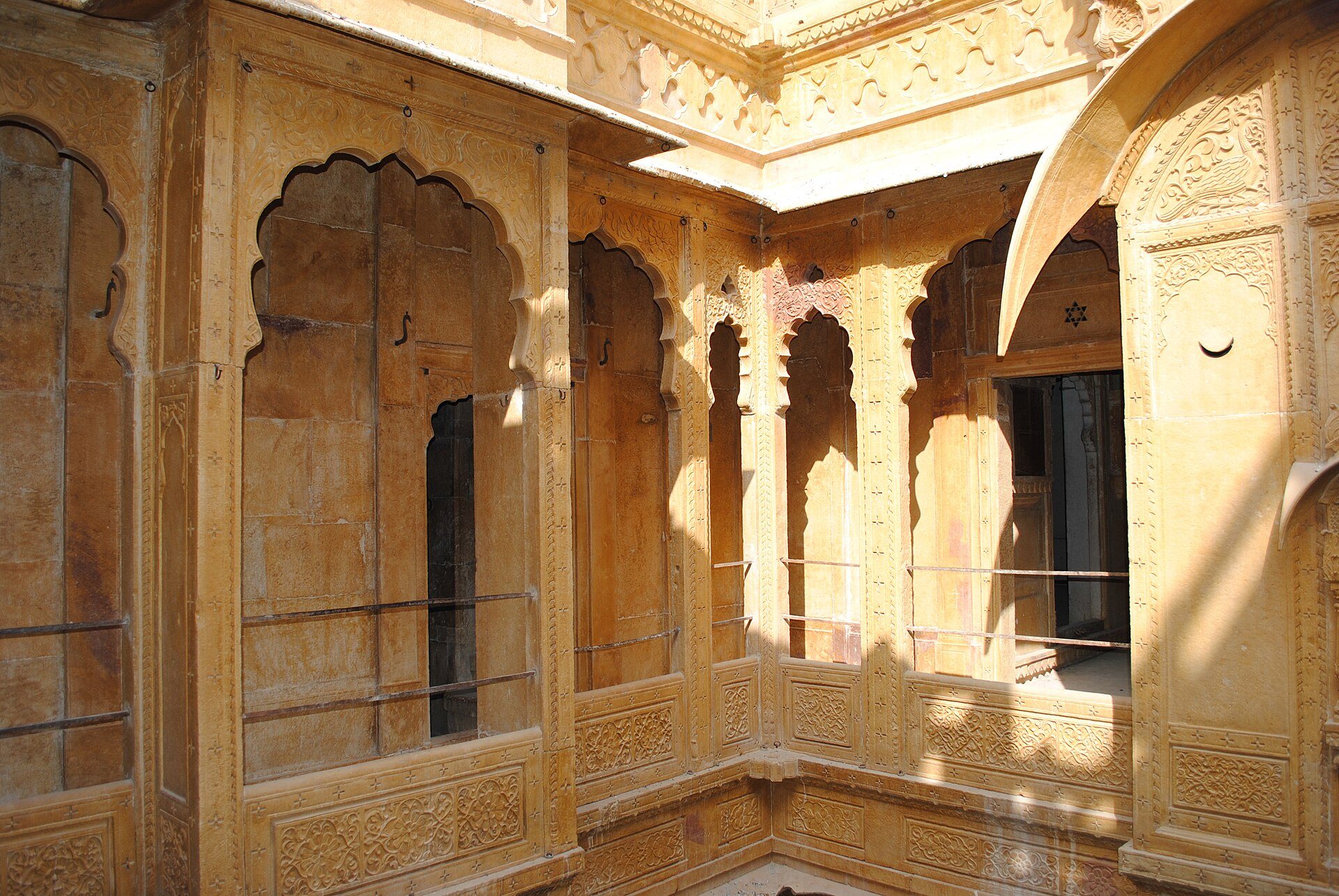
Fotografía de portada: Patwa Haveli, Jaisalmer, by Schwiki (CC BY-SA 3.0), via Wikimedia Commons
The reason there are so many palaces to stay in is a constitutional amendment.
The Constitution (Twenty-sixth Amendment) Act, 1971 derecognised the rulers of the former princely states and ended their privy purses and privileges. An earlier attempt in 1970 had failed by a single vote in the Rajya Sabha, and the Supreme Court had found for the rulers that December; the amendment settled it. Five hundred and sixty-five princely states had been receiving privy purses. The allowances stopped.
What the families were left with was buildings — enormous, beautiful, structurally demanding buildings with no income attached — and the hotel conversions that followed over the next three decades are the direct consequence. This is not a romantic origin story. It is a fiscal one, and it explains a good deal about what these properties are like to stay in.
What the classification actually requires
The Ministry of Tourism's definition is worth quoting because it is narrower and odder than the word heritage suggests. Heritage Hotels cover running hotels in palaces, castles, forts, havelisHaveliA traditional townhouse or mansion built around one or more internal courtyards.Read in the glossary, hunting lodges or residences of any size built prior to 1950.
Of any size. The entry-level Heritage category requires five rooms — ten beds — traditional local cuisine, and a heritage ambience. That is the whole bar. A five-room pre-1950 residence with local food is, officially, a heritage hotel.
Heritage Classic moves the build year back to 1935 and the room count up to fifteen, and adds a requirement for four to five dishes approximating continental cuisine, plus at least one sporting facility. Heritage Grand keeps the 1935 year and the fifteen rooms, requires at least half the rooms to be air-conditioned — or heated, in hill stations — adds a second sporting facility, and asks for a superior appearance and decor throughout.
The clause that does the real work is the one on alteration, and it is not a prohibition. Any extension, improvement, renovation or change in the existing structures should be in keeping with the traditional architectural styles, and newly constructed areas cannot exceed fifty per cent of total built-up area. So a Heritage-classified hotel can be up to half new build. That is a style-conformity rule with a ceiling, not a conservation standard, and it is the single most useful thing to understand before booking.
Then there is the other scheme. The Ministry separately classifies Legacy Vintage hotels, where at least fifty per cent of the material used to construct or build the hotel is sourced from heritage properties or buildings. Same three tiers, same 1950 and 1935 years applied to the source property, same room minimums, with stricter air-conditioning requirements. The guideline does not say whether this supplements or replaces the heritage categories.
Read plainly: a brand-new building made of old stones can hold a Ministry of Tourism classification. We think that is worth knowing, and we have never once seen it disclosed in a hotel's own description of itself.
The hundred metres, and the three hundred
The constraint that bites hardest on a genuine fort is the Ancient Monuments and Archaeological Sites and Remains Act, as amended and validated in 2010.
The Act creates a prohibited area beginning at the limit of the protected monument and extending one hundred metres in all directions, in which no person other than an archaeological officer shall carry out any construction. Then a regulated area beginning at the limit of the prohibited area and extending a further two hundred metres, in which construction, reconstruction, repair and renovation are not barred but require permission from the competent authority.
This is the source of a confusion worth clearing up, because both versions you will have read are correct. The Act's own language is a hundred metres prohibited and two hundred metres regulated — the width of the second belt. Stated as distance from the monument, the regulated area runs from a hundred metres to three hundred. The phrasing to use is a hundred-metre prohibited zone, then a further two hundred metres of regulated zone, reaching three hundred metres from the monument in all.
The oversight body is the National Monuments Authority, constituted under section 20F, which recommends on grading and classifying protected monuments, oversees the working of the competent authorities, and considers the impact of large-scale developmental projects in regulated areas.
On how many monuments this applies to, the figures move. A government statement reported in February 2025 gave 3,698 centrally protected monuments. A Ministry of Culture release of 18 April 2026 gives 3,686, and that is the more recent and more authoritative number. The count fell, which is not an error to smooth over — there has been reporting of protected monuments found missing on the ground. The Survey works through around thirty-eight circles, each headed by a Superintending Archaeologist, and spent ₹374 crore on conservation in 2024-25.
The fire code, which is the one nobody expects
This is the cleanest documented trade-off in the whole subject, and it cuts directly against the industry's own talking point.
Heritage structures receive no separate fire-safety standard and no heritage exemption in India. The National Building Code of India 2016, Part 4, places heritage structures and archaeological monuments inside Subdivision D-3 occupancy, Group D Assembly buildings. A fort hotel is treated, for fire and life safety, as an assembly building — the same class as a cinema or an auditorium — with no alternative compliance pathway written into the Code.
That is a hard requirement to meet in a building with one staircase, stone walls you cannot core, and a layout determined by defensive logic four centuries ago. It is also the reason that hoteliers have publicly sought relaxation of fire norms, citing space and money. A request for relaxation is itself the evidence that no relaxation exists.
We mention it not to alarm anyone but because it reframes what the capital expenditure in these properties is actually for. A good deal of what a serious fort conversion spends is invisible: detection, suppression, secondary egress, electrical rework. A property that has not spent it looks exactly the same in a photograph.
On the accessibility question, honestly
We get asked about this frequently and we want to be careful, because the honest answer is that the framework exists and the specifics do not.
The Accessible India Campaign was launched on 3 December 2015 across three verticals — built environment, which expressly includes tourist places, transport, and information and communications technology — with legal backing from the Rights of Persons with Disabilities Act, 2016. Section 40 of that Act mandates accessibility standards; sections 45 and 46 set a five-year timeline for buildings. Under the Adopt a Heritage programme, across twenty-eight approved projects, creation of barrier-free monuments has been made mandatory, and a separate initiative targets seventy-five pilgrimage sites.
What we could not find — and we looked hard — is any Archaeological Survey or Ministry of Culture statement on lifts, ramps or structural alteration inside protected structures. The one parliamentary answer on protected monuments we could retrieve, from August 2026, covers budgets, staffing and the Adopt a Heritage successor programme and says nothing about accessibility at all.
So we describe the constraint as what it is: a statutory tension rather than a published policy. The Act bars construction outright inside the monument's prohibited area and permissions it in the regulated area, and the Survey's institutional position on altering protected monuments is on the record in litigation — it has told a court that a protected monument cannot be changed. Those two facts, together, are why a genuinely protected fort cannot simply install a lift.
Practically: a guest with limited mobility can have an extraordinary time in India's heritage properties, and the ones to choose are the large pre-1950 palaces built on level ground with ceremonial approaches — not the hill forts, whose entire design premise is that getting up them should be difficult. We write about this at more length elsewhere, and we survey properties ourselves rather than relying on a booking page.
The UNESCO claim, and what it usually means
A fort hotel marketing itself as UNESCO award-winning is almost always borrowing the credit of a conservation project that is not the hotel, and the pattern is worth being able to spot.
The UNESCO Asia-Pacific Awards for Cultural Heritage Conservation began in 2000 and are run from the regional office in Bangkok. Across the years we verified against UNESCO's own citation documents, hotel conversions are strikingly rare among the Indian winners. We can confirm exactly one: Hotel de l'Orient, Pondicherry, in 2000, whose citation praised it for proving that successful heritage conservation does not require massive intervention or rebuilding, having added two guestrooms and a staircase for economic viability.
The most celebrated Indian winner is not a hotel at all. The Ahhichatragarh Fort at Nagaur took the 2002 Award of Excellence, cited for an ambitious large-scale restoration that checked advanced dilapidation through a comprehensive, multi-faceted and standard-setting conservation programme. The fort was placed in the care of the Mehrangarh Museum Trust in 1985; the work was funded by four grants from the Getty Foundation and two from the UK's Helen Hamlyn Trust, with the Trust's own contributions, and it was shortlisted — not selected — for the Aga Khan Award for Architecture in the 2011-13 cycle, with ninety fountains running in gardens and buildings where none had worked at the project's outset. There is also a joint wall-painting conservation project with the Courtauld Institute. Nagaur is a thirty-six-acre museum trust restoration, and that is a better thing than a hotel award.
The other verified Indian winners we could confirm from UNESCO's own documents are temples, churches, civic buildings, libraries, streetscapes and Mumbai commercial architecture — Chanwar Palkhiwalon-ki-Haveli in 2000, the Krishan Temple in Punjab and DBS House in Mumbai in 2001, the Jaisalmer streetscape project in 2002, Hampi's historic water system and the Sethna Buildings in 2012, Our Lady of Grace Cathedral at Vasai in 2025.
We checked several properties commonly described as UNESCO award-winning and found no award for any of them. One likely source of the confusion is genuinely instructive: Chettinad, Village Clusters of the Tamil Merchants, sits on UNESCO's World Heritage Tentative List, which is a completely different instrument from a conservation award.
Where UNESCO is genuinely relevant is the inscription itself. Hill Forts of Rajasthan was inscribed in 2013, reference 247, comprising Chittorgarh, Kumbhalgarh, Ranthambore, Gagron, Amber and Jaisalmer. India holds forty-four World Heritage Sites in all — thirty-six cultural, seven natural and one mixed.
What it is actually like to stay in one
All of the above resolves into a set of experiences, and we would rather describe them than let a guest discover them.
The rooms are not the same as each other. A palace was not built to a room schedule, and in a good conversion the irregularity is the point — but it means the room you are given and the room in the photograph may be different sizes, different shapes, and have different views. Ask which room. A property that will not tell you is telling you something.
The windows are small and deep-set, and the walls are thick. This is a climate response and it works: a stone room in Jodhpur in April is cooler than any air conditioning. It also means the light is a single shaft rather than a wash, and a guest who wants a glass wall over a lake should book a modern hotel with a glass wall over a lake, of which India has several excellent ones.
The floors are uneven and the stairs are not to code. Not through neglect, but because the alternative is cutting the building. Over a week this is the single most common source of guest complaint and it is entirely predictable.
Sound travels in stone courtyards. A wedding in the courtyard — and there will be a wedding in the courtyard, between November and February — is audible everywhere.
Heating and cooling are limited by what can be installed without destroying a surface. Heritage Grand requires half the rooms air-conditioned; the other half are not, and in a December in Rajasthan a stone room without heating is genuinely cold. We check this property by property rather than trusting a category.
And the service is often extraordinary in a way a city hotel's is not, because many of these houses are still run by the families who own them, with staff whose families have been there as long. That is the part that does not appear in any classification document and it is the actual reason to choose a fort over a resort.
How we choose between them
We ask four questions of every heritage property before we place a guest in it.
What exactly is old? The fifty-per-cent new-build allowance means the answer ranges from everything to half. We want to know which wing the guest is in.
What has been spent that cannot be seen? Fire detection and suppression, secondary egress, electrical rework, water. A property that can answer this quickly has done it.
Who runs it? A family-owned house, a family-owned house with a management contract, and a brand operating a leased palace are three different products at similar prices.
And what is the room we are actually booking? Not the category — the room.
Get those four right and a fort is the best thing India offers in hospitality, and nothing else in the world is quite like it. Get them wrong and the guest has paid palace money for a small dark room above a function lawn, which happens, and which is why we would rather have this conversation before the booking than after it.
Los viajes que le llevan allí
Leer a continuación