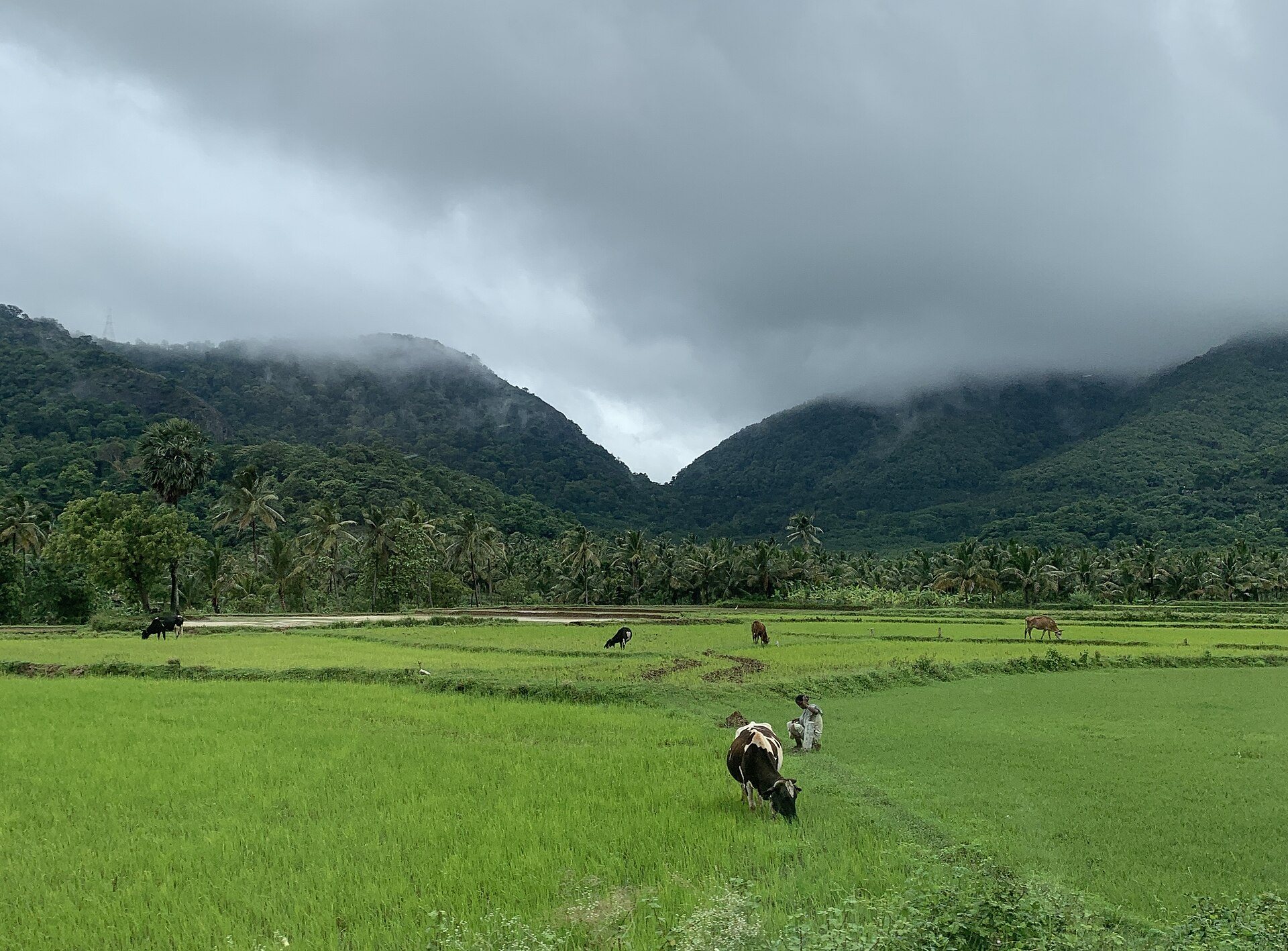
There is a version of monsoon India that gets sold every year, and most of it is true. The hills are impossibly green. The crowds are not there. The light is extraordinary and the photographs are better than anything the dry season produces. The rates are lower. The Ayurvedic houses are at their most serious, because this is the season their tradition says the body is most receptive.
What is usually left out is the arithmetic, and the arithmetic is not an argument against going. It is an argument for going knowingly, which is a different thing and a better one.
So: the house position, with the numbers attached, including the ones that cut against us.
The monsoon does not end when you were told it ends
The India Meteorological Department's long-period averages for Kerala across the four southwest monsoon months are 556 mm in June, 659 mm in July, 427 mm in August and 252 mm in September. That is the shape of the thing: July is the wettest month and September is under forty per cent of it. So far the received wisdom holds, and the case for the tail of the monsoon looks straightforward.
Then October arrives, and Kerala's October normal is about 310 mm. More than September. At station level it is starker still: at Thiruvananthapuram the October normal of 295.2 mm is the second-highest month of the whole year, behind only June's 312.9 mm and well ahead of July's 192.1 mm.
This is not an anomaly or a bad year. It is the northeast monsoon, which Kerala calls Thulavarsham to distinguish it from the June Edavappathy, and it is a second rainy season that the English-language travel press largely does not mention. It normally arrives over coastal Tamil Nadu and south coastal Andhra on 20 October. Tamil Nadu takes forty-eight per cent of its annual rainfall from it. South peninsular India as a whole takes about thirty per cent. Kerala collects roughly 492 mm between October and December.
And the first monsoon does not leave early to make room. IMD's own operational rule is that withdrawal from the southern peninsula occurs only after 1 October, when the wind regime flips. In 2026 the department had still not declared complete withdrawal as of its 4 October bulletin — the withdrawal line ran through Supaul, Ranchi, Raipur, Parbhani, Baramati and Harnai, which is to say that all of Kerala, Tamil Nadu and south Karnataka were still under the southwest monsoon, with the northeast monsoon not yet declared.
A note on normals, because the figures do not all come from one table. IMD's monthly Kerala figures sum to about 1,894 mm for the season, while its Thiruvananthapuram office uses a June-to-September normal of 2,018.6 mm — a 125 mm gap, almost certainly different reference periods. Quote one or the other. Never the arithmetic of both.
Which coast, and why it is the whole question
The single most useful fact in this piece is a comparison of two November numbers. Panaji's November normal is 21.2 mm. Thiruvananthapuram's is 216.7 mm. Ten times the rain, in the same month, in two places a short flight apart, both of which get sold as south India in the shoulder season.
Goa genuinely dries out. Its southwest monsoon is colossal — the state average runs 972 mm in June, 1,093 mm in July, 725 mm in August, 259 mm in September, about ninety per cent of an annual figure near 3,300 mm — and then it stops. By November it is over. The Goa season and the Goa monsoon are cleanly separated in a way that makes planning simple.
Kerala does not work like that, and anyone treating the two coasts as one proposition is going to be wrong about one of them. Be careful, too, with a state average read as a beach figure: Goa's state-average monsoon total runs well above the coastal station's, because the Ghats catch far more than the shore.
What the rate data actually says
We want to be exact here, because the claim that luxury hotels halve their rates in the monsoon is everywhere and we could not substantiate it.
The one published, non-promotional quarterly series we could find is HVS Anarock's India Hospitality Industry Overview for 2024. On its figures the monsoon quarter, July to September 2024, ran an average room rate of roughly ₹7,100 to ₹7,300 against ₹8,900 to ₹9,100 in the peak October-to-December quarter — about twenty per cent lower, with occupancy four to six points down.
Three caveats have to travel with that number. It is national and all-segment, dominated by branded business hotels in metros, and it is not an index of luxury leisure rates in Kerala or Goa. The quarters do not line up with the monsoon — Q2 is April and May dry plus a wet June, Q3 is wet throughout. And most awkwardly for the usual story, the cheapest quarter in that series was not the monsoon at all: April to June came in marginally below July to September. Rates bottom in the pre-monsoon heat and have already begun recovering by the time the rain arrives.
On Goa and Kerala luxury rates specifically we will not give a number, because there is not one to give. Hotelivate's 2025 trends report gives annual market figures only — Goa at 71.4 per cent occupancy and an ADR of ₹10,841 for 2024-25, Kochi at 66.9 per cent and ₹6,090 — with no monsoon or low-season analysis anywhere in it. Everything we found claiming a fifty-per-cent monsoon discount was hotel or booking-site marketing. The discounts are real; the published evidence for their size is not.
The part the green-season brochure leaves out
The Geological Survey of India has mapped about 4.3 lakh square kilometres of India as landslide-prone across nineteen states. Kerala's share is 20,000 square kilometres, of which 3,000 are classed high susceptibility and 7,000 moderate. Kerala's total area is about 38,860 square kilometres. Roughly half the state sits in a mapped landslide-prone zone, and the warning system runs on probabilistic rainfall thresholds rather than on the calendar.
The scale of what the rain can do is on IMD's own record. Its post-event report on the August 2018 Kerala rainfall gives 758.6 mm for the state between the 1st and the 19th — 164 per cent above normal — in two spells, 8 to 10 August and 14 to 17 August. Idukki district recorded 1,478.9 mm in that single month, breaking a record set in 1924. Approximately three hundred people died.
The 2024 Wayanad landslide near Meppadi, on 30 July, is documented in the government's own account of the response: naval personnel deployed the same day, 110 air force sorties, 326 people airlifted. The forecasting timeline is also on the record — Kerala was warned on 23 July, seven days ahead, with nine disaster-response teams airlifted in anticipation, and told on 26 July to expect more than twenty centimetres of rain with possibilities of landslides potentially causing loss of life. We will not publish a death toll, because the government documents describe the response rather than the casualties and we could not source the figure officially.
And here is the sentence we think settles the honest framing, because it is the state's own prose. Kerala's Orange Book of Disaster Management directs the tourism department, under an Extremely Heavy Rainfall Warning, to close all hill stations and resorts in coastal and low lying areas and evacuate public to safer areas. Under lesser warnings it directs that tourists be advised not to stop beside streams and rivulets crossing ghat roads, as these are possible tracts of landslides.
The trigger for that is a rainfall warning, not a date. Which is exactly why we think the monsoon is bookable and why we think it has to be booked differently.
What is actually open
Less is closed than the warnings suggest, and more is uncertain than the brochures admit.
On the tiger reserves: the National Tiger Conservation Authority's technical committee directed monsoon closure as far back as 28 July 2015, in the terms that under no circumstance should monsoon tourism be carried out, and in June 2025 it reaffirmed closure for sixteen reserves including Periyar and Parambikulam. The same reporting states that despite the 2015 direction, several reserves in Karnataka and Kerala remain open anyway. We could not retrieve the Kerala Forest Department's own published position at all — the official reserve sites return nothing readable and the state ecotourism portal refuses automated access. We check by phone for the specific year, and we would not sell a Periyar date without doing so.
On the backwaters: there is no standing monsoon closure that we could document. What exists is episodic suspension at a few hours' notice when the rivers rise — in July 2023 the Alappuzha district administration suspended houseboats, shikaras and motor and speed boats, and the State Water Transport Department suspended tourist services in Kuttanad, after the Pampa breached its banks. Houseboats run through the monsoon. They can also be stopped on the morning of your cruise.
On the ghat roads: no scheduled annual closure of a Western Ghats hill-station road exists that we could find. What exists is repeated unscheduled closure after landslides — the Shiradi Ghat section of NH-75 between Bengaluru and Mangaluru has been shut to vehicles on multiple monsoon occasions with traffic diverted via Charmadi and Sampaje.
On the sea: Goa's lifesaving agency advises against swimming and water sports from June to September, and flags rocky areas, cliffs and shoreline hills as perilous because of their slippery nature. Separately, and with actual teeth, the Collectors of North and South Goa issued circulars in May 2024 banning swimming in waterfalls, abandoned quarries, rivers and lakes until further orders. Kerala, by contrast, has no seasonal no-swim order that we could find; its restrictions are alert-triggered. Do not let anyone tell you Kerala bans monsoon swimming. It does not.
The Ayurveda claim, attributed rather than adopted
Kerala Tourism's own position is quotable and on the record: according to Ayurveda, monsoon is the best season for rejuvenation therapies, because the atmosphere remains dust-free and cool, opening the pores of the body to the maximum, making it most receptive to herbal oils and therapy.
The Karkidakam tradition is documented too — the last month of the Malayalam calendar, falling in July or August, when the body is considered highly receptive, and when oil therapies and those prescribed under Panchakarma are recommended. So is karkidaka kanji, the medicated gruel of boiled cereals and twelve to twenty-four medicinal plants.
What we could not find is a Ministry of Ayush, CCRAS or retrievable peer-reviewed source endorsing the monsoon specifically as the season for Panchakarma. Everything else returned was clinic and resort marketing. The physiological mechanism — open pores, peak receptivity — is a tourism board's assertion, framed as according to Ayurveda. We are happy to repeat it with that attribution attached. We will not present it as a finding.
One more small correction while we are here. Karkidakam is conventionally given as mid-July to mid-August, and that is almost certainly right, but Kerala Tourism's own two pages say July or August on one and mid July / Mid June on the other. Attribute the span to the Malayalam calendar, not to the tourism board.
What the arrivals data says, which is not what you would guess
The Ministry of Tourism's monthly foreign tourist arrivals for 2024 put the trough in May, at 622,189, then August at 661,322, then April at 672,684, then September at 691,247. December, at 1,060,621, exceeds August by sixty-one per cent.
But look at July: 799,842, within five per cent of October's 840,330, and comfortably ahead of April, May, June and September. And in 2025 September — 7.2 lakh — was busier than both July and August.
So the monsoon is not the bottom of the market, and the late monsoon is already recovering. The genuinely quiet months in India are the pre-monsoon heat of April and May, which nobody describes as a green-season opportunity because there is nothing green about them.
A caveat on Kerala specifically: Kerala Tourism publishes annual visitor totals only, broken down by district and source country, with no month-wise table anywhere in its statistics releases. Any monthly Kerala seasonality figure you have been quoted is not coming from Kerala Tourism.
The house position
We think the tail of the monsoon in south India is one of the best things we sell, and we think it has to be sold with its trade named in the same paragraph as its price. Specifically:
Separate the coasts. Goa in late September and October is a straightforward proposition: the rain is leaving, the beaches are emptying of nobody because nobody has arrived yet, and by November it is dry. Kerala in October is a different trip, and it is a trip about interiors — the hill houses, the Ayurvedic programmes, the backwaters under rain, the food — rather than about beaches and boat decks.
Build soft days. Not spare days in a sense of luxury, but genuine slack, because the risks here are the kind that resolve in twenty-four hours. A trip with one fixed, unmissable commitment in it is the wrong trip for August and September.
Treat the hills seriously. Half of Kerala is in a mapped landslide zone, the state's own SOP contemplates closing hill resorts on a warning, and the ghat roads are the first thing to go. We do not build a monsoon itinerary whose only route out of a hill property is one ghat road.
And tell the guest the actual numbers. A guest who has been told that October in Kerala is wetter than September, and who comes anyway because they want green hills and an empty country and a serious Ayurvedic fortnight, has a wonderful time. A guest who has been sold the end of the rains, and who meets the northeast monsoon instead, has been misled by someone. We would rather it not be us.
One last thing, on 2026 specifically. If anyone tells you this year's monsoon tail proves the case, be careful: 2026 was a deficient monsoon by IMD's own category — 759.4 mm nationally against a long-period average of 868.6 mm, eighty-seven per cent — and the south peninsula came in at seventy-six per cent of its average, with Kerala twenty-eight per cent below normal. Whatever this year felt like, it was not a normal monsoon tail.
Preguntas, respuestas
Is the monsoon actually cheaper?
On the only published, non-promotional quarterly series we could find — HVS Anarock's 2024 figures — the monsoon quarter ran about twenty per cent below the peak quarter nationally, across all segments. There is no published figure for luxury rates in Kerala or Goa specifically, and in that same series the cheapest quarter was the pre-monsoon one, not the monsoon.
When does the rain actually stop in Kerala?
It does not stop in October. IMD's October normal for Kerala is higher than its September normal, and the northeast monsoon normally arrives around 20 October, bringing a further 492 mm or so across October to December. The reliably dry months are January to March.
Is it safe to travel in the Western Ghats in the monsoon?
With proper planning, yes, but the risk is real and it is weather-triggered rather than seasonal. Roughly half of Kerala is in a mapped landslide-prone zone, and the state's disaster SOP provides for closing hill stations and resorts on an extremely-heavy-rainfall warning. We build monsoon hill itineraries with alternative routes and genuine slack, and we move guests on a warning rather than after an event.
Should I go to Goa or Kerala in the shoulder season?
By November, Goa. Its November rainfall normal at Panaji is 21.2 mm against 216.7 mm at Thiruvananthapuram. In late September and October the two are much closer, and the choice is really about what kind of trip you want: Goa's is outdoors and coastal, Kerala's in that window is better as a hills, food and wellness trip.