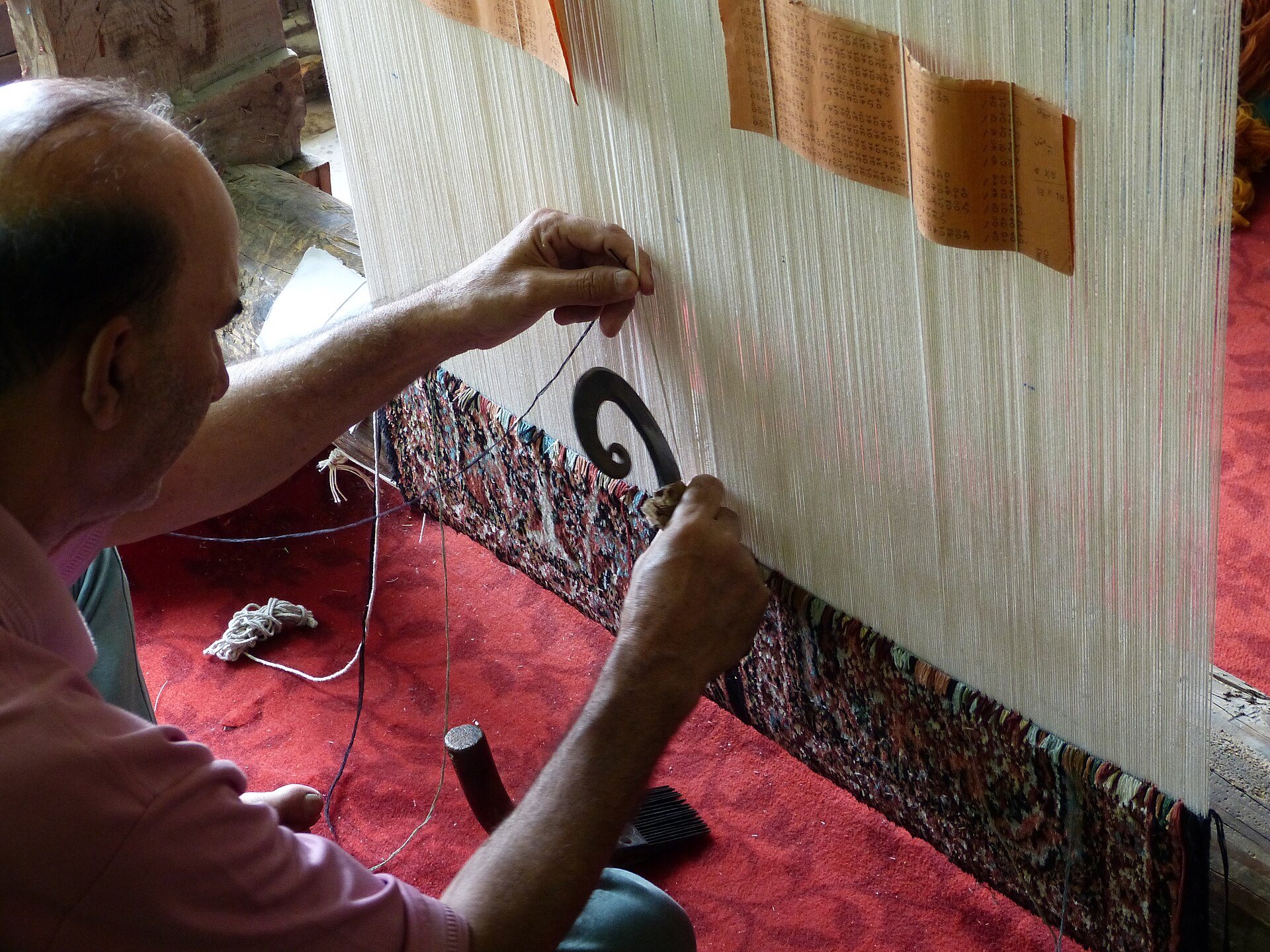
Photo d'en-tête : Kashmiri silk carpet knotting with talim pattern sheets, by Zatara-Iqbal (CC BY-SA 4.0), via Wikimedia Commons
We write a good deal about Indian textiles and almost nothing about buying them, which is a gap, because the buying is where the money and the risk are. A guest who spends a hundred pounds on a scarf has made a decision about a scarf. A guest who spends twelve thousand on a carpet has entered three legal systems — Indian export control, Indian tax, and their own country's customs — and has done so, usually, on the strength of what a shopkeeper told them over tea.
This piece is the practical half of the textile story. It is longer than our usual and it has more law in it, and we make no apology for either. Everything below is from the statutes, the Geographical Indications register, the customs tariffs, and government enforcement orders. Where we could not verify something we say so, and there is more of that than we would like, because large parts of this subject have simply never been documented by anybody with no stake in the answer.
The one rule that cannot be worked around
The Antiquities and Art Treasures Act, 1972 is the hard constraint on everything else, and it is the most misreported law in Indian travel writing.
It sets two age thresholds. Seventy-five years for manuscripts, records and documents. One hundred years for coins, sculpture, painting, epigraphs and — this is the limb that catches a carpet — any other work of art or craftsmanship, and anything illustrative of science, art, crafts, literature, religion, customs, morals or politics in bygone ages. A rug woven before about 1926 is, on its face, an antiquity.
Section 3 says it shall not be lawful for any person other than the Central Government or an authority or agency authorised by it to export any antiquity or art treasure.
Read that again, because the consequence is the thing nobody tells buyers. There is no export permit a private person can obtain for an antiquity. None. Permission exists only at the level of the Director-General of the ASI in consultation with the Culture Secretary, and in practice it is for institutional loans and exhibitions — six months, extendable by six, with longer terms for formal loans.
So when a dealer offers to arrange your antique export permit, one of two things is true: he is confused, or he is lying. What actually exists is a non-antiquity certificate, and it certifies the exact opposite of what the buyer thinks. It says the piece is not old enough to be caught by the Act, and may therefore leave.
That certificate comes from an Expert Advisory Committee constituted at the ASI Circle for the region where the object is — not from Delhi, not from customs, and not from the dealer. We should say plainly that the ASI publishes neither a fee nor a service standard for it, and that every two-to-three-weeks figure you will read online is uncited. The only reliable route is the Circle office for the city you buy in. A showroom that has never heard of the process is telling you something about the showroom.
Three more provisions worth knowing. Section 5 requires a licence to carry on the business of selling antiquities, so a shop genuinely dealing in old pieces should hold one; ask. Section 24 provides that if any question arises whether an article is an antiquity, it goes to the Director-General of the ASI and that decision is final — your dealer's opinion and your appraiser's are legally irrelevant at the border. And section 25 sets the penalty for unlawful export at not less than six months' imprisonment and up to three years, with a fine, the minimum being mandatory and the fine cumulative rather than alternative.
The practical consequence is counter-intuitive and worth stating baldly: the threshold bites at exactly the age a collector wants. If a piece is genuinely nineteenth-century, you cannot take it home. If it can leave, it is not what it was sold as.
Shahtoosh, which is the thing that ends the holiday
Everything we have said so far concerns the carpet. This concerns what might be on it or beside it in the same showroom, and it is the one error with consequences beyond the financial.
Shahtoosh is woven from the under-fleece of the chiru, the Tibetan antelope. The Wildlife Protection Society of India puts it at three chiru for a two-metre by one-metre lady's shawl and five or six for a man's, because each pelt gives about a hundred and fifty grams of under-fleece and a shawl needs three to six hundred. The animal cannot be shorn; it has to die. Chiru populations fell by about ninety-five per cent in thirty years.
The chiru has been CITES-listed since 1975 and on Appendix I, the highest protection, since at latest 1979. In India it is Schedule I under the Wild Life (Protection) Act, 1972, retained there after the 2022 restructuring, and dealing in Schedule I species and their articles is prohibited. In the United States it has been endangered under the Endangered Species Act since April 2006.
The reason stale advice persists is that the law in Kashmir genuinely did flip-flop. Until 2002 the chiru sat in Schedule II of the separate J&K Wildlife Act of 1978, which made licensed trade possible. The High Court ordered enforcement in May 2000, the state moved the chiru to Schedule I and banned manufacture in August 2002, a Division Bench reversed that in February 2003 citing the human aspects involved — shahtoosh employed perhaps fifteen thousand people, mostly women — and the Supreme Court issued notice in August 2003. The central Act now applies in the Union Territory.
It is unambiguously illegal everywhere in India today, and importing it is an Appendix I offence in every destination market we have looked at.
PashminaPashminaThe fine undercoat wool of a Himalayan goat, and the shawls woven from it.Read in the glossary is a different animal entirely — the fine undercoat of a domesticated goat, combed or shorn annually. The confusion between the two is commercially engineered, and the tell is what the seller emphasises. Anything sold on ring-passing, on extreme fineness, or with the phrase shahtoosh quality is being sold on the wrong attributes. DNA testing on shahtoosh shawls, new and historic, found every one had been woven from chiru wool taken from dead animals.
The general rule, which covers trim as well as shawls: anything on a rug that came off an animal is a separate legal question from the rug, and it is the part that gets the whole consignment seized. If the seller cannot name the species, do not buy it.
What the Geographical Indications register actually says
The GI register is the single most useful document in this subject, because it is a government list that cannot be argued with, and it contradicts a great deal of what gets said in showrooms.
The carpet and floor-covering GIs are: Hand Made Carpet of Bhadohi (Uttar Pradesh), Kashmiri Hand Knotted Carpet (Jammu & Kashmir), Mirzapur Handmade Dari, Agra Durrie, Navalgund Durries, Warangal Durries, Gwalior Handmade Carpet, Himachal Handmade Galicha, Kashmir Namda and Gabba.
Now read the gaps, because they are the valuable part.
Mirzapur holds a GI for a dari — a flatweave. There is no GI for a Mirzapur pile carpet. Agra holds a GI for the Agra Durrie, also a flatweave; its other registrations are for leather footwear and stone inlay. There is no GI for an Agra carpet.
And Jaipur — one of the largest carpet-producing and exporting centres in India — has no carpet GI at all. Its only relevant registration is Blue Pottery of Jaipur. A GI-certified Jaipur carpet is a logical impossibility, which makes it an excellent fraud detector.
On pashmina, the distinction that costs people money: Kashmir Pashmina is GI number 46, registered in December 2005, held by a society of Kashmiri artisans and operated through the Craft Development Institute in Srinagar with a testing laboratory. Its standard requires one hundred per cent pashm fibre at up to sixteen microns, hand-spun and handloom-woven. Machine-spun yarn of real sixteen-micron pashm is genuine pashmina and is explicitly ineligible for the mark. So genuine pashmina and GI Kashmir Pashmina are two different claims, and you should ask which is being made.
The laboratory tests are real and specific: fibre origin by projection microscope confirming the scale morphology of Capra hircus; fineness by optical fibre diameter analyser; spinning by twist tester, where an S twist means hand-spun and a Z twist means machine-spun and ineligible; and weave by pick glass. The GI label is a small rectangle, twenty by thirty-five millimetres, designed to break when removed, carrying a unique number and a QR code encoding the product, the authorised user and the artisan.
The one check you can do yourself, and the fraud it caught
For a Kashmiri carpet there is a verification route that works in the shop, and every buyer should use it.
The Indian Institute of Carpet Technology in Srinagar runs the testing and labelling for the Kashmiri Hand Knotted Carpet GI, whose registered proprietor is a Srinagar weavers' cooperative. Certified carpets carry a secured heat-fusion label with covert and overt security features, a QR code and a registered GI logo. Scan the QR for the carpet's details. If the scan fails, type the alphanumeric code printed on the label into the Institute's own site.
In July 2025 a tourist named Syed Furqan Alam did precisely that, after paying ₹2.55 lakh for what he had been sold as a hand-knotted, GI-certified Kashmiri carpet. He complained to the Director of the Institute, who confirmed the QR label was forged and had not been issued by the Institute. The carpet was machine-made. The Quality Control Division of the J&K Department of Handicrafts and Handloom inspected and seized it, and by order dated 22 July 2025 the showroom — The Kashmir Art Bazaar at Konchipora, Tangmarg — was blacklisted and deregistered, with a criminal complaint ordered under the GI Act and the Bharatiya Nyaya Sanhita for violations of the J&K Registration of Tourist Trade Act, 1978.
That was not an isolated action. In February 2025 the same division inspected wholesale carpet dealers in Srinagar and found Turkish and Iranian carpets, some unlabelled or partly labelled, being misrepresented as Kashmiri hand-knotted, and confiscated them. On 25 July 2025 the whole registered trade was given seven days to remove machine-made stock, on pain of penalties, blacklisting or deregistration — the goods, the department said, mostly imported from Turkey and Iran.
Two caveats to go with the verification route. Only about 9,800 carpets have ever been certified and labelled by the Institute, which is a rounding error against the size of the trade — so a Kashmiri carpet without a label is not thereby fake, though its absence should change the price you pay. And the published GI specification itself — knot density, permitted materials, weave, dye standards — is not on any reachable public page, so be sceptical of anyone quoting you a knot count as the GI standard.
It is worth saying what this means structurally. The best consumer remedy in the Indian carpet trade exists only in Kashmir, and it exists because of the J&K Registration of Tourist Trade Act, 1978, which registers dealers and allows the state to deregister them. Uttar Pradesh and Rajasthan have no equivalent regime.
The marks that mean something, and the ones that do not
A Geographical Indication is statutory, under the 1999 Act, and certifies origin within the defined territory and compliance with the registered specification — for authorised users. It does not certify quality beyond that specification, and it does not certify that the shop you are standing in is an authorised user. Ask for the authorised-user number.
The Handloom Mark is a real government scheme, run by the Textiles Committee since 2006, with its logo protected under the Trade Marks Act and labels carrying a unique QR code. Draft regulations would make a valid label compulsory on anything sold as handloom. But neither the scheme's own pages nor the draft state whether carpets and floor coverings are within scope, so do not treat it as proof that a carpet is hand-knotted.
The Carpet Export Promotion Council is a real body — set up by the Ministry of Textiles in 1982, with more than two thousand members representing over twenty-five thousand units — and it is the wrong tool. It issues export registration certificates and binds members to a code of conduct that prohibits child labour and misrepresentation, removing them after more than two violations. It is not a consumer quality mark, it issues no authenticity certificate, and it publishes no complaint route for buyers. Membership is a filter, not a remedy.
Woolmark is a private trade mark testing fibre content and performance. It tells you nothing about India, origin, hand-knotting or knot count.
Craftmark is a private scheme run by a crafts association, not a government one. India Handmade is a marketplace, not a certification; we could find no statutory mark of that name.
The tests the trade offers you, and why we will not endorse them
This is the section where we are going to disappoint readers, and we think honesty is worth more than reassurance.
You will be shown how to tell a hand-knotted carpet from a hand-tufted or machine-made one: examine the back for individual knots, look for a glued scrim backing and a fringe sewn on rather than continuous with the warp, watch for machine-perfect regularity and a serged edge. These are real craft observations and experienced people use them. What we could not find is a single museum, conservation body, standards organisation or government laboratory that publishes them as a test. Every source was a rug retailer's own blog. We are not going to present dealer marketing as verified method.
On knot count, we could not establish whether a Bureau of Indian Standards specification exists setting knots per square decimetre and the counting method. There probably is one. Until we have it, we will not publish a threshold.
On silk versus mercerised cotton — art silk, as the trade calls it, which is its own euphemism — the reliable methods are chemical fibre identification and microscopy, both laboratory procedures. The burn test performed on a shop floor is widely described and we could not verify it from any standards body or laboratory.
And on natural versus synthetic dye, which is the claim dealers make most freely: there is no consumer-level test. It is an analytical chemistry problem, solved by chromatography in textile conservation laboratories. Abrash — the subtle banding of colour across a field — indicates small dye lots, not natural dyestuff. The vegetable dye claim is the least verifiable claim in the entire trade and it is priced as though it were the most certain.
What we would actually do, and what we tell guests to do. First, get the description written on the invoice before you pay: hand-knotted or tufted, the fibre named properly — Bombyx mori silk, or viscose, or mercerised cotton — the knot count, the region, the dye type. A written misdescription is what enforcement acts on; that is what the Tangmarg order turned on. Second, photograph the piece, its reverse and its label in the shop. Third, pay by an instrument that gives you a chargeback. And fourth, on a six-figure purchase, pay a laboratory. The Institute in Srinagar does fibre and yarn analysis, fabric testing and thermal analysis; the Textiles Committee tests too. Against the price of a serious carpet the fee is noise.
Tax in India, and the refund that does not exist
GST on carpets and other textile floor coverings fell from 12 per cent to 5 per cent on 22 September 2025, under the two-rate restructuring agreed at the GST Council's fifty-sixth meeting. Anything written before that date overstates the tax by more than double. Hand-woven tapestries, embroidered articles, carved wood and carved stone moved to 5 per cent at the same time.
There is no tourist refund. Section 15 of the IGST Act, 2017 is headed refund of integrated tax paid on supply of goods to tourists leaving India. It exists on the statute book and it has never been brought into force — the Ministry of Finance confirmed as much in 2018, and we found no notification, rule or operational scheme as of October 2026. Export bodies are still lobbying for one, which is itself evidence.
So every comparable shopping destination runs a refund scheme and India has had the statutory power since 2017 without switching it on. Budget the 5 per cent as sunk.
There is a legitimate alternative and it is the real reason serious buyers ship rather than carry. If the dealer exports the carpet in your name, the supply should be a zero-rated export of goods, and GST should not sit on the invoice at all. We put that as should rather than will — we have not verified it against the statute — so ask the dealer to invoice it as an export and take your own advice. But it is the tax, not the convenience, that drives the decision.
Getting it home: four countries, four different answers
This changed more in 2026 than in the previous twenty years, and anything written before the summer is now wrong. We will give you the structure and tell you where to check the number, because rates move and we would rather be useful than precise about something that has since changed.
The United States. The tariff position was rewritten three times this year. The emergency-powers tariffs were struck down by the Supreme Court in February 2026; a temporary 15 per cent measure ran to July; and the operative regime since 24 July 2026 is a Section 301 action, under which India carries an additional 10 per cent ad valorem. The ground for it is worth knowing: the tier was set by whether a trading partner had committed to adopt and effectively enforce prohibitions on importing goods made with forced labour. A buyer worried about the ethics of the trade is paying a levy premised on them.
Underneath that sits the ordinary tariff, and the structural point is that classification rather than origin drives it. Within the hand-knotted wool lines the rate is free on most and low single figures on the residual line, and there is a formal certified hand-loomed and folklore products provision at free. We are not printing current rates because we could not reach the live tariff schedule, and you should not rely on a figure from an article anyway.
One potentially valuable exclusion, which we flag rather than assert: accompanied baggage appears among the exclusions from the Section 301 duty, which would mean a carpet carried home in your luggage escapes the 10 per cent where a shipped one does not. The operative text sits in annexes we could not read in full. It is probably right and it is worth a phone call to US Customs before you decide how to get it home.
Separately from duty, you declare it. Every article brought into the United States must be declared; the returning resident's exemption is $800 of accompanying goods, and unaccompanied effects need their own form.
The United Kingdom is now the most favourable of the four, and that is three months old. The UK-India Comprehensive Economic and Trade Agreement entered into force on 15 July 2026, giving zero-duty access on about ninety-nine per cent of Indian exports and removing textile tariffs of up to twelve per cent. But preference is not automatic: it has to be claimed with an origin document, and a shipment sent without one will pay the ordinary rate even though a zero rate exists. Make sure the dealer provides it.
The traveller's allowance has a sting that catches almost everybody. You may bring in goods worth up to £390, and the government's own guidance says that if you go over your allowance you pay tax and duty on the total value of the goods, not just the value above it. On a single expensive item that is brutal, and it is the opposite of what people assume.
The European Union is in a different position from the United Kingdom for the first time, and buyers do not know it. The EU-India agreement was concluded on 28 January 2026 but is not in force — it still needs legal revision, translation, Council signature, European Parliament consent, Council conclusion and Indian ratification, with no target date. There is no GSP preference either; India is graduated out of the textiles section. An EU buyer pays the ordinary rate today while a UK buyer does not.
Australia charges no duty on a hand-knotted wool carpet — the general rate on that line is free, with no trade agreement needed — and has by a distance the hardest border of the four, for a reason that has nothing to do with tax.
India is not on Australia's foot-and-mouth-free country list. Wool must be sourced from an approved free country or treated to mitigate the risk, and the accepted treatments are specific: heating to at least 95°C for thirty minutes, commercial scouring at a minimum of 60°C for five minutes, autoclaving at 120°C for ten minutes, or specified carbonisation. Fumigation is not among them, and fumigation is what a dealer will often offer. Treatments must be attested by a health certificate or a government-endorsed manufacturer's declaration naming where the wool was sourced and made.
We should be honest that we could not establish whether a finished woollen carpet counts as a woollen article for those purposes — the relevant notice does not address it. Australian buyers should settle that with the agriculture department before shipping. What is clear is the instruction for personal effects, which is literally to vacuum carpets, rugs and mats, and that non-compliant goods are treated, exported or destroyed at the importer's expense. Get the declaration in the shop, at the point of sale, not afterwards.
Australia's passenger concession is A$900, and it carries the same whole-value rule as the United Kingdom: exceed it and duty and tax fall on the entire importation.
Carry it or ship it
The two optimisations point in opposite directions, which is why this decision is harder than it looks.
Carrying it may win on tariff — the accompanied-baggage exclusion from the US duty, if it holds, plus the personal allowances of $800, £390 and A$900 as far as they go. Though note that for anything above those thresholds the UK and Australia tax the whole value, which wipes out the advantage on a serious piece.
Shipping wins on almost everything else: biosecurity treatment and its certification, proper insurance, and the ability to have the dealer invoice it as a zero-rated export and save the 5 per cent GST.
On shipping itself we have to report a thin record. We could not verify from any independent source what Indian dealers typically offer by way of terms, what insurance norms are, or any regulator's finding on non-delivery rates. Every result was a forwarder's marketing page. What is documented in this trade is not non-delivery; it is substitution at the point of sale, and the government enforcement orders quoted earlier are the evidence.
For a serious piece our own practice is to ship through a freight agent we have used before rather than through the dealer's own arrangement, to insure at the purchase price, and to have the carpet photographed front and back at the shop, at the packer and on arrival.
Child labour, honestly
This cannot be left out of a piece about buying Indian carpets, and it should not be handled with a reassuring sentence.
The United States Department of Labor's list of goods produced by child labour or forced labour, as of September 2024, names Indian carpets for both. India's entry runs to twenty-nine goods.
The substantial research is Siddharth Kara's study for Harvard's FXB Center, published in January 2014, covering 172 exporters across nine states of northern India. It recorded 3,215 cases of forced labour as defined by Indian law, of which 1,406 involved child labour, 2,010 bonded labour and 286 human trafficking, and concluded that roughly half of the workforce was in conditions amounting to forced labour and about twenty per cent were children. The same work set out the economics: Indian handmade carpets with an import value of $306 million in 2012 retailed in the United States for between $1.8 billion and $3.1 billion — a multiple of roughly six to ten between landed value and Western retail. A buyer in India is buying inside that multiple, and the dealer knows where.
GoodWeave, founded as RugMark in 1994 by the Nobel laureate Kailash Satyarthi, is the certification most buyers encounter. Its standard prohibits child, forced and bonded labour; it inspects tier-one factories and all outsourced production including homes, unannounced; each label carries a unique code traceable to the licensed producer.
What it does not certify, and does not claim to: quality, knot count, fibre, dye, whether the rug is knotted rather than tufted, geographic origin, or whether the weaver was paid well. It addresses child, forced and bonded labour, not wage levels.
We should also report, with attribution rather than endorsement, that the scheme's own history has been criticised. Magazine reporting describes the Indian supply chains as having been corrupted by around 2009, prompting the rebrand and relocation; quotes a GoodWeave official acknowledging that distinguishing children working with relatives from forced labour is not always straightforward; and notes that at least one major Indian producer declined certification on the grounds that conditions could not accurately be judged. Kara's structural criticism is that subcontractors evade inspectors by moving loom sheds into remote rural areas. That is journalism, not an independent audit, and parts of it are old; we could find no methodologically transparent assessment of the scheme's current effectiveness.
The honest position for a buyer is that a GoodWeave label is meaningfully better than nothing and is not a guarantee, that the production unit in much of this trade is a family home, and that paying a serious price to a named workshop you have visited is a better safeguard than any label on a rug bought from a showroom that will not say where it was made.
What we would actually tell you to do
Buy in the region that makes what you want. The GI register is a better guide than any dealer's pitch: Bhadohi, Gwalior and Himachal for pile carpets; Mirzapur, Agra, Navalgund and Warangal for flatweaves; Kashmir for hand-knotted carpets, namda and gabba; and Kashmir alone for silk.
Ask three questions before price comes up. Where was this made, by whom, and is the workshop one I can visit? Is it hand-knotted, and will you write that on the invoice? And does it carry a GI label I can verify?
Get everything on the invoice before you pay — construction, fibre by its proper name, knot count, region, dye, price, and the shipping terms.
Verify what can be verified, in the shop. For a Kashmiri carpet that means the QR code or the alphanumeric code at the Institute's site. For pashmina it means asking whether the claim is genuine pashmina or GI Kashmir Pashmina, which are different things.
Treat the vegetable dye claim as unpriceable. If it matters to you, pay for a laboratory report.
Assume nothing over a century old is leaving the country, and be suspicious of anything sold to you as both antique and exportable.
And have the conversation about time rather than about discount. A serious carpet represents months of somebody's life. The question worth asking a dealer is how long this one took and who made it — and the answer, or the absence of one, will tell you more about what you are buying than any amount of haggling.
Les voyages qui vous y emmènent

À lire ensuite