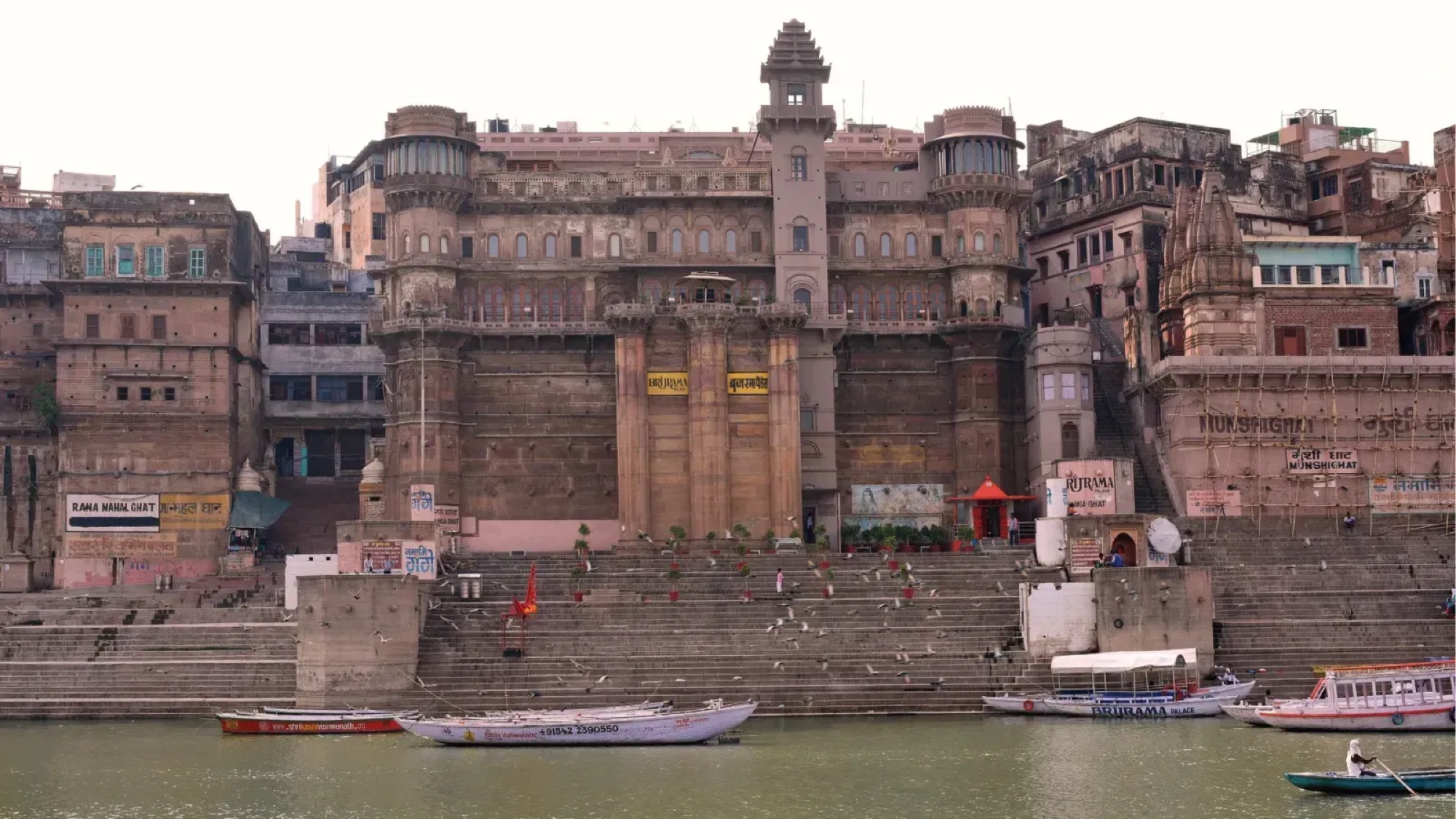
BrijRama rises straight out of the riverfront wall above Darbhanga GhatGhatA flight of steps leading down to a river or tank, used for bathing, worship and cremation.Read in the glossary. It was built in 1812 by Shridhar Narayan Munshi and given in 1915 to King Rameshwar Singh Bahadur of Darbhanga, after which it was known as Darbhanga Palace. Brijpal Das spent some eighteen years restoring it.
There is no vehicle access. Guests come by boat from Assi Ghat or Namo Ghat, or on foot through the lanes — which means that from the first minute Varanasi is arriving on the city's own terms. From the river-facing rooms you look straight down onto the ghat steps and the traffic on the water.
Why We Place Guests Here
- The boat arrival onto your own ghat is the single best entrance in north India, and it is not optional here — it is simply how you get in.
- Being on the ghats rather than in the cantonment means the dawn aarti is a walk, not a drive through a waking city.
- Thirty-two rooms, an entirely vegetarian kitchen and a ten-course tasting menu built on the palace's own history — a serious house, not a view with beds behind it.
The Table
- Darbhanga — all-day multi-cuisine
- Aangan — ten-course heritage tasting menu
- Udayan Terrace
The Elevated India Signature
Subah-e-Banaras: out on the water before first light, with the ghats coming alive from the river.
Questions, Answered
How do you get to BrijRama Palace in Varanasi?
By boat from Assi Ghat or Namo Ghat, or on foot through the old lanes. No vehicle reaches the palace — it stands on Darbhanga Ghat itself.
Is BrijRama Palace vegetarian?
Yes, the kitchen is entirely vegetarian, in keeping with its position on the ghats. Aangan's ten-course tasting menu runs about two and a half hours and is themed on figures from the palace's own history.
Journeys That Take You There
Explore the destination guide: Varanasi, Uttar Pradesh ↗
Photography: Photograph courtesy Brij Hotels