Begin with the strangest fact in the region, because it tells you what Chettinad is.
At Kanadukathan, in Sivaganga district, there is an airport. The British used the airstrip as a base in the Second World War. Around 1953 it served as a hub for Jupiter Airways — an airline bought in 1947 by Sir Alagappa Chettiar, born at Kottaiyur in Chettinad, who offered his Dakotas to the government to evacuate families during Partition. Since then it has been abandoned. The runway is reportedly undamaged. The site is maintained by the Tamil Nadu Animal Husbandry Department.
In December 2025 the state's industrial development corporation floated a tender of just under four crore rupees to convert the airstrip into a regional aviation and training hub for flying schools and drone testing. Nothing has happened yet.
So a region whose entire wealth came from being connected to Rangoon, Colombo and Penang has a working runway lying in a field, and every visitor drives ninety kilometres from Madurai. That is Chettinad: an enormous apparatus of connection, built for a world that stopped existing, left standing in the dry country east of Madurai while the people who built it decide what to do with it.
Who they were, and where the money came from
The community calls itself Nagarattar, or Nakarattar. Nattukottai Chettiar is the name everybody else uses.
They were never numerous. The anthropologist David Rudner, whose 1994 study of them remains the standard work, puts the caste at perhaps ten thousand people in 1896, forty thousand by 1920, and around a hundred thousand when he did his fieldwork in 1980. Hold that number: it is the ceiling on everything that follows.
Their business was banking, not usury — deposit-taking, the discounting of indigenous bills of exchange, and agricultural and commercial lending, organised through family partnerships with branch agency houses staffed on rotating three-year contracts. A young man went to Rangoon or Penang for three years, kept the books, and came home.
The scale, from the Burma Provincial Banking Enquiry's report of 1930, is the part that surprises people. Close to seven hundred Chettiar firms in British Malaya. Four hundred and fifty in Ceylon. A hundred and five in Cochin China, in what is now southern Vietnam. Two hundred and ninety-five firms in Burma — which, because a firm is a family partnership rather than a branch, translated into about 1,650 offices there by 1930, up from perhaps thirty in 1905. The enquiry recorded that in nearly every well-populated part of Lower Burma there was a Chettiar within a day's journey.
In Singapore in 1883 there were twenty-eight Chettiar firms against four mercantile exchange banks.
Their capital in Burma in 1930 was put at six hundred and fifty million rupees as an unassailable minimum, with seven hundred and fifty the working consensus. They were lending between a hundred and a hundred and twenty million rupees in Lower Burma, which the enquiry estimated at seventy per cent of all borrowings from all sources. Two-thirds of their outstanding loans were to agriculturalists, and about two-thirds of those were secured on land.
They founded formal banks too. The Bank of Chettinad, in Rangoon in 1929. And the Indian Overseas Bank, incorporated in February 1937, which opened simultaneously at Karaikudi, Madras and Rangoon. A bank whose day-one branch network was a Tamil town, a colonial capital and a city in another country tells you exactly what business it was in.
What happened, told properly
The Chettiar story in Burma is contested, and both of the available framings are partisan.
The Government of India's own migration paper says they lent at exorbitant rates and gradually became absentee landlords, becoming a target of Burmese nationalist sentiment. The revisionist scholarship says the opposite. Sean Turnell and Alison Vicary, working from the same 1930 banking enquiry, found that the Chettiars did not charge especially high interest rates and that their rates were much lower than indigenous moneylenders'. Rudner independently records that their rates were generally far lower than competitors', in some cases by an order of magnitude.
What actually happened is better described by neither. Paddy fell from a hundred and sixty-nine rupees per hundred baskets in 1928-29 to eighty rupees in 1931, and stayed down until after the war. Borrowers could not service debt secured on land, so the land came to the lenders. Chettiar-occupied land in the thirteen principal rice-growing districts of Lower Burma went from about five hundred and seventy thousand acres in 1930 — six per cent of occupied land — to roughly two and a half million acres by the late 1930s, around twenty-five per cent. A fourfold increase in under a decade.
A member of the banking enquiry put the Chettiar disposition well: their predilection is to be a financier, and he would rather have for his assets loans which he can transfer. They did not want the land. They wanted the paper.
The honest formulation is that they were a foreign-domiciled banking caste structurally positioned to absorb the agrarian losses of a depression they did not cause, and were then blamed for it. In May 1930 riots at Rangoon port killed over two hundred Indians.
Then it unwound, in four stages, and the dates matter.
In 1942 the Japanese invasion drove the Indian population of Burma out on foot. Hugh Tinker's account, built on contemporary medical returns, records a senior medical officer logging about two hundred and twenty thousand people reaching safety through the central Manipur sector with 4,268 known deaths, and separate reports of two hundred thousand through Chittagong and a hundred thousand by the Taungup route. The figure usually quoted — half a million left and half of them died — comes from an Indian government paper and is not supported by the sector returns. Something on the order of half a million left; the proportional death toll was far lower than the version in circulation.
In 1948, with independence, they were not allowed to return. Of four hundred thousand citizenship applications under the new state, around ten thousand were approved. The Land Nationalisation Act followed in 1953.
And then Ne Win. The coup in March 1962; Imperial Chemical Industries nationalised that August; the Burma Oil Company in January 1963; all banks, domestic and foreign, in February 1963; all large-scale industry by June. The demonetisation law of May 1964 made the fifty and hundred kyat notes worthless. By July 1965, of some hundred and nine thousand Indians enumerated in the relevant category, ninety-seven thousand had left. The Indian government records 144,353 assisted repatriates returning from June 1963 onwards, and notes, in a sentence written forty-five years afterwards, that the compensation due to these people has not been settled.
An advocacy group of Chettiar descendants, the Burma Investors Group, claims that about a hundred families hold documents showing ownership of three hundred thousand acres in Burma. Set that against the two and a half million acres the community held in 1937. One of its members was shot and killed in 1945 while pursuing compensation through Parliament.
The houses, and what they were for
The money came home and became architecture, and the architecture is not domestic in the way visitors assume.
UNESCO's own nomination dossier makes the point: the mansions were conceived to perform different functions, rituals and family celebrations, and the architecture is closely linked to the lifecycle rituals and living traditions of the community. These are not houses that grew. They are ritual machines — wedding venues and lineage theatres — built to hold hundreds of people for a few days a year and sit largely empty the rest of the time.
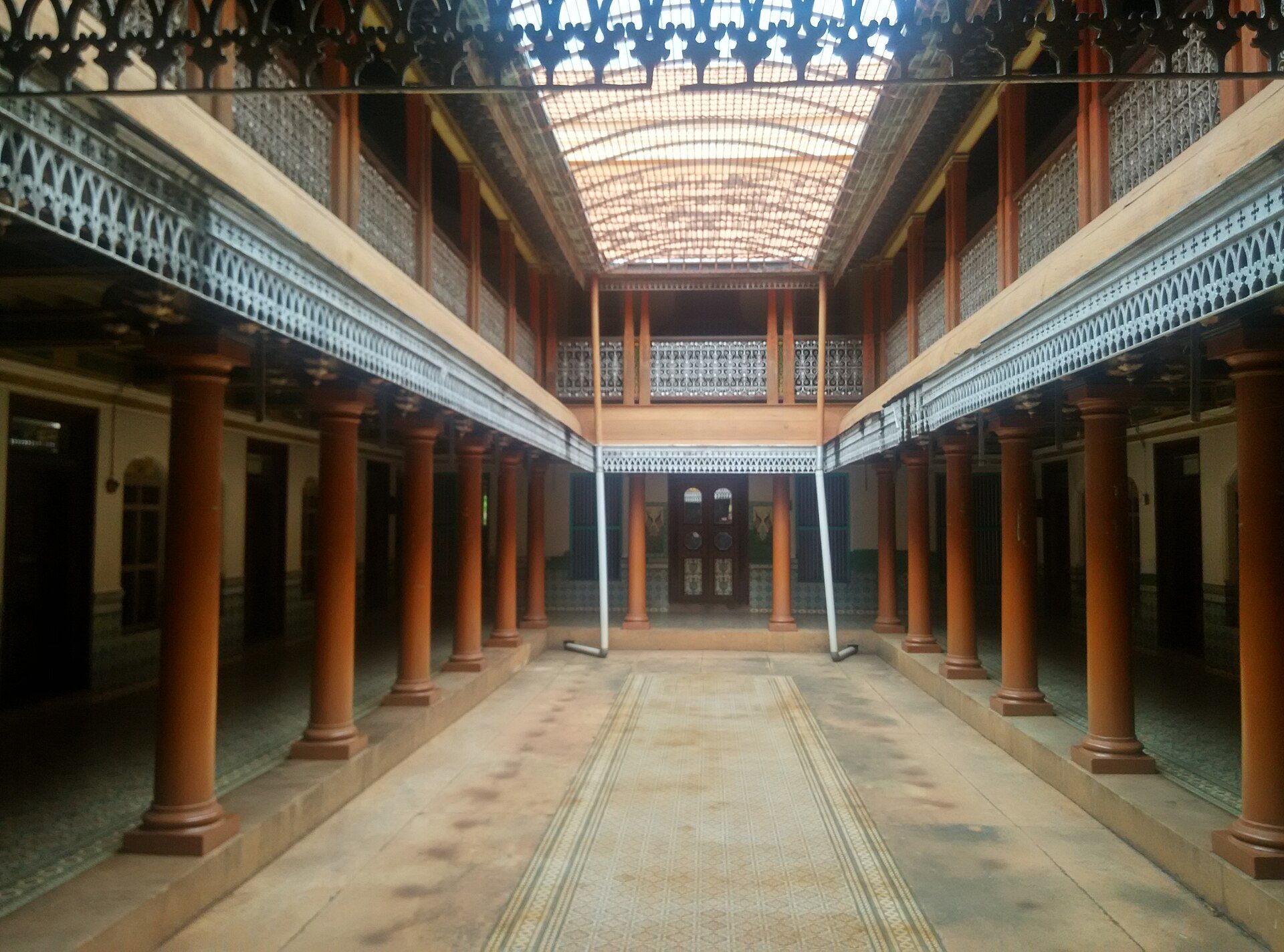
The plan is a sequence, and the sequence is the point. The mugappu, the outer front. The thinnai, the raised platforms flanking the entrance where the business was done. Then the valavu with its muttram, the central courtyard where the rituals happen. The rettaiarai, the paired double rooms ringing it. The pettagasalais at the four corners, where the strongbox sat. And at the deep end the irandamkattu, the women's zone, containing the ukraanam, the pantry, and the adupadi, the kitchen.
A peer-reviewed study of the gendering of that plan makes the obvious observation that nobody says aloud: the house maps a gradient from male and commercial at the street to female and domestic at the back, with the kitchen as its terminal point. The man who had spent three years in Rangoon did his business on the platform by the front door and never went to the far end.
The materials came from everywhere, which is the same point in another form. UNESCO's dossier records teak from Burma, marble from Italy and from Belgium, and tiles from multiple nations, with the Art Deco examples built mostly in the 1930s and 40s. Field survey records Japanese and Venetian wall-cladding tiles in situ. The standard travel formula — Italian marble, Belgian glass — is a simplification of something messier and more interesting.
Now the claim everybody repeats, which we are not going to repeat.
The lustrous lime finish on these walls is universally described as egg-white plaster. Masons working in Chettinad today do make it that way: one surviving practitioner at Karaikudi describes lime and sand left to settle for days, conch and shell powder from the Ramanathapuram and Thoothukudi coasts, then curd from cow's milk mixed into the whites of twenty to twenty-five country eggs for a ten-foot square of wall. Seven skilled artisans are left in the whole region who can do it.
What has never been established is that the historic plaster contained egg at all. The only published laboratory characterisation of mortar from a Kanadukathan house — using X-ray diffraction, X-ray fluorescence, electron microscopy and infrared spectroscopy — found calcite, quartz, calcium oxide and magnesium, and reported no organic additive. Egg white appears in that paper once, in the introduction, as general background on Indian lime mortars.
The technique is real and it is endangered. Its antiquity is undocumented. That is a better paragraph than the folklore and it does not take anything away from the seven men who can still do it.
The salvage trade
This is the part of the story that is happening now, and it is not usually written because it is uncomfortable.
The causal chain is clear and every link is documented. The Burma and Ceylon and Malaya income stops. The capital base that paid for the houses disappears. The houses pass under Hindu partition to ever-larger numbers of co-heirs. Nobody can or will pay for maintenance. And demolition becomes the rational outcome.
One mansion at Nerkuppai, a hundred and fifty years old, has eighty-five family shareholders and is visited weekly by a caretaker from Madurai. An owner in Pudukkottai district put it to a reporter plainly: who has the time or funds to maintain them, so families demolish the mansion, divide the land and the wood.
The best account of what happens next is a field study by the architect Anuradha Patwardhan, built on interviews with demolition contractors, site engineers and homeowners, and on direct observation of the demolition process and the warehouses. Her finding, verbatim: the demolition activity became a structured business, and contractors started salvaging, repairing and selling building parts in a piecemeal manner. And the reason it works: the building construction system of these homes is such that dismantling the entire building into several individual, intact components like door, windows, columns is possible.
The houses were built to come apart. That is what makes them worth more dead than alive.
What comes out: polished granite columns, satinwood and Burma teak, Japanese and Venetian wall-cladding tiles, ceiling tiles, frescoes, murals, brackets, paintings, stained glass, carved doors and windows, timber roofs, balconies taken apart piece by piece, staircases that can be reassembled. At the plain end, structural timber for new furniture.
Where it goes, in the study's own words: these are then sold as separate components to Southeast Asian countries and within India too. Where it waits: warehouses in Karaikudi and Kanadukathan, which the study describes as stocked with copious amounts of building materials and as an indicator of the staggering number of buildings that have already gone under the axe.
And the end of the chain is checkable from a laptop. Chettinad architectural components — a pair of satinwood columns, a monumental coffered door with its stone base — are listed for sale on international dealer platforms. The salvage chain terminates in Western interiors, and anybody can go and look at it.
On how much has gone: the only figure with institutional standing is UNESCO's, and it is twelve years old. The dossier put the original stock at ten to fifteen thousand palatial houses built between the 1850s and the 1940s, with more than ten thousand remaining, and recorded the loss of about nineteen per cent of the buildings. We could not find the survey behind that number, and we would not print the alternatives in circulation — thirty per cent destroyed, twenty demolished a month, a thousand tonnes of teak per house — because none has a basis and the last is arithmetically absurd.
Nobody is protecting any of this
We expected to find a conservation regime and we found an absence, and the absence is the story.
No Chettinad building is a centrally protected Monument of National Importance. The Archaeological Survey's Tirumayam sub-circle, which covers this ground, lists three entries, all at Thirumayam in Pudukkottai: the fort, and two rock-cut temples. Karaikudi, Kanadukathan, Athangudi, Pillaiyarpatti, Pallathur, Kottaiyur and Devakottai do not appear.
Chettinad has been on UNESCO's Tentative List since 15 April 2014, as Chettinad, Village Clusters of the Tamil Merchants, covering eleven villages in three clusters. Eleven years and no nomination dossier has proceeded. It was also placed on the World Monuments Watch in 2008.
Tamil Nadu has a Heritage Commission Act, passed in 2012 and amended in 2024. It is worth reading for what it does not do. The Commission advises; no local authority may act inconsistently with its advice; but it cannot itself prevent a demolition, and the Act codifies no penalty for demolishing a heritage building. We could not verify that the Commission has been constituted and is functioning, or that any Chettinad building has been listed under it.
What exists instead is private. The M.Rm.Rm. Cultural Foundation, which obtained the Geographical Indication for the Chettinad kottan basket in 2013, revived the craft among village women and restored the Verappa Chettiar mansion at Kottaiyur. ArcHe-S and the Revive Chettinad Heritage Campaign, which drove the Tentative List submission. A handful of architects: one has renovated roughly a dozen mansions and observes that maintenance comes at a cost, and redesigning and renovating these houses requires several man hours. And four or five families who turned their own houses into hotels.
A hundred thousand people built ten to fifteen thousand palaces, and the state has protected none of them.
The tiles, and a correction
Athangudi tiles are the thing visitors leave wanting, and the most-repeated fact about them is wrong.
They do not have a Geographical Indication. We checked the registry's own state-wise list and the name does not appear in any status, and no Tamil Nadu entry relates to tiles of any kind. The peer-reviewed study of the craft says so in terms: despite being a culturally indigenous art form, Athangudi tiles have not been designated as a heritage craft, and this craft has not been allocated a GI tag. Its authors recommend applying. A state press report in 2022 reported an intention. Nothing has been registered.
What Tamil Nadu does have, relevant here, is the Chettinad kottan — the palmyra basket, registered in 2010 — and the Kandangi saree, registered in 2013.
How the tiles are made is genuinely remarkable and worth watching. A metal stencil is laid on a transparent glass plate clasped in a cast-iron frame. Coloured mixtures of local iron-rich lateritic sand, white cement, natural oxides and water are poured into the stencil cells, or drawn freehand with sticks three or four millimetres thick. The frame is tilted to even the colour and the stencil lifted. Dry sand and cement is dusted over to fix it, then a mortar layer hand-compacted, then more powder, then compression with an iron plate. The frame comes off, the tile air-dries for a day and is then immersed in water, curing over eight to twelve days. It is sun-dried among husks, and the glass plate detaches by itself, leaving the glazed face.
The glass is the mould and the glaze at once, and it falls away when the tile is ready. There is no kiln.
Forty manufacturing units survive, producing about 0.42 million square metres a year and around €2.8 million of revenue, employing roughly four hundred people. For about eighty households in the village it is the only source of income. Eighty-six per cent of the craftsmen are illiterate and many are near retirement. Fifty-four per cent named shortage of skilled labour as their main problem; manufacturers hesitate to take large orders because they cannot staff them.
On how old the craft is, the published scholarship contradicts itself — a hundred years, the eighteenth century, a hundred and fifty years — so we will not give you a date. Roughly a century to a century and a half, and the sources do not agree.
The food, and what it actually records
We should be honest that this is the weakest-documented part of the subject. There is no primary corpus on Chettinad cooking comparable to UNESCO on the architecture or the banking enquiry on the money. What exists is cookbooks by named practitioners, dated journalism, and one very useful government dataset about the land.
The marker is kalpasi — a lichen, Parmotrema perlatum, sold as black stone flower. Its presence is the most reliable single tell of a Chettinad masala. Alongside it: star anise, fennel, pepper, cinnamon, cloves, bay, cumin, fenugreek, tamarind as the sour axis, and chilli — but the distinguishing feature in every account we trust is aromatic complexity rather than heat.
We will not tell you this is the spiciest food in India. We found nothing supporting it. And the flavour most visitors associate with the name comes from the Chennai restaurant idiom rather than from Chettinad home cooking, which are different things.
The techniques worth naming: wet-grinding on the ammi kal, the stone grinder, so the base is a wet masala rather than a dry powder — a simple curry can carry eighteen spices ground that way — heavy reliance on pepper and fennel, and nose-to-tail use of the animal.
Now the structural point, which is the reason this food belongs in a story about banking.
The community's older tradition is vegetarian. The meat and seafood repertoire is an accretion from the diaspora period. Meenakshi Meyyappan, who runs The Bangala at Karaikudi and has spent a lifetime on this, describes Chettinad food as an intangible map of all the lands the Chettiars have traded with — Malaysia, Singapore, Vietnam — citing chilli-garlic grilled fish and meat gravies that echo the sweet-sour flavours of Singapore.
The cuisine is the one surviving, daily-performed trace of the Burma-Ceylon-Malaya economy. The houses are a monument to it; the kitchen still runs on it.
And then there is the dried food, which the land explains exactly. Sivaganga district gets around 850 to 950 millimetres of rain a year depending on which government source you take, and four hundred and fifteen of those millimetres fall in the northeast monsoon between October and December. Half the year's water arrives in a ten-week window. The district is tank-irrigated rather than river-fed — Anna University counts six hundred and three tanks — and about a third of the sown area is purely rainfed.
A cuisine built on vathal, sun-dried vegetables; on vadagam, dried seasoning cakes; and on karuvadu, salted fish, is the rational food system for one short wet season and nine dry months. It is also, though this is our inference rather than anyone's finding, the rational food system for households whose men were away in Rangoon on three-year contracts.
One detail from the published record that we like more than any amount of description. Madhur Jaffrey's meal at The Bangala: fresh prawns, kingfish slices smeared with spices and pan-fried, okra with tamarind, green beans in coconut milk, a soupy rasam made with fresh crabs, chicken with black pepper — and then, at dinner, a European course, a legacy of the hostess's childhood with an Irish governess. That is a truer picture of a Chettiar table than a banana-leaf feast.
What there is to see, and what to be careful of
Use the UNESCO clusters as the itinerary, because they were chosen by a heritage nomination rather than by a tour operator. Kanadukathan, Pallathur, Kothamangalam and Kottaiyur in the first; Athangudi, Chokalingampudur, Karaikudi and Kandanur in the second; Rayavaram, Arimalam and Kadiapatti-Ramachandrapuram in the third. Most of the first two clusters sit inside a radius of about fifteen kilometres.
The nine clan temples are the structure underneath all of it, and they are more interesting than they look. Rudner lists them: Ilayathakudi, Mattur, Vairavan, Iraniyur, Pillaiyarpatti, Neman, Iluppaikudi, Soraikudi, Velankudi. Marriages were registered at the respective clan temple, which made the nine temples the community's civil registry and its cross-cutting social structure, not merely nine shrines. Lists in general circulation that include Kundrakudi and Kottaiyur Sivan are not the nine.
Pillaiyarpatti is the one most visitors are sent to, and the solid version of its story is this: a rock-cut Ganesha shrine far older than any Chettiar mansion, attributed to the Pandya or Pallava period, one of the nine clan temples, administered by the community's own trust rather than by the state endowments department or the ASI, and not protected as a monument. A seventh-century rock-cut shrine run as a caste trust is a genuinely unusual thing.
A warning about the palace. The Chettinad Palace at Kanadukathan was built for Raja Sir Annamalai Chettiar and completed in 1912, with teak, glass, marble and crystal brought from overseas, a courtyard, a car shed for nine vehicles and a lift. It is still privately held and it is not a museum. The state tourism department describes its interior as though it were open; the BBC found it chained shut. Access depends entirely on who is at the gate. Do not build a day around it.
Three different things are routinely confused here and the confusion is in print everywhere: the Chettinad Palace, which is the Raja's private house; Chettinadu Mansion, which is a separate heritage hotel behind it; and Visalam, which is marketed as a palace and is a hotel.
Getting there, and what the inventory actually is
Trichy and Madurai are both between eighty-five and ninety kilometres from the heart of Chettinad, about two hours by road. Neither is meaningfully nearer; choose on international connections. Karaikudi Junction is the railhead.
The season is October to March, and the climate sharpens that: half the year's rain falls between October and December, so January to March is the dry, cool, reliable window. April to June is punishing.
On hotels we will be plain, because the region will disappoint a guest who has not been told.
There are fewer than a hundred rooms of genuine heritage inventory across the whole of Chettinad, concentrated in four or five properties, with no international brand and no mid-market heritage tier. Visalam at Kanadukathan has fifteen rooms and is the most professionally run. Saratha Vilas at Kothamangalam has ten — a house of 1905 restored by French architects, open since 2010, and the one cited academically as an adaptive-reuse exemplar. The Bangala at Karaikudi is the food destination and was the first heritage hotel in the region. Chidambara Vilas near Thirumayam is a 118-year-old house after a three-year restoration. Chettinadu Mansion at Kanadukathan is large and its upkeep draws comment.
That is the list. There is essentially nothing between those houses and ordinary town hotels in Karaikudi. Book months ahead and do not expect choice.
Two days covers the core. Three allows Athangudi's workshops at working pace, the antique market at Karaikudi — where, with a particular kind of attention, you are looking at the contents of houses that no longer exist — Pillaiyarpatti and Thirumayam. More than four needs the food or the September heritage festival as a reason.
Why we think it is worth the detour
Because there is nowhere else like it, and because it is going.
Everything in this piece is a single system: a hundred thousand people who financed the rice economy of three colonies, built ten thousand palaces out of the proceeds, lost the income in three stages between 1942 and 1965, and have spent the sixty years since deciding what to do with buildings designed to be dismantled.
The food still carries the trade routes. The tiles are still made by hand with a glass plate that falls away. Seven men can still mix the lime. And the salvage warehouses in Karaikudi are full, which is the honest way of saying that a great deal of this has already been sold.
We are not going to end on a plea. But a guest who comes here, stays in one of the four houses that were saved, eats a proper meal, watches a tile made and buys something from a family rather than from a dealer is doing the only thing a visitor can usefully do about any of it.
Questions, Answered
Where is Chettinad and how do I get there?
It is a cultural region rather than an administrative one, spread across Sivaganga and Pudukkottai districts in Tamil Nadu — traditionally 96 villages, 76 in the community's own ritual reckoning, and described by UNESCO's dossier as a network of 73 villages and two towns over 1,550 square kilometres. Trichy and Madurai airports are both about 85 to 90 kilometres away, roughly two hours by road, and neither is meaningfully closer. Karaikudi Junction is the railhead. The season is October to March, with January to March the driest and most reliable.
How many Chettinad mansions are left?
The only figure with institutional standing is UNESCO's, from 2014: an original stock estimated at ten to fifteen thousand palatial houses built between the 1850s and the 1940s, with more than ten thousand remaining and about nineteen per cent lost. We could not find the survey behind that number. We would treat the other figures in circulation — thirty per cent destroyed, twenty demolished a month, sixty thousand mansions — as unsupported; the last is impossible against a community that numbered about a hundred thousand people.
Can you visit the Chettinad Palace at Kanadukathan?
Not reliably. It was built for Raja Sir Annamalai Chettiar and completed in 1912, and it remains privately held by the family — it is not a museum. The state tourism department describes its interior as though it were open; the BBC found it chained shut. Access depends on who is at the gate, so do not build a day around it. Note also that three different places are routinely confused: the Chettinad Palace (private), Chettinadu Mansion (a heritage hotel behind it), and Visalam (a hotel marketed as a palace).
Do Athangudi tiles have a GI tag?
No. We checked the Geographical Indications registry's own state-wise list and the name does not appear in any status; no Tamil Nadu entry relates to tiles at all. The peer-reviewed study of the craft states this explicitly and recommends an application. Tamil Nadu's registrations relevant to Chettinad are the Chettinad kottan basket (2010) and the Kandangi saree (2013).
Is Chettinad food the spiciest in India?
We found nothing supporting that, and the distinguishing feature in every source we trust is aromatic complexity rather than heat. The marker is kalpasi, a lichen sold as black stone flower, alongside star anise, fennel and pepper, wet-ground on a stone rather than used as a dry powder. Note too that the Chettinad flavour most visitors know comes from the Chennai restaurant idiom, which is not the same as Chettinad home cooking. The community's older tradition is vegetarian; the meat and seafood repertoire came home from Burma, Ceylon and Malaya.
Where should I stay in Chettinad?
There are fewer than a hundred rooms of genuine heritage inventory in the whole region, in four or five properties, with no international brand and nothing in the middle. Visalam at Kanadukathan (fifteen rooms) is the most professionally run; Saratha Vilas at Kothamangalam (ten rooms, a house of 1905 restored by French architects) is the most architecturally serious; The Bangala at Karaikudi is the food destination and the region's first heritage hotel; Chidambara Vilas near Thirumayam is a 118-year-old house restored over three years. Book months ahead.