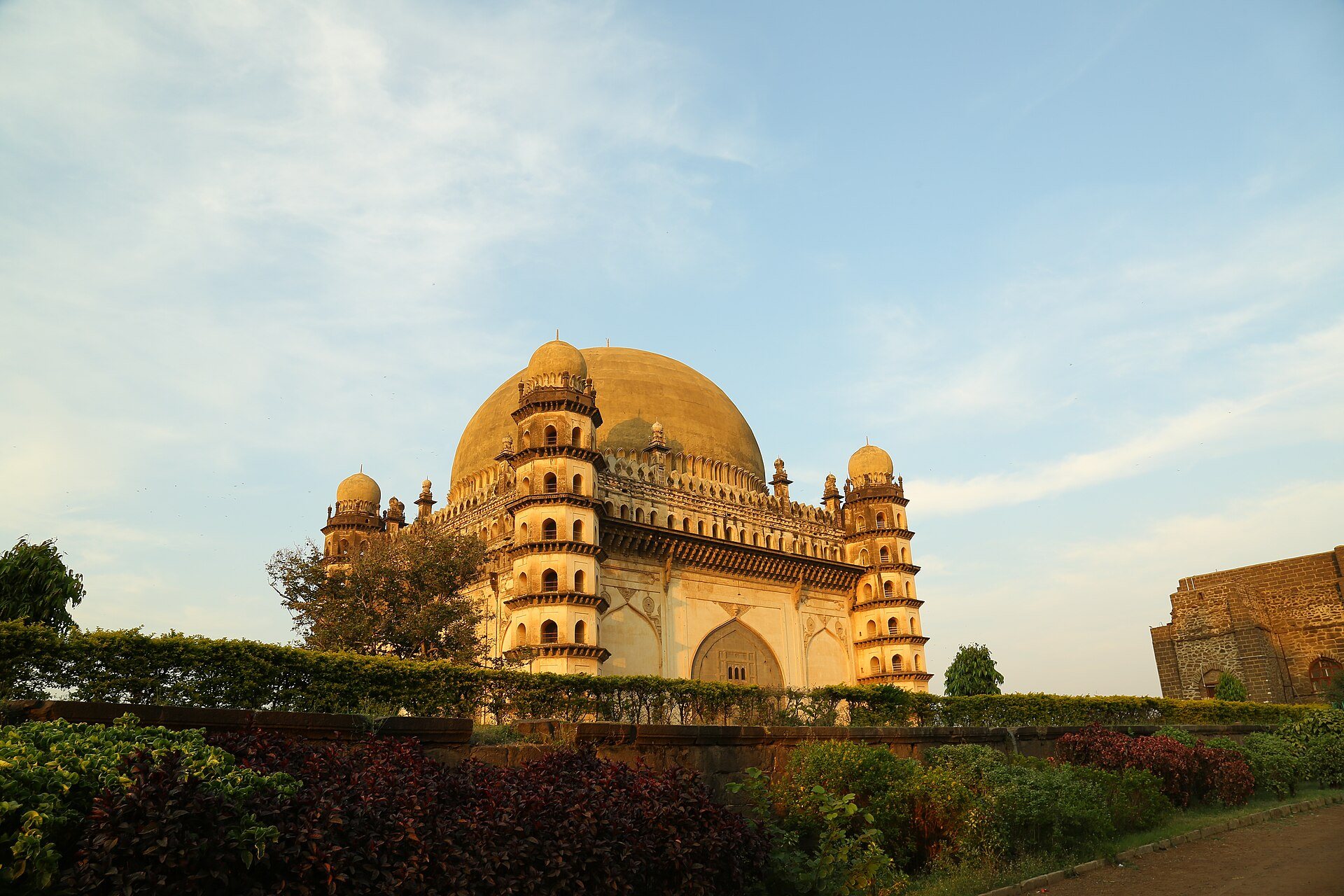
Most visitors to India never go to the Deccan plateau, and the ones who do go to Hyderabad and stop. What lies west and north-west of it — Bidar, Gulbarga, Bijapur — is one of the great architectural landscapes in Asia and almost nobody is in it.
We will be honest at the outset about why, because the reason is real and we are not going to pretend otherwise. There is essentially no good hotel in any of these towns. We will come back to that.
But the story is extraordinary, and the version in circulation is wrong in several specific and checkable ways. So here is the Deccan as the documents actually describe it, starting with the thing that is missing from every account most readers will have encountered.
The Africans who ran the Deccan
Malik Ambar was born Chapu, in Ethiopia, around 1548. He was sold as a slave in Baghdad. He converted to Islam, was bought by a chief minister, was freed, and rose into the nobility of the sultanate of Ahmadnagar.
By the early seventeenth century he was its de facto king. He built an army out of African former slaves. His daughter married Sultan Murtaza Nizam Shah II. He was a serious patron of the arts. And in 1610, the year he took Ahmadnagar fort back from the Mughals, he founded a city called Khadki — which at its height had palaces, fountains and avenues across fifty-four quarters and a population of two hundred thousand, and which is now called Aurangabad.
He also built it a water system: canals called nahars drawing from streams and lakes in the surrounding country through elevated and underground channels. One of them, the Nahar-e-Ambari, still partly works, bringing water from Harsul Lake four hundred years later.
At Bijapur the same thing happened to a man called Malik Raihan, who grew up alongside the sultan's son, was promoted when that son acceded in 1627, became commander of troops and an important adviser, was made governor of a province, received the title Ikhlas Khan in 1635, and died in 1656.
These are not footnotes. They are documented by name, with dates, by the Metropolitan Museum, and the court painters of the Deccan painted them as what they were. The Portrait of Malik Ambar from the early seventeenth century is in the Museum of Fine Arts in Boston. Ikhlas Khan with a Petition, from around 1650, is in the San Diego Museum of Art. And Sultan Muhammad Adil Shah and Ikhlas Khan Riding an Elephant, from about 1645, is in the Ashmolean in Oxford — the sultan and his African minister on the same elephant.
The Met's own framing of Deccani art names eastern Africa alongside Iran, Turkey and Europe among the formative foreign influences on the region.
A well-read traveller knows the Deccan as a Persianate world, which it also was. The African dimension — enslaved Ethiopians who became regents, generals, provincial governors and royal in-laws, and were painted as such — is simply not in the standard picture, and it ought to be.
What the sultanates actually were
The frame, briefly, because the dates in circulation are mostly wrong.
The Bahmani sultanate was founded in 1347 by Ala-al-Din Hasan Bahman Shah, with its capital at Gulbarga, where eight sultans ruled. In 1424 — not 1422, which is the accession year, and not 1430, which is when the fort was rebuilt — Ahmad Shah Wali moved the capital to Bidar and renamed it Muhammadabad. At its height the sultanate ran from the Arabian Sea to the Bay of Bengal and from Berar and the Vindhyas to the Tungabhadra.
It ended in 1528, breaking into five successor sultanates: the Adil Shahis at Bijapur, the Qutb Shahis at Golconda, the Nizam Shahis at Ahmadnagar, the Imad Shahis in Berar and the Barid Shahis at Bidar.
Here is the thing travel writing nearly always gets wrong. Only three of those five fell to the Mughals — Ahmadnagar in 1636, Bijapur in 1686, Golconda in 1687. Berar was absorbed by Ahmadnagar in 1574 and Bidar by Bijapur in 1619. They ate each other first.
The man who made the Bahmani state work was Mahmud Gawan, a Persian who served as vizier, expanded the kingdom, reformed its administration, and built in 1472 a madrasa at Bidar — sixty-eight metres by sixty, two storeys around a quadrangle, with lecture rooms, a prayer hall, a library and living quarters, faced in green and azure majolica with a gold Quranic band on green and blue.
He was executed in April 1481 by the sultan he served.
Then Aurangzeb took the madrasa as a barrack in 1656 and gunpowder was stored in the rooms near the south-east minaret. It exploded, destroying about a quarter of the tower and the entrance. Patches of the Persian tilework survive. We should say that the year 1696, which circulates widely for that explosion, is not supported by either source we could reach, so we are not printing a date for it.
Talikota, which is not the story people tell
On 23 January 1565, four of the sultanates — Bijapur, Bidar, Ahmadnagar and Golconda — met the Vijayanagara army at Talikota. Rama Raya, who commanded for Vijayanagara, was captured and executed.
Two corrections, and the second matters.
Four sultanates, not five. Berar still existed in 1565 but did not join; it was swallowed by Ahmadnagar nine years later.
And the empire did not end. The city of Vijayanagara was captured, destroyed over a period of five months and never reoccupied — that part is true and it is why Hampi looks the way it does. But the dynasty withdrew to Penukonda and continued, and Tirumala usurped the throne there in 1570. Travel writing gets this wrong in both directions: either the empire ended at Talikota, which is false, or Hampi declined gently, which is also false.
Nor was it a religious war. These states had been fighting with and against each other in shifting coalitions for decades. Richard Eaton's work traces the causation back forty-five years to the battle for Raichur in 1520, and to the humiliating terms Krishna Raya imposed on the defeated Bijapuri sultan.
That earlier battle is worth knowing about in its own right, because it is a documented first. Raichur in 1520 saw the earliest significant appearance of cannon as field artillery in South Asia, the earliest known matchlock firearms, and the first major engagement of European mercenaries — the technology having arrived because Turkish gunners and gunsmiths displaced by Portuguese naval victories after 1508 settled in Bijapuri territory.
And the side with the better guns lost.
Bijapur, and the dome claim
Bijapur — officially Vijayapura since 2014, which matters when booking, and we will come to that — has an ensemble of eighty monuments and one building everybody has heard of.
Gol Gumbaz is the mausoleum of Muhammad Adil Shah II, built in 1657 by Yaqut, a master builder of Dabul. Its dome is 37.9 metres in diameter. The Archaeological Survey's own text at the site says it is the second largest in the world, comparing it with St Peter's in Rome at 42.4 metres and St Paul's in London at 32.9.
That comparison omits Florence. The official figure from the cathedral authority for Brunelleschi's dome, finished in 1436, is an interior diameter of 45.5 metres. So by internal diameter it goes Florence, then St Peter's, then Gol Gumbaz — and the Pantheon, conventionally given at 43.3, would put Gol Gumbaz fourth, though we could not verify that one at an institutional source.
The claim is a Victorian comparison that nobody has corrected, and it is on a government sign in front of the building.
The interesting part is that ASI's second claim is true and is the better one. Gol Gumbaz encloses about 1,682 square metres, which implies a chamber roughly forty-one metres square, and that is the largest floor area ever covered by a single pre-modern masonry dome. The reason is geometrical and rather elegant: a round dome on pendentives over a square room covers more floor than a round dome over a round room. St Peter's 42.4-metre dome covers about 1,412 square metres.
So the honest formulation is: roughly the fourth-largest pre-modern dome by diameter, and the largest floor area ever enclosed by one. That is a more interesting sentence than the folklore and it has the advantage of being true.
On the whispering gallery we will be careful too. ASI says a ten-fold echo can be obtained. One journal paper gives ten to twelve and a reverberation time of twenty-six seconds, which we would treat sceptically — cathedral naves run six to twelve — and which we could not corroborate. Every other figure in circulation, the whisper that carries thirty-seven metres, the exact seven echoes, the page turning across the dome, comes from guides rather than from measurement. The effect is real and audible. It has never, as far as we can establish, been measured.
The building most architectural writing should be pointing at is the other one. Ibrahim Rauza, built in 1626 by Ibrahim Adil Shah II, holds the tombs of the king, his wife Taj Sultan and his family in a rectangular enclosure of about 138 metres square. ASI calls it one of the finest examples of Islamic ornamental decoration in India — note the different register from the language it uses about Gol Gumbaz, which is all about size. It has a hanging stone ceiling with no apparent means of support, and chains carved from single blocks of stone.
It is also thirty-one years earlier than Gol Gumbaz and considerably finer. We will not tell you that architectural historians agree about this, because we could not source a consensus; we will tell you that ASI's own language rates the two differently and that we think the earlier one is the better building.
You will be shown the Malik-e-Maidan cannon, fourteen feet long and fifty-five tons, with a lion devouring an elephant carved at the muzzle. The usual account — cast at Ahmadnagar in 1549 and taken to Bijapur as war booty — we could not verify, so take the object and leave the provenance.
And Gagan Mahal, built in 1561 by Ali Adil Shah as royal residence and council chamber, should be described for what it is. ASI's own words: the wooden ceiling of the great hall was supported by heavy beams, none of which now exists. It is a magnificent façade and a shell.
The water, which is the real Bijapur story
The thing almost nobody writes about Bijapur is how it was supplied, and it is remarkable.
Water came from two directions: Torvi to the west, and the Begum Talab to the south — a reservoir of 234 acres built in 1651 by Muhammad Adil Shah in memory of his wife, four and a half kilometres from Gol Gumbaz.
The step-wells are extraordinary objects in their own right. Taj Bavadi, built in 1620 by Ibrahim Adil Shah, is 120 feet long by 100 wide by 53 deep. Chand Bavadi, built in 1549 by Ali Adil Shah in memory of Queen Chand Bibi, measures 144 feet east to west by 156 north to south. Masa Bavadi fed the Gol Gumbaz complex; Mantapa Bavadi fed Ibrahim Rauza, which sits in a trough and had no other source.
The distribution is the clever part. From Torvi, a great subterranean tunnel ran from Surang Bavadi past the Moti Dargah to Ibrahim Rauza. From the Begum Talab, terracotta pipes in short lengths were embedded in concrete and run across the city — and at intervals along them, water towers called gunj were built, twenty-five to forty feet high, for pressure relief and filtration.
The Gol Gumbaz complex alone has a 185-metre feeder channel and twenty-eight documented hydraulic features: tanks, fountains, tank-cum-lifts, tank-cum-distributors.
A seventeenth-century city with a pressurised piped water network, filtration towers at intervals, and a tunnel under it. Look up as you walk around Bijapur; some of those towers are still standing, though we could not find a published count of how many.
Bidar, and the qanat that was not restored
Bidar fort was rebuilt as the Bahmani capital in 1430 on a site going back to the Western Chalukyas — a quadrangular layout inside three miles of walls and a triple moat, with thirty-seven octagonal bastions. The Rangin Mahal, the Gagan Mahal, the Tarkash Mahal, the Solah Khamba Masjid and the Jami Masjid survive; the audience halls are ruins.
Eight kilometres east, at Ashtur, are twelve Bahmani mausoleums, and they contain the most under-photographed thing in the region. The state's own description records painted ceilings and floral designs in the queen's tomb, and tilework with blue, green and yellow paintwork in Sultan Allauddin Shah II's. Sultan Humayun's tomb, in black trap masonry, has been split open by a lightning strike.
And then the karez, which is the thing we most wanted to tell you about and which requires a correction.
Under Bidar runs a qanat — a subterranean water channel of the Persian type, introduced by immigrants from Iran in the fifteenth century and adapted by local engineers to the Deccan's geology. The Naubad karez is 3.28 kilometres long including its branch, bypass and distribution channels, with two mother wells, built in the Bahmani period.
It is routinely described as restored. It has not been. The one scholarly survey of the Deccan's karez systems records that an attempt to rejuvenate it was initiated in 2015 by the government of Karnataka and was abandoned midway. The system still carries water, choked with debris. Work since has been by non-governmental bodies, on keeping solid and liquid waste out of it rather than on rehabilitation.
The same survey calls it the one and only karez system that can be completely revived in India, which is a better and truer thing to say than restored.
Two other corrections. Bidar's is not India's only one — Aurangabad has fourteen nahar systems averaging five to six kilometres, and Burhanpur and Bijapur have their own. And the shaft counts in circulation, seventeen or twenty-one or dozens, are not in any source we could reach. Nor is there any institutional documentation of how a visitor sees it, so anybody planning to should establish that before travelling rather than after.
Bidriware, and the black that is not black
Bidar's craft is bidri: a high-zinc alloy inlaid with silver, blackened so that the silver reads against it. It holds a Geographical Indication — application number 20, filed on 24 January 2005, registered, in Karnataka. There is no GI registered under the name Bidar, Bijapur or Vijayapura for anything else.
The technique as usually described is not what the analysis shows, and the real version is better.
A conservation scientist at the British Museum published the chemistry in 2015. The alloy is high zinc with between two and ten per cent copper, mostly two to five — so the sixteen-to-one ratio you will be told is a workshop rule of thumb, not a measurement. Lead and tin appear inconsistently and are accidental impurities. The inlay is silver and brass; gold appears in historical references and is not analytically confirmed.
The blackening uses soil taken from beneath the fort walls, boiled with ammonium chloride, and the soil is the famous part — artisans will tell you it is unique to Bidar and has special oxidising properties.
It is unique to Bidar for an entirely different reason. Its significance derives from salt saturation, because the fort walls are commonly used as a latrine. The paper treats the mystique as mythologised and gives a chemical substitute that does the same job: potassium nitrate, ammonium chloride and sodium chloride in hot water, in a one to four to one ratio.
And the patina itself, by X-ray diffraction, has three crystalline components — simonkolleite, zincite and cuprite. None of them is black. The blackness appears to come from the particles' small size and needle-like form absorbing light.
One more thing from the same paper, which is the real surprise: no documentation of bidri ware has been found before the mid-seventeenth century, against a tradition that places its origin in the fifteenth-century Bahmani court. The craft may be two hundred years younger than every brochure says.
On how many artisans remain, we have one figure and it is one artisan's estimate: a hundred and fifty to a hundred and sixty, given to a reporter in March 2021, by a man who had lost ninety per cent of his business to the pandemic and whose trade depended largely on foreign sales. There is no census we could verify.
Golconda, and where the diamonds actually came from
Golconda Fort has fortifications and water systems spanning over seven kilometres, eight gateways, and a history going back to 1143, though it is the Qutb Shahi capital from 1518 to 1687 that everybody means.
The clap at the Fateh Darwaza is the thing every visitor is shown. The Ministry of Tourism's own wording is that the echoes reverberate to a pavilion on a hill almost a kilometre away. We could find no acoustic measurement of it anywhere, and the elaborations — that it was a designed military alarm, that it reached the sultan's chamber, that the acoustics were deliberately engineered — are not documented at all. The phenomenon is real and demonstrated daily. It has never been measured.
Now the diamonds, where the correction is clean and geographical.
There were no diamond mines at Golconda. The Kollur mine is on the south bank of the Krishna, a kilometre and a half from Kollur village in Andhra Pradesh, at 16°43' north, 80°02' east. Golconda Fort is at 17°23' north, 78°24' east. That is about a hundred and ninety kilometres apart in a straight line and considerably more by road.
Golconda was the fortified capital, the market, the cutting centre and the clearing house of a trade whose mines lay in the Krishna valley to the east. The name attached itself to the stones the way Antwerp attaches itself to diamonds now: it names where they were sold, not where they came out of the ground.
On the stones themselves we are going to be more cautious than most writing is. The Smithsonian says the Hope Diamond is believed to have come from the Kollur mine — note the hedge, from the institution that owns it. Tavernier's stone weighed 112 and three sixteenths carats and he sold it to Louis XIV in 1668; it was recut to 67 and an eighth carats in 1673, reset in 1749, stolen from the French royal treasury in 1792, and now weighs 45.52 carats. The Smithsonian's position on the link to the stolen French Blue is that strong evidence indicates the stone was the recut French Blue.
The Koh-i-Noor's origin at Kollur, which is stated everywhere, we could not verify from any primary institutional source. The same goes for most of the famous list — the Regent, the Orlov, the Darya-i-Noor, the Dresden Green. These are attributions rather than records, and the Hope is the one with an institutional statement attached, hedged at that.
And Golconda as a gemmological grade, used in the trade for exceptionally transparent type IIa stones, has no definition from any authoritative gemmological body that we could find. It is a marketing term, not a provenance.
The necropolis, and the conservation project nobody writes about
A kilometre north-west of the fort is the Qutb Shahi necropolis, and what has happened to it over the last decade is one of the largest conservation projects in India and is almost unwritten.
UNESCO's tentative list entry from 2010 describes thirty tombs including those of five sultans. That figure is now superseded, and by a considerable margin.
The Aga Khan Trust for Culture signed a memorandum with the state in January 2013 for a ten-year programme across 106 acres. Its survey found forty mausoleums, twenty-three funerary mosques, six step-wells and a mortuary bath, alongside pavilions and garden structures. It produced over two thousand drawings and a high-definition three-dimensional laser scan, and projected over three hundred thousand man-days of work for master craftsmen in stone, lime and glazed ceramic tile.
It was inaugurated as complete on 28 July 2024. The trust's chief executive put the final tally at over a hundred monuments conserved against forty to forty-five planned, plus many of 169 open graves. Six of the seven Qutb Shahi sultans are buried there; the seventh, the last, died in Mughal captivity.
Funding came from the Tata Trusts, the United States Ambassadors Fund for Cultural Preservation, the InterGlobe Foundation and the German consulate at Chennai. No amounts are published anywhere, so we are not going to guess at a figure.
The park is open daily from half past nine to six.
A note on its status, because it will be described to you wrongly. Neither Golconda nor the necropolis is a World Heritage Site. They appear on India's tentative list twice — once in a 2010 entry for the Qutb Shahi monuments, and again in a 2014 serial nomination covering Gulbarga, Bidar, Bijapur and Hyderabad. India has effectively tabled the same monuments in two different nominations, sixteen and twelve years ago, and neither has advanced.
Gulbarga, and the mosque with no courtyard
The best-verified single claim in this whole subject belongs to Gulbarga, and it is the strongest reason to stop there.
The Jama Masjid inside the fort was built in 1367 for Muhammad I by a named Persian architect, Rafi ibn Shams ibn Mansur of Qazvin. It measures about sixty-six metres by fifty-four. And where the open courtyard of a mosque should be, there are sixty-three small domes.
The Encyclopaedia Iranica states flatly that it is unique among Indian mosques in being entirely covered, and notes that its style has reminded some observers more of Andalusia or the Maghreb than of Persia.
A roofed Friday mosque is a contradiction in terms almost everywhere in the Islamic world. There is one in Karnataka, built in 1367, and essentially nobody goes.
East of the fort are seven more tombs, the Haft Gumbad, including the twin-domed mausoleum of Firuz Shah. And Gulbarga is not a ruin-field: the Khwaja Bande Nawaz dargah is a major living pilgrimage centre and the city functions around it.
What was made here, and where it went
Deccani painting is the under-told half of this story, and the honest version of where to see it is disappointing in a way worth stating.
The Metropolitan Museum's 2015 exhibition brought together some two hundred works and remains the authority. Its curator's distinction is the useful one: Mughal art is generally committed to naturalism, while Deccani art is more imaginative — a freedom of imagination and expression that deviates from reality into a sense of fantasy. And crucially these were not naïve painters; they came from a formal tradition of Indo-Persian technical training, achieving absolute technical mastery while exploring otherworldliness.
The example to look up is Emaciated Horse and Rider, from Bijapur around 1625, which uses water marbling for abstract effect — set beside a Mughal equestrian portrait of Shah Jahan from five years later, the difference is the whole argument.
Bijapur under Ibrahim Adil Shah II, with his court painter Farrukh Husain, is where the refined and lyrical style that influenced much of Deccani art was made.
And almost none of it is in the Deccan. The great Deccani paintings are in Boston, San Diego, Oxford, New York and London. The Archaeological Survey's museum at Bijapur — established in 1892, a district museum from 1912, taken over by ASI in 1962, open nine to five, closed Fridays, five rupees — holds inscriptions, sculpture, manuscripts, coins, Chinese wares, carpets, bidri ware, illuminated Qurans, arms. For the paintings it holds photo enlargements of excellent specimens of Adil Shahi miniatures. Reproductions.
That is the real melancholy of this region. You stand in the buildings that produced the paintings and look at photographs of them.
One more thing the Deccan made, and the claim needs narrowing. Urdu's literary career began here, and that is remarkable — but it began in early fifteenth-century Gujarat and the Deccan together, not in the Deccan alone. The earliest known Deccan work is Fakhr-i Din Nizami's Kadam Rao Padam Rao, internally dated between 1421 and 1434, over four thousand lines in a regular Persian metre. Muhammad Quli Qutb Shah, who ruled Golconda from 1580 to 1611, wrote poetry marked by a lively interest in local customs and festivals. Mulla Nusrati of Bijapur introduced the critical distinction between meaning and theme.
And the north came later. There was very little Urdu literature in Delhi before Wali, and literary activity there accelerated only after 1720, when Wali's collected works arrived in Shahjahanabad. The Deccan's own moment was over by the mid-eighteenth century.
So: Urdu's literary life began in the Deccan and Gujarat two centuries before Delhi's, and Delhi became its centre only after a Deccani poet's book reached it. Not that Urdu was born in Hyderabad, which is the version you will hear.
Going, honestly
Now the part where we tell you what this trip actually is, because the gap between the material and the infrastructure is the largest of any destination we write about.
There is no luxury hotel and no genuine heritage hotel at Bijapur, Bidar, Gulbarga or Raichur. We looked. The state tourism corporation has one property at Bijapur and nothing at all at Bidar or Gulbarga. Private inventory at Bijapur is business hotels at twenty to thirty dollars a night. There is no Taj, no Oberoi, no restored palace, no converted haveli that we could verify at any of the four.
So the Deccan sultanate circuit is, today, a journey you make from bases at either end. Hyderabad at one end, where the hotels are serious and the Qutb Shahi park and Golconda are, and Hampi or Bengaluru at the other. Bidar and Gulbarga are each a hundred and forty kilometres from Hyderabad airport on the state's own figures; Bijapur is 530 kilometres from Bengaluru.
The geometry means it runs as a line, not a loop: Hyderabad, Bidar, Gulbarga, Bijapur, then Hampi and out through Bengaluru, or the reverse. Nights in the middle will be in clean, modest, unremarkable hotels, and a guest should be told that before they book rather than discovering it at a reception desk.
On flights, a specific warning. Bidar and Kalaburagi have Bengaluru links that exist because the state is paying for them — twenty-eight and a half crore rupees of viability gap funding, announced in May 2026. Bidar had no flights at all from December 2023 to June 2026, when the previous subsidy lapsed. Never build an itinerary on these routes without reconfirming at the point of booking, and always have a road or rail fallback. Rail here is the resilient option rather than the budget one.
Vijayapura's own airport we could not verify as operational; the state's own tourism page sends visitors to Belagavi or Hubballi.
Season is November to February, which is where all four official recommendations intersect. The plateau is semi-arid, in the rain shadow of the Western Ghats, and the summers are punishing.
And one entirely practical trap that will cost somebody a booking. Search for hotels in Bijapur and the aggregators will show you Bijapur in Pali district, Rajasthan — a different place thirteen hundred kilometres away. The city was renamed Vijayapura in 2014 and a decade of split search results has followed. Book as Vijayapura, Vijayapura District, Karnataka.
Who this is for
Not a first trip to India, and not a guest for whom the hotel is part of the point. We would be doing nobody a favour by pretending otherwise.
It is for the traveller on their fourth or fifth visit who has done the obvious things properly and wants something that almost nobody has seen — and who will accept four nights of ordinary rooms in exchange for standing alone inside a mosque with sixty-three domes and no courtyard, under the largest floor area any pre-modern dome has ever covered, and in a necropolis that a decade of craftsmen have just finished putting back together.
And it is a region that is going to change. The conservation at the Qutb Shahi park finished in 2024. The serial nomination has been sitting on the tentative list since 2014. When Bidar and Bijapur eventually get the inscription they are plainly owed, the hotels will follow and the emptiness will go.
Of all the places we write about, this is the one where going early is not a figure of speech.
Questions, Answered
Is Gol Gumbaz really the second-largest dome in the world?
No, and the Archaeological Survey's own signage at the site says it is. ASI compares it only with St Peter's (42.4 m) and St Paul's (32.9 m), omitting Florence, whose official interior diameter is 45.5 m against Gol Gumbaz's 37.9. By diameter it is roughly fourth among pre-modern masonry domes. ASI's other claim does stand: at about 1,682 square metres it encloses the largest floor area of any single pre-modern dome, because a round dome on pendentives over a square chamber covers more floor than a round dome over a round room.
Were the Golconda diamonds mined at Golconda?
No. The Kollur mine is on the Krishna in Andhra Pradesh at 16°43'N 80°02'E; Golconda Fort is at 17°23'N 78°24'E — about 190 kilometres apart. Golconda was the fortress, market and cutting centre of a trade whose mines lay in the Krishna valley, the way Antwerp names where diamonds are traded rather than mined. The Smithsonian says the Hope is 'believed to have come from' Kollur; the Koh-i-Noor's Kollur origin is not documented by any primary institutional source we could find, and 'Golconda' as a gemmological grade has no definition from any authoritative body.
Has the Bidar karez been restored?
No. The one scholarly survey of the Deccan's karez systems records that a revival attempt was initiated by the government of Karnataka in 2015 and abandoned midway. The 3.28-kilometre system, with two mother wells, still carries water but is choked with debris; work since has been non-governmental and focused on keeping waste out of it. The same survey calls it the only karez in India that could be completely revived — a better claim than 'restored'. Visitor access is not documented by any official source, so confirm it before travelling.
Where should I stay in Bijapur, Bidar or Gulbarga?
There is no luxury or genuine heritage hotel at any of them, and we would rather say so. The state tourism corporation has one property at Bijapur and nothing at Bidar or Gulbarga; private inventory is modest business hotels. The circuit works as a line between proper bases — Hyderabad at one end, Hampi or Bengaluru at the other — with ordinary rooms in the middle. One practical warning: booking sites resolve 'Bijapur' to Bijapur in Pali district, Rajasthan. Search for Vijayapura, Karnataka.
When is the best time to visit the Deccan plateau?
November to February, which is where every official recommendation for Bidar, Gulbarga, Raichur and Bijapur intersects. The plateau interior is semi-arid and sits in the rain shadow of the Western Ghats, and summers from March to June are extremely hot. October and March are workable shoulders.
Did all five Deccan sultanates fall to the Mughals?
No — only three. Ahmadnagar fell in 1636, Bijapur in 1686 and Golconda in 1687. Berar was absorbed by Ahmadnagar in 1574 and Bidar by Bijapur in 1619. They ate each other before the Mughals arrived, and this is the most common error in travel writing about the region.