It is difficult now to appreciate how audacious the decision was. In 1947 Partition placed Lahore, the capital of undivided Punjab, inside Pakistan. India's Punjab was left without an administrative centre, and the new republic — three years old, short of money, food and almost everything else — decided not to adapt an existing town but to build a capital from nothing, and to hire the most uncompromising architect in Europe to do it.
Nehru's brief was explicit: the new city was to be unfettered by the traditions of the past, an expression of the nation's faith in the future. Whatever one thinks of the result, nobody can accuse it of timidity.
What actually got built
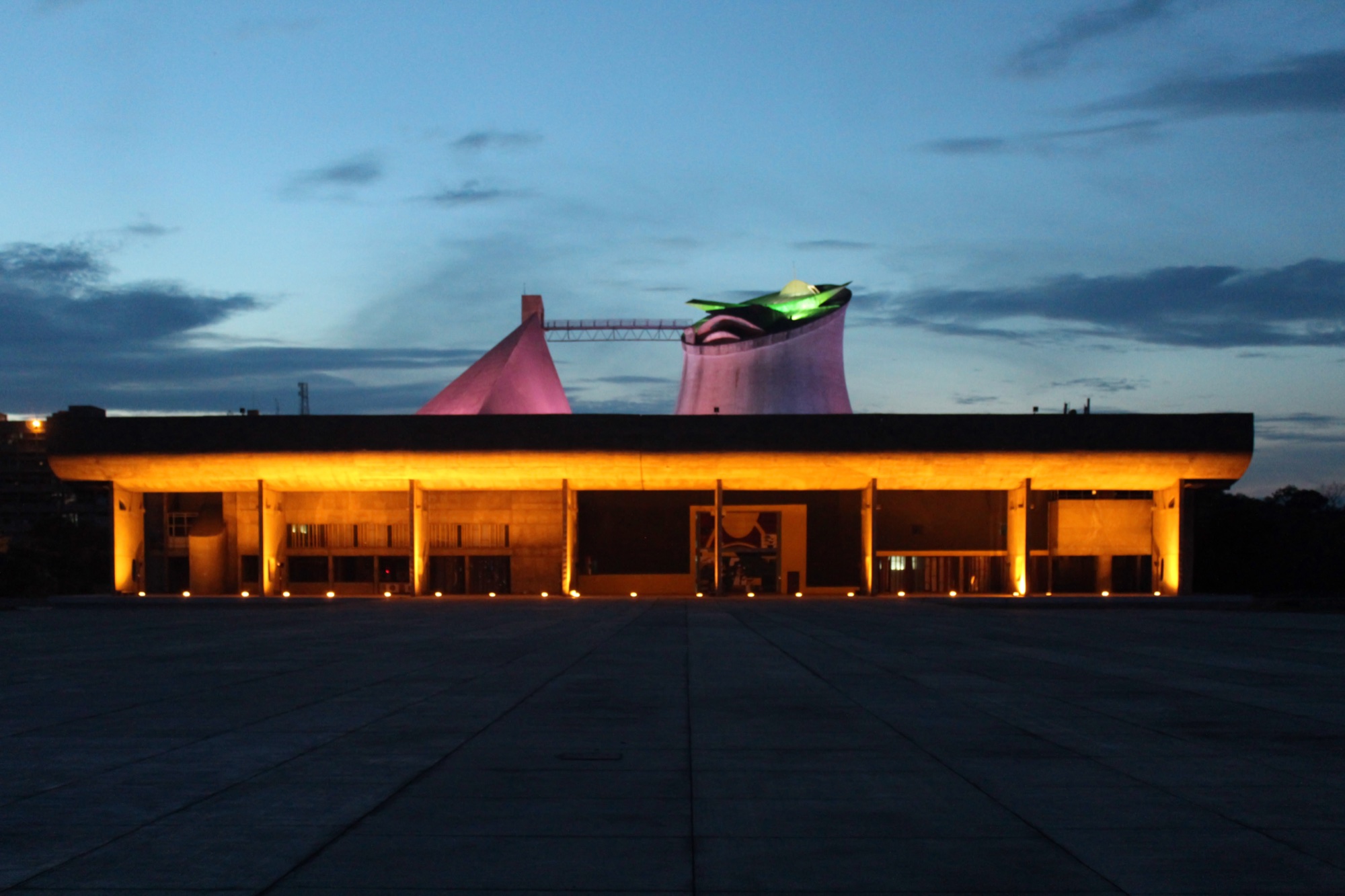
Le Corbusier came to the project after the original planner, Albert Mayer, left, and he worked with Pierre Jeanneret, Jane Drew and Maxwell Fry. The plan divides the city into numbered sectors, each intended to be largely self-sufficient, arranged on a grid and served by a deliberate hierarchy of roads. The government buildings — the Secretariat, the Assembly, the High Court — stand together on open ground against the Shivalik hills.
The concrete is raw and the scale is enormous. Some visitors find it magnificent; others find it inhuman. Both reactions are reasonable, and the argument is more interesting than a consensus would be.
The reply nobody commissioned
The most loved place in Chandigarh was built in secret and against the law. Nek Chand, a roads inspector, spent years quietly assembling a sculpture garden in a forest belt on government land, using construction rubble, broken bangles, discarded tiles and industrial waste — thousands of figures, courtyards and waterfalls, entirely unplanned.
When the authorities discovered it in the 1970s they could have demolished it. They chose instead to protect it and to put Nek Chand on the payroll. That a folk kingdom made of the master plan's own debris now sits inside the master plan, drawing more visitors than the Capitol, is the most eloquent commentary anyone has offered on the whole project.
How to see it
The Capitol Complex needs to be arranged in advance — it remains a working seat of government, identification is required, and access is guided. Guests who turn up hoping to wander are turned away. The Rock Garden is straightforward and best early, before it fills.
One night is enough. It sits usefully on the road north, between Delhi and Amritsar or on the way up into the Himalayan foothills, and works best inside a wider journey rather than as a destination on its own. October to March is comfortable; the Punjab plains in May and June are severe.
Questions, Answered
Why was Chandigarh built?
Partition in 1947 placed Lahore, the capital of undivided Punjab, in Pakistan. Indian Punjab needed a new capital, and the decision was taken to build one from scratch rather than adapt an existing city.
Who designed Chandigarh?
Le Corbusier, working with Pierre Jeanneret, Jane Drew and Maxwell Fry, after the original planner Albert Mayer left the project. Le Corbusier was responsible for the master plan and the principal government buildings.
Can you visit the Capitol Complex?
Yes, but only on an arranged guided visit with identification, since it is still a working seat of government. It should be booked in advance.
What is the Rock Garden?
A sculpture garden built in secret over many years by Nek Chand, a government roads inspector, from construction waste and discarded materials. Discovered in the 1970s, it was preserved rather than demolished and is now Chandigarh's most visited attraction.