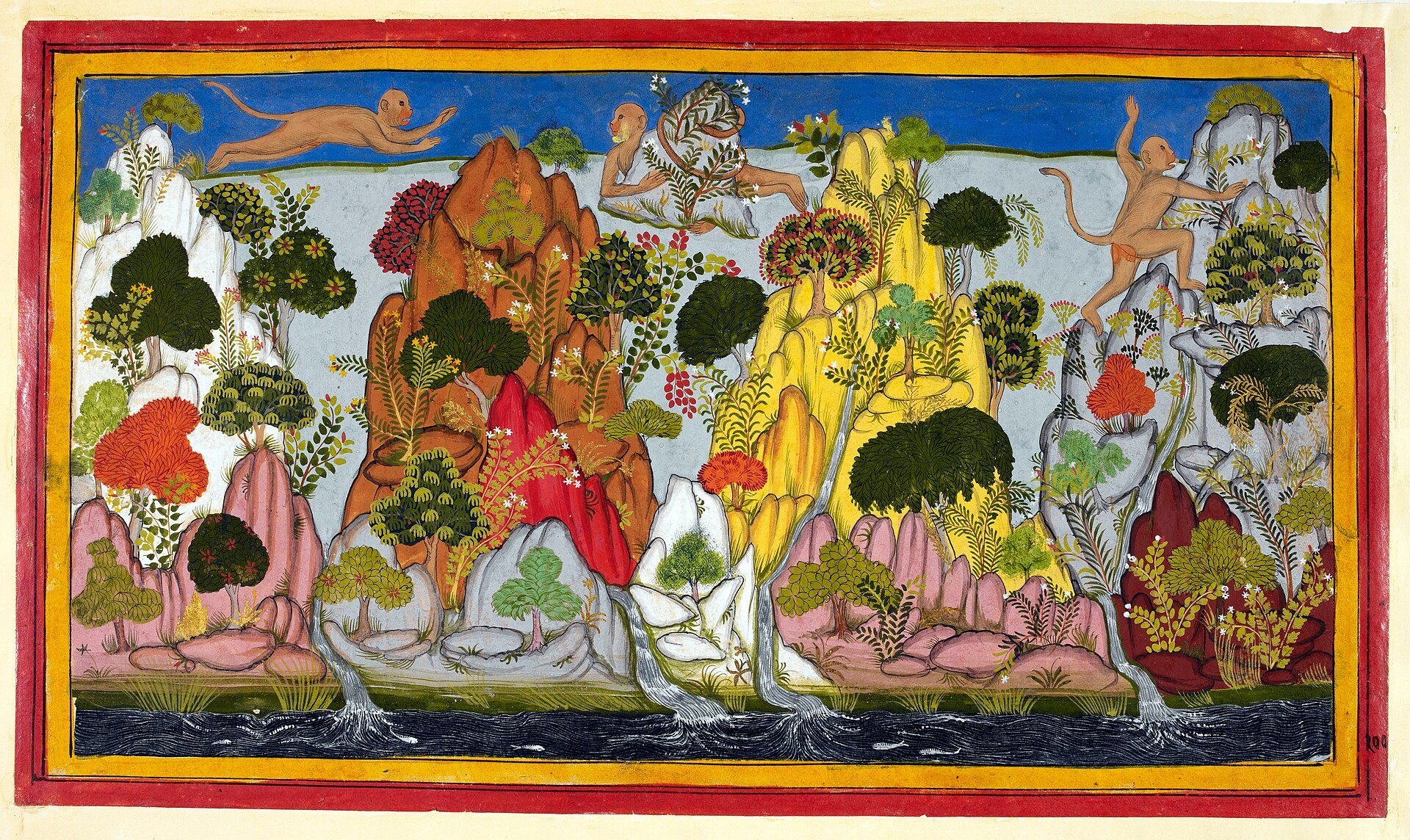
The Mewar school is the oldest named painting tradition in Rajasthan, and Udaipur is where it was made. That much is uncontroversial and well documented. What happens next, for a traveller who arrives wanting to see it, is where this piece has to be careful — because the gap between what is verifiable and what is asserted on a signboard is wider here than in almost any craft we write about.
So we are going to do this in the order that is useful rather than the order that flatters. The paintings first, because they are extraordinary and because most of the good ones are not where you would guess. Then the living painters, with the evidence we could and could not find. Then Nathdwara, which is a better proposition than Udaipur for anyone who actually wants to watch work being done.
Two museums, thirty metres apart
Inside the City Palace complex there are two museums. Most visitors see one of them.
The City Palace Museum, run by the Maharana of Mewar Charitable Foundation, charges ₹400 for an adult and is very good. Its collection spans the sixth century to the present — paintings on cloth and paper, historic photographs, stone sculpture, textiles, arms, and the first gallery in Asia given over entirely to silver. When the Smithsonian's National Museum of Asian Art mounted the major international Mewar exhibition of the last decade, A Splendid Land, in 2022 and 2023, it borrowed from here.
Thirty metres away, inside the same walls, is the Government Museum, Udaipur — a Rajasthan state museum that opened in 1890 as the Victoria Hall Museum and moved into the palace complex in 1968. It holds nine thousand Mewar School miniatures, dated 1628 to 1861. The Ministry of Culture's own Museums of India portal calls it the largest collection of Mewar art in the world, and the Ministry of Tourism corroborates the figure independently. Admission is ₹10 for an Indian adult, ₹50 for a foreign one. It closes at five and shuts on Mondays. Its three named galleries are Children's, Handicrafts and Sculpture.
Read that list again. There is no painting gallery among them.
We want to be exact about what this does and does not mean, because it would be easy to turn it into an accusation and it is not one. Neither government source states how many of the nine thousand are on display and how many are in storage. Nobody has published that split. Given the gallery list, the hanging fraction is certainly small — but we are not going to print a number we cannot source, and neither should anyone else. The two people who can answer it are the Superintendent of the Government Museum and the Rajasthan Directorate of Archaeology and Museums, and we have not yet had an answer worth printing.
What we can say is that the ₹10 ticket is one of the great undervalued objects in Indian travel, and that almost no visitor to Udaipur buys it.
1605, at Chawand
The school's conventional starting point is a dated set of Ragamala paintings made at Chawand in 1605 by an artist named Nasiruddin — Nisardi in some transliterations, Nisardin in others.
Chawand was Mewar's capital between 1585 and 1609, the Rana being in exile from Chittor. The V&A, which holds two leaves from the set, calls it the earliest dated Rajasthani ragamala and therefore a milestone in the history of Rajasthani painting. The Government of India's own NCERT art textbook gives the same account. LACMA, the V&A and the Smithsonian all hold pages from it and all name Nasiruddin on the object record.
Of those, only one is on view: Shri Raga, at the Smithsonian's Freer gallery, accession F1991.1, which the museum notes is a page from a set of forty-two and part of one of the earliest inscribed and dated Rajput painting series. The LACMA page and both V&A pages are in storage.
Who commissioned the set is not settled — either Rana Pratap Singh or his son Amar Singh, and the sources do not choose. We mention this because it is the first of several places in this story where the honest answer is a shrug, and we would rather give you the shrug than a confident sentence.
Sahibdin, and the thing about him worth knowing
The great name of the school is Sahibdin, active roughly 1628 to 1655, working for Maharana Jagat Singh I. He is one of the very few Rajasthani painters whose name is known at all.
His dated works run Ragamala in 1628, the Gita Govinda at the end of the 1620s and into the 1630s, the Suryavamsha in 1645, the Bhagavata Purana in 1648, and the Yuddha Kanda — the sixth book of the Ramayana — in 1652. He used an oblique aerial perspective that let him fit the scale of a war onto a page, and he combined the popular Mughal devices then current across northern India with the older Rajput manner, without ever becoming a Mughal satellite.
That last point is the one to hold onto if you want to see what makes a Mewar painting a Mewar painting. Mughal painting went vertical and went deep. Mewar kept the horizontal format inherited from palm-leaf manuscripts, kept the flat red and yellow borders, and kept the synoptic frame — several episodes of a story happening at once in a single picture, which Mughal painting had abandoned as unsophisticated. Standing in front of one, you are looking at a deliberate refusal, not a provincial lag.
And here is the biographical fact that makes him worth a paragraph rather than a line. Sahibdin was Muslim. He spent his working life painting the Ramayana, the Bhagavata Purana and the Gita Govinda for the Rajput house that made the loudest and longest refusal of Mughal submission in India. That is documented, not stretched, and it is a more interesting thing than any of the legends attached to him.
One warning, because it is in print in places you would trust. Britannica says the Yuddha Kanda is in the British Museum. It is in the British Library, Additional Manuscript 15297 — the Additional Manuscripts series moved across when the British Library was created in 1973. The error is a legacy of that split and it is everywhere.
The Ramayana of Jagat Singh, which you cannot see
The masterpiece of the school is the Ramayana made for Jagat Singh between 1649 and 1653, with a supplementary Bala Kanda volume added in 1712 under Sangram Singh. Sahibdin painted much of it, alongside Manohar and at least one unknown master working in a mixed Mewar-Deccani manner.
It is somewhere between 370 and 380 paintings across hundreds of folios — the British Library's curator emeritus J. P. Losty puts it at 377, the Library's own press office said over 370, and we will not pretend to adjudicate between them.
It is in four places. The British Library holds Add.15295, Add.15296 and Add.15297. The Chhatrapati Shivaji Maharaj Vastu Sangrahalaya in Mumbai holds further folios. The Rajasthan Oriental Research Institute in Jodhpur has the Aranya Kanda, the third book. A private collection in Mumbai has more Bala Kanda paintings.
How it came apart is documented and worth knowing: four of the books were given to Lieutenant Colonel James Tod by Maharana Bhim Singh in the early nineteenth century, and Tod passed them to the Duke of Sussex on returning to Britain in 1823. The rest dispersed over time.
In 2014 the British Library, working with CSMVS and other Indian institutions, digitally reunified the manuscript for the first time in nearly two centuries and put it online. That project is why most people have heard of the Mewar Ramayana at all.
It is offline. The British Library was hit by a ransomware attack in October 2023 and its digital collections have been unavailable since; the Library's own service guidance, updated at the end of September 2026, says restoration work continues through the year. The address the 2014 press release gave the public now returns a 404. The last archived capture is from July 2023.
So the position in October 2026 is this: the largest Mewar collection on earth is in Udaipur and its display state is unpublished, and the most celebrated Mewar manuscript on earth has been digitally reassembled and then taken off the internet by a criminal attack on a library in London. Neither of those is anyone in Udaipur's fault, and both of them shape what you can actually see.
Wikimedia Commons carries British Library-sourced images with the shelfmarks attached, and Smarthistory reproduces folios from Add.15296 and Add.15297. That is the working substitute for now.
The living craft, and what we could verify
Now the part this piece exists for.
There are working miniature painters in Udaipur. Several of them can be named from dated independent journalism rather than from their own signage, which is the test we apply. Reader's Digest India, in September 2025, named Sanju Soni of Sanju Arts, Nirbhay Raj Soni of Nirbhay Raj Studio, Lokesh Kumawat and Devendra Kumar Gaud, all working near the Jagdish Temple and the City Palace. A 2025 academic paper from Panjab University names Prakash Paliwal of Udaipur as a practitioner continuing a family tradition.
The most institutionally traceable practice in the city is the collaboration between the American artist Waswo X. Waswo and the Udaipur miniaturist R. Vijay, born in Udaipur in 1970, who was trained by the traditional miniaturists Sukhdev Singh Sisodiya and Laxmi Narayan Sikaligar. They have worked together since 2004 — R. Vijay signs each painting, Waswo embosses his initials — and the work has been published and exhibited into the art-historical record. Working with them are Chirag and Shankar Kumawat, Dalpat Jingar, and the hand-colourist Rajesh Soni, grandson of Prabhu Lal Soni, court photographer to Maharana Bhopal Singh. That is a documented three-generation Udaipur lineage, although in photography rather than painting.
Three things the artists themselves say, which are worth hearing before you walk into a studio. Sanju Soni: 'I may well be the last generation of artists in my family. In 10 or 15 years, you won't find craftmanship like this anymore.' On the season: 'This business, however, only thrives for about four months — from October to March — when European tourists visit.' On time: 'I need a minimum of one week — or about 42 hours — on a single artwork. For detailed historical scenes, it can take up to nine months.'
Note that last figure against the others you will hear. We have seen three different accounts of how long a miniature takes, from three sources, ranging from forty-two hours to nine months to eight months for a twenty-seven-foot cloth. All three are the artists' own claims about their own work and all three are probably true of the thing being described. Nobody should quote one of them as the time a miniature takes.
What we could not verify, which matters more
We went looking for accreditation and came back with a clean negative result. We are printing it because the absence is the useful information.
The Ministry of Textiles awards its Shilp Guru and National Awards to master craftspeople, and six Shilp Guru awards for miniature painting have gone to Rajasthan artists: Nand Kishore Verma in 2010, Reva Shankar Sharma in 2013, Kailash Chand Sharma in 2014, Mohan Lal Soni in 2017, Gopal Prasad Sharma in 2018 and Asharam Meghawal in 2019. The 2017 to 2019 awards are confirmed in the government's own press release of November 2022.
Of the two we could place, Gopal Prasad Sharma is in Bijolia and Asharam Meghwal is in Jaipur. The award list for those three years contains no awardee with an Udaipur, Rajsamand or Nathdwara address, and no Pichwai awardee at all. We could not retrieve the post-2019 National Award lists; the Development Commissioner (Handicrafts) award pages did not yield a downloadable one.
So: in the award lists we could reach, there is no government-recognised miniature painter with a documented Udaipur address. That is not the same as saying none exists, and we would be glad to be corrected by the Development Commissioner's office. But it does mean that anyone telling you their studio holds a national award is making a claim you can check, and should.
There is no Geographical Indication for Mewar or Udaipur miniature painting either. Udaipur's GI is application 747, Koftgari metalwork, filed in April 2021. The Rajasthan handicraft GI list runs to Kota Doria, Jaipur blue pottery, Molela clay work, kathputlis, Sanganeri and Bagru block print, Thewa, Pokaran pottery, Bikaner Usta Kala and Kashidakari, Jodhpur Bandhej, Nathdwara Pichhwai and Udaipur Koftgari. No miniature painting. No Phad.
And the claim you will hear most often — that a studio's painters descend from Sahibdin's atelier — has no documentation of any kind behind it. There is no record linking any living Udaipur painter to Sahibdin or to the Jagat Singh workshop. Even whether Nasiruddin and Sahibdin were related is undocumented. The real continuity, if you want one, runs through the court atelier itself: the dated works of Shivalal in 1868 and 1893 and Pannalal Parasuram Gaud in the early 1900s put the Udaipur court school into the twentieth century. That is a bridge you can stand on. Sahibdin is not.
The shops around Lake Pichola — the honest answer
We could not find any published work that separates the working studios around Lake Pichola from the resellers and copy shops, and we are telling you that plainly rather than filling the gap with atmosphere.
Everything in the watch-learn-commission space in Udaipur resolves, on inspection, to commercial self-description with online reviews as the only third-party record. No museum vets these studios. No government register covers them. There is no investigation that audits the shopfronts, tests attributions or counts how many of the paintings on a given wall were made in the room behind it.
That leaves one defensible test, and it is the one we use ourselves. Does the named person appear in a Ministry of Textiles award list, in a museum object record or exhibition, or in dated independent journalism or academic work? By that test the people named earlier in this piece clear it. A signboard does not.
This is also, bluntly, why we do what we do. Arranging an afternoon with a painter whose work is in the published record is a different proposition from being walked into a shop by a driver on commission, and the difference is not the price of the painting.
Nathdwara, which is better ground
Two hours north of Udaipur, in Rajsamand district, is Nathdwara, and for anyone who actually wants to watch painting being done it is the stronger destination.
Pichhwai — Sanskrit for that which hangs from the back — are the cloth hangings made for the shrine of Shrinathji. The image of Shrinathji was installed at Nathdwara around 1670 to 1672, having been brought from Mathura by Goswami priests; the two standard sources give different years, so we write it as a span. Vitthalnath, son of the Pushtimarg founder Vallabhacharya, employed artisans under the temple administration to make the hangings. They are painted on cloth in opaque watercolour, gold and silver, though by the early twentieth century some painters had taken up oil and foreshortening.
Unlike Udaipur miniature painting, this craft has a Geographical Indication. We checked it at the registry rather than taking it second-hand: application number 748, 'Nathdwara Pichhwai Painting', handicraft, Rajasthan, registered, filed 12 April 2021. The government's own announcement in August 2023 confirmed it alongside four other Rajasthan products, with NABARD supporting the applications.
The painters' quarters are documented and named: chitron ki gali, the street of paintings, and chitrakaron ka mohallah, the colony of painters, where work frequently results from collaborative effort supervised by master artists.
Two sets of families are documented twice over, which is unusual and useful. The Artists of Nathdwara collective was founded in 2015 by Suresh Sharma, and its named members — Girish, Jatin, Madhuri, Parmanand, Piyush, Raja Ram and Suresh Sharma — use natural colours ground from mud or indigo on stone, strained, then bound with gum. Tradition has a painter begin independent work at fourteen. One commission of twenty-seven by fifty-seven feet, for Mumbai's NMACC, took eight months. Separately, the Sharmas of the Kokasiya clan are the subject of a university exhibition in the United States built on fieldwork in Nathdwara, with the patriarch Charturbhuj Sharma, his sons Yugal Kishore, Shyam Sunder and Mahesh, and his grandsons Jatin, Gaurav and Ankit all named — five to seven generations.
One caution and one correction. Whether visitors can observe painters at work in their homes along the painters' lanes is not documented anywhere, and access has to be arranged through the collective or the families rather than assumed. And Pichvai Tradition & Beyond, which comes up first in most searches, is not a Nathdwara atelier: by its own account its atelier was established in 2018 in New Delhi. It is a good operation. It is not the town.
A note on pigments, since everybody asks
There are two palettes in circulation and they get merged, so we will keep them apart.
The Smithsonian's account of the historic Udaipur works names ultramarine, iron oxide, lead, gold and Indian yellow. A 2025 materials-science study of a living Jaipur workshop documents orpiment — harital — and malachite. Those are two different things: one is what the court painters of Udaipur used, the other is what a Jaipur workshop uses now. Combining them into a single sentence about traditional Mewar pigments produces something that sounds authoritative and is not true of either.
There is one piece of Udaipur conservation work that is real, documented and worth knowing about. A paper-conservation laboratory was established between 2016 and 2018 inside the Zenana Mahal of the City Palace, with the original bathroom converted into the wet area and the thick masonry walls doing the work of climate control. Treatments use methyl cellulose in ethyl alcohol and deionised water, steam pencils, heated spatulas, gluten-free wheat-starch paste, Japanese tissue and a low-pressure vacuum suction table, with work done under a stereo microscope to cover each millimetre. A custom hydraulic lift moves paintings through an unsealed window so they are not carried. The conservators published an account of it in the Splendid Land catalogue.
What a visit actually looks like
Two days, and the order matters.
Start with the Government Museum, early, before the City Palace crowd builds. ₹10, closed Mondays, shuts at five. Go in knowing that what is on the walls is a fraction of what is in the building, and ask what the fraction is — if enough visitors ask, somebody eventually publishes the answer.
Then the City Palace Museum. One practical warning: its own website gives two different sets of opening hours — the FAQ says nine in the morning to nine at night, the visitor guide says half past nine to half past five. Check on the day. The ticket is ₹400, with concessions for children, for serving defence and police personnel and for over-sixties. Audio guides are in English, French, German and Spanish; guides wear orange lanyards; no flash. If seeing Mewar painting is the point of your visit, ask specifically whether the Bhagwat Prakash Gallery is open — the government portal names it as the Mewar painting gallery, the museum's own galleries page does not list it, and we would not want you to travel for it on our word.
An afternoon with a painter is the middle of the second day, and it should be a named painter whose work you can look up before you arrive. Expect a conversation about time rather than about price. Forty-two hours is the floor for a small piece, by the painter's own account, and the European season that supports the whole trade runs October to March — which means the painters you want to meet are busiest exactly when you are most likely to be there.
Nathdwara is a separate day and needs arranging in advance. It is the better half of this story for anyone who wants to see scale: a pichhwai is a cloth hanging, not a page, and watching one being painted is a different experience from watching a miniaturist work under a magnifier.
And if you take one thing from this piece, take the ₹10 ticket. There is no other building in India where nine thousand paintings of a single school sit behind one admission price that low, and the fact that nobody goes is the most surprising thing about Udaipur.
Questions, Answered
Where can I see original Mewar miniature paintings in Udaipur?
The Government Museum, Udaipur, inside the City Palace complex, holds nine thousand Mewar School miniatures dated 1628 to 1861 — described by the Government of India's Museums of India portal as the largest collection of Mewar art in the world. Admission is ₹10 for an Indian adult and ₹50 for a foreign one, it closes at 5pm and it shuts on Mondays. Be aware that neither government source states how many of the nine thousand are on display rather than in storage, and the museum's three named galleries are Children's, Handicrafts and Sculpture. The separate City Palace Museum, ₹400, holds Mewar paintings too and was the majority lender to the Smithsonian's A Splendid Land exhibition.
Can I see the Mewar Ramayana online?
Not at the moment. The British Library digitally reunified the manuscript in 2014 and put it online, but the Library was hit by a ransomware attack in October 2023 and its digital collections have been unavailable since; the address given in the original press release now returns a 404. Wikimedia Commons carries British Library-sourced images with their shelfmarks, and Smarthistory reproduces folios from Add.15296 and Add.15297. The manuscript itself is split between the British Library, CSMVS in Mumbai, the Rajasthan Oriental Research Institute in Jodhpur, and a private Mumbai collection.
Are the miniature painters in Udaipur's shops genuine?
Some are and the public record cannot tell you which. There is no museum vetting, no government register and no published audit separating working studios from resellers around Lake Pichola. The test we use is whether the named individual appears in a Ministry of Textiles award list, in a museum object record or exhibition, or in dated independent journalism or academic work. Sanju Soni, Nirbhay Raj Soni, Lokesh Kumawat, Devendra Kumar Gaud, R. Vijay, Rajesh Soni and Prakash Paliwal all clear that test. A signboard does not. Treat any claim of descent from Sahibdin's atelier with scepticism — no documentation links any living painter to him.
Is Mewar miniature painting GI-protected?
No. There is no Geographical Indication for Mewar or Udaipur miniature painting. Udaipur's GI is application 747, Koftgari metalwork, filed in April 2021. Nathdwara Pichhwai painting does have one — application 748, filed 12 April 2021, registered — but it is filed from Rajsamand district, not Udaipur.
Udaipur or Nathdwara for watching painters work?
Nathdwara, if watching the work is the point. Its craft has a Geographical Indication, its painters' quarters are documented by name, and several families are named in both dated journalism and a United States university exhibition built on fieldwork in the town. Visitor access to the homes and studios is not documented, so it has to be arranged through the collective or the families rather than assumed. Udaipur is the stronger destination for seeing historic paintings; Nathdwara for seeing living ones.
How long does a miniature painting take?
There is no single answer and anyone who gives you one is quoting a single artist. The figures in the record range from about forty-two hours for a small piece to nine months for a detailed historical scene, and eight months for a twenty-seven-foot pichhwai cloth — all of them the artists' own accounts of their own work.