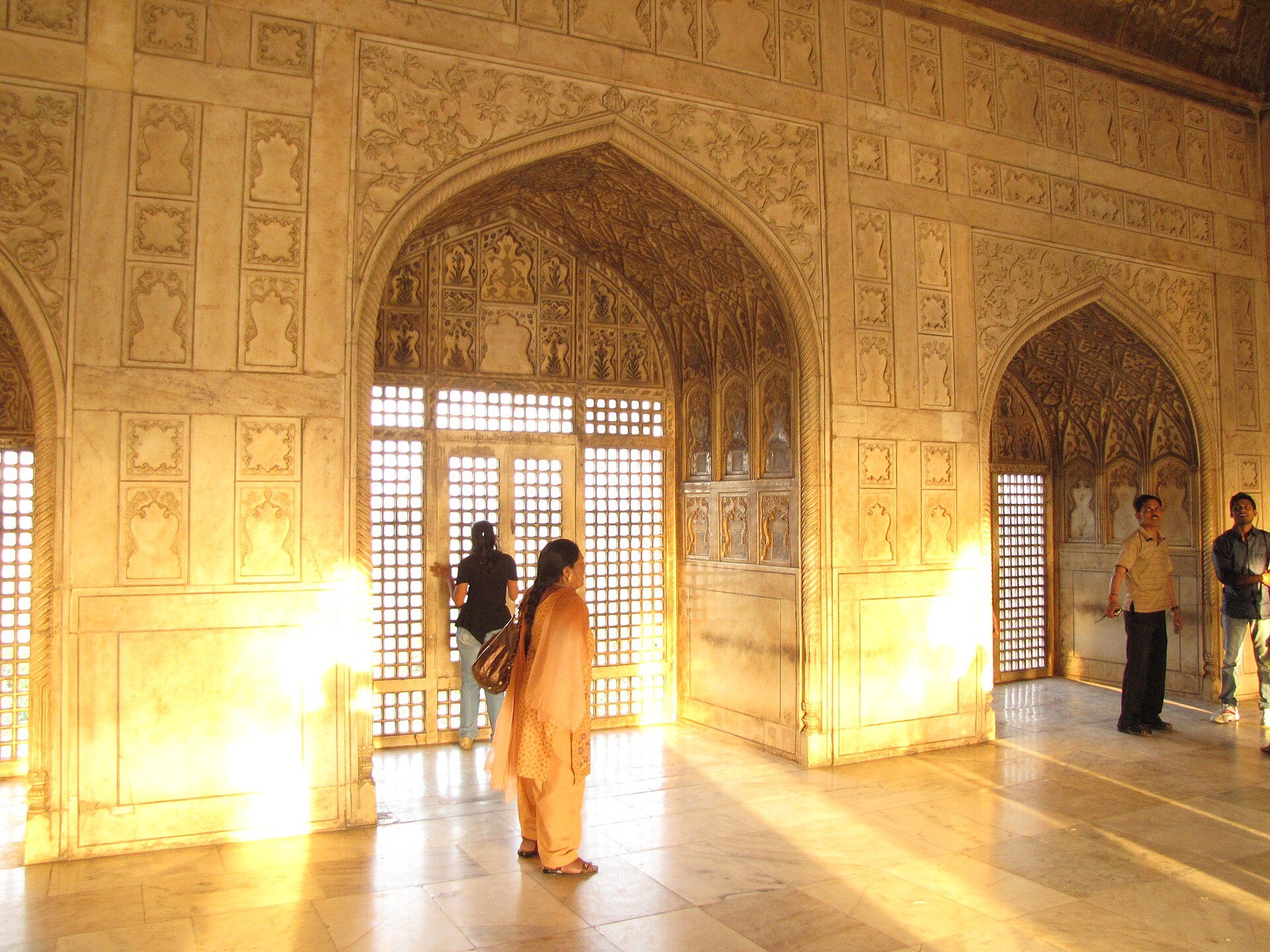
Hero photograph: Agra Fort, by Christopher John SSF (CC BY 2.0), via Wikimedia Commons
A good guide is the single largest variable in an India trip and the one most travellers do not think to ask about. What they ask about instead is the hotel, which is the most predictable element of the whole thing. The system behind guides in India is also widely misdescribed: the Regional Level Guide licence everybody refers to was superseded in 2021 by the Incredible India Tourist Facilitator certification, and in any case the power to license someone to show you a centrally protected monument for payment sits with the Archaeological Survey under a 1959 rule, not with the Ministry of Tourism. What follows is how the system works and what a day with a good guide actually consists of — which is mostly not talking.
Ask a prospective guest what they most want to get right about their India trip and they will tell you the hotels. Ask us and we will tell you the guides, and we will be right, because the hotel is the most predictable thing in the whole itinerary and the guide is the least.
A fort with a good guide is a working building with a water system, a grain store, a reason for every angle of every wall, and a family who still own it. The same fort with a poor guide is a sequence of dates and a gift shop. The stone has not changed.
What follows is both halves of the subject: how the system works, which is more complicated and less well documented than anyone admits, and what a good day actually looks like.
The licence everybody refers to no longer exists
The Regional Level Guide licence is the thing travel writing cites, and it is out of date. It was superseded by the Incredible India Tourist Facilitator and Tourist Guide programme, and existing RLG holders were required to undergo the new refresher course before 30 September 2021 to convert.
The new structure has two tiers: a basic Tourist Facilitator certification and a specialised Tourist Guide certification in two tracks, Heritage and Adventure. The training, examination and refresher courses are run by the Indian Institute of Tourism and Travel Management under the Ministry of Tourism. Certification is pan-India rather than regionally confined, which is a real improvement. A language specialisation can be added by any certificate holder with fluency in a spoken foreign language, and in more than one language if they have it.
The eligibility change is the part worth knowing, because it is the reason the scheme was litigated. The old route required a graduate degree, or a three-year degree in tourism or hospitality, or a diploma in archaeology. The new one requires that candidates under forty have completed 10+2, and those over forty class 10. That is a substantial lowering of the bar, and existing licence holders took the ministry to court over it.
What the ministry argued it gave them in exchange is on the record from its own submissions: operational area expanded from regional to pan-India; validity extended from three years to five; the paid classroom refresher replaced with a free online one; and restrictions on holding a parallel profession removed.
We cannot tell you how long a certification lasts in a single sentence, and neither can the guideline. The document carries three different clocks — a three-year validity on the online course-completion certificate, a five-year validity on the certification before refresher, and a two-year registration renewal at half fee — and does not reconcile them. The five-year figure is the one the ministry relied on in court.
Nor can we tell you how many certified guides exist. The only numbers we could find are from the ministry's December 2023 court submissions — 3,071 candidates passed the February and July 2021 examinations, and 692 RLG holders registered for the refresher — plus a first badge batch of 302 candidates from western and central India issued in Mumbai in May 2022. None of those is a current total, and we found no published one.
The rule that actually governs the monument
Here is the part that almost nothing written about Indian guides mentions, and it is the part that determines who can legally stand in front of the Taj Mahal and explain it to you.
Guide licensing at centrally protected monuments rests on Rule 8(d) of the Ancient Monuments and Archaeological Sites and Remains Rules, 1959, which requires a licence from an archaeological officer for anyone showing visitors around a monument for payment. By an Archaeological Survey notification dated 31 January 2017, there was to be only one category of guide, known as the ASI Monument guide, authorised to work in centrally protected monuments — and the same notification withdrew the Survey's power to endorse RLG licences.
We have that from a High Court judgment quoting the notification and the rule rather than from the Survey's own site, which we could not reach, and a later Delhi judgment refers to a further withdrawal instrument dated 5 February 2020 whose text we could not retrieve. So we would describe the present status of the single-category rule as unconfirmed in its detail while being clear about the principle: the legal authority to guide inside a protected monument is the Archaeological Survey's, not the tourism ministry's.
The tourism ministry's own framing supports that reading. It describes its programme as a certification rather than a licence, and what it imposes are conduct rules rather than licensing powers — certified facilitators may not canvass business on behalf of travel agents or hoteliers, may not accept monetary commission, may not solicit tips, may not accompany tourists to shops on pain of certificate cancellation, and may not lend or transfer the badge.
Those conduct rules are, incidentally, the best short description of what separates a good guide from a bad one that any Indian government document contains.
The states have their own systems, and one of them is a gap
Kerala runs the clearest structure we found: three tiers, with regional licences issued by the Government of India after a central examination, state licences where the Kerala Institute of Tourism and Travel Studies provides the certificate and the state tourism department issues the licence, and district licences valid only in the applicant's own district. Note that Kerala's own portal still describes the central licence as covering four states, which is the pre-2021 regional system — it has not been updated.
Rajasthan licenses guides under the Rajasthan Tourism Trade (Facilitation and Regulation) Act, 2010, which treats a tourist guide as a species of travel agent. Registration is mandatory, runs from one to five years at the applicant's choice for a fee of ₹1,000, and operating without it carries a fine up to ₹1,00,000. There are no training or examination criteria for guides in the rules.
Goa is the genuine gap. Its Registration of Tourist Trade Act, 1982 contains no standalone definition of a guide at all — a guide is folded into the definition of travel agent, registration is compulsory, and no qualification, training, examination or conduct criteria specific to guides appear anywhere in the Act or its rules. That is not an omission in our reading of it. It is simply absent.
What a good day actually consists of
Now the part that matters more than the paperwork.
A good guide day in India starts earlier than the guest wants it to and ends earlier than the guest expects. The first hour after a monument opens is worth the next four, and a guide who argues for a seven o'clock start is doing their job. The best of them will also tell you, on arrival, what they propose to cut.
It contains perhaps two hours of actual explanation across a six-hour day. The rest is positioning: standing you where the sightline works, timing a courtyard so the light is across it rather than behind it, moving you out of a space before a group arrives rather than after. A guide who talks for six hours is not a good guide having a bad day; they are a different product.
It contains at least one thing you did not ask for. The small JainJainA follower of Jainism, an ancient Indian religion whose central commitment is non-violence towards every living thing.Read in the glossary temple behind the main complex, the stepwellStepwellA well reached by a long descending staircase, so that water can still be drawn as the water table falls.Read in the glossary nobody photographs, the sweet shop that has been there four generations, the particular window in the fort from which the thing finally makes sense. This is the entire premium of a private guide over an audio tour and it is the thing we interview for.
It contains a frank answer to the question you were too polite to ask. Guests want to ask about caste, about poverty, about religion, about politics, about whether the thing they are looking at was taken. A guide who deflects those is wasting the single best opportunity the trip offers. A guide who answers them honestly, from their own position, with their own disagreements intact, is the reason to come to India with a person rather than a book.
And it contains a lunch that is better than the hotel's, somewhere you would not have found.
The rules a guide is working around
It is worth knowing what constrains your guide's day, because a lot of what looks like inflexibility is a monument regulation.
The Taj Mahal closes every Friday. That is a hard constraint and it is the single most common cause of a rearranged Golden Triangle. The Red Fort's Monday closure, by contrast, has ended: an Archaeological Survey order dated 13 February 2026, signed by the Director General, opened it on all days of the week. We would add the caveat that makes that useful rather than misleading — the Red Fort has the least predictable calendar of any major Delhi monument, having been closed to all visitors from 15 July to 15 August 2026 for the eightieth Independence Day, and previously at short notice for bird flu and for protests. Open every day is not the same as reliably open.
On photography, the Survey's 2018 order permits photography within the premises of all centrally protected monuments and sites except three: the Ajanta Caves, Leh Palace and the Taj Mahal.
Several things that circulate widely we will not repeat, because we could not verify them. The Taj Mahal's three-hour visit limit is documented from June 2019, when turnstiles were installed and officials described visitors being charged extra at the exit gates if they overstayed — but we found no source confirming it is still enforced, so treat it as introduced in 2019 rather than currently in force. The forty-thousand-a-day cap on the cheap domestic ticket was an Archaeological Survey proposal in January 2018 with a 20 January start date, and we found nothing at all confirming it took effect or is in force; sources even disagree on whether the ticket it attached to was ₹40 or ₹50. The only hard cap we could document is a different, pandemic-era one of five thousand a day from September 2020. And the photography fees quoted everywhere — ₹750 a photograph, ₹50,000 a day for filming — are site-museum fees, not monument fees, despite the government's own mis-named PDF. We could not obtain the monument schedule, so we do not publish a tripod or video fee.
Current monument entry tariffs we also will not tabulate. The only schedule we could verify is from April 2016 and is almost certainly superseded. Ticketing itself has moved on: online booking now covers over a hundred and seventy centrally protected monuments and museums, with a small discount for booking that way.
On unlicensed guides, which is a real problem
Because Rule 8(d) requires a licence to show a monument for payment, unlicensed guiding inside a centrally protected monument is a licensing breach rather than merely a nuisance, and the courts have said so. The Allahabad High Court, quoting its own earlier judgment, recorded directions that steps be taken to ensure that touts, fraudulent, unlicensed guides or any other unauthorised persons are not permitted to take visitors around protected monuments for monetary consideration.
Enforcement happens, if sporadically. In December 2020 the Survey intercepted an unlicensed guide operating under multiple identities, buying tickets illegally and charging guide fees, after which police arrested half a dozen people. The same episode documents the ticket black market that grew up around the pandemic cap — ₹50 tickets reselling at ₹200 — and the Survey's response of capping online bookings to five adult tickets at a time, down from twenty, and printing visitor identities on tickets, which the travel industry opposed as cumbersome.
It is not confined to the budget end of the market. An unlicensed guide accompanied the United States ambassador around Fatehpur Sikri, which is as good an illustration as we could ask for that the problem is not solved by paying more.
We could find no official statistics at all on the number of unlicensed guides, prosecutions, or enforcement outcomes, and we would not quote one.
How we choose them
We do not hire on licence, because the licence is a floor and a low one. We hire on four things.
Can they answer the uncomfortable question. We ask it in the interview.
Do they have a subject. The best guides in India are not generalists — they are people who know MughalMughalRelating to the Muslim dynasty of Central Asian descent that ruled most of the subcontinent from the sixteenth to the eighteenth century.Read in the glossary gardens, or Jain architecture, or Deccan metallurgy, or the Awadhi kitchen, properly, and who can tell you where their own knowledge stops. A guide who says I do not know is worth four who do not.
Do they manage the day or narrate it. We watch them work before we use them.
And will they say no. A guide who tells a guest that the fourth fort of the week is a mistake, and proposes a morning in a market instead, is the most valuable person on the ground.
The last thing, which is a commercial point and we will make it plainly: a guide paid properly, by the day, with no commission relationship to any shop, behaves differently from one who is not. The ministry's own conduct rules identify shop commissions as the central corruption of the profession. The way to not have that problem is to pay for the day.
Journeys That Take You There

Read Next