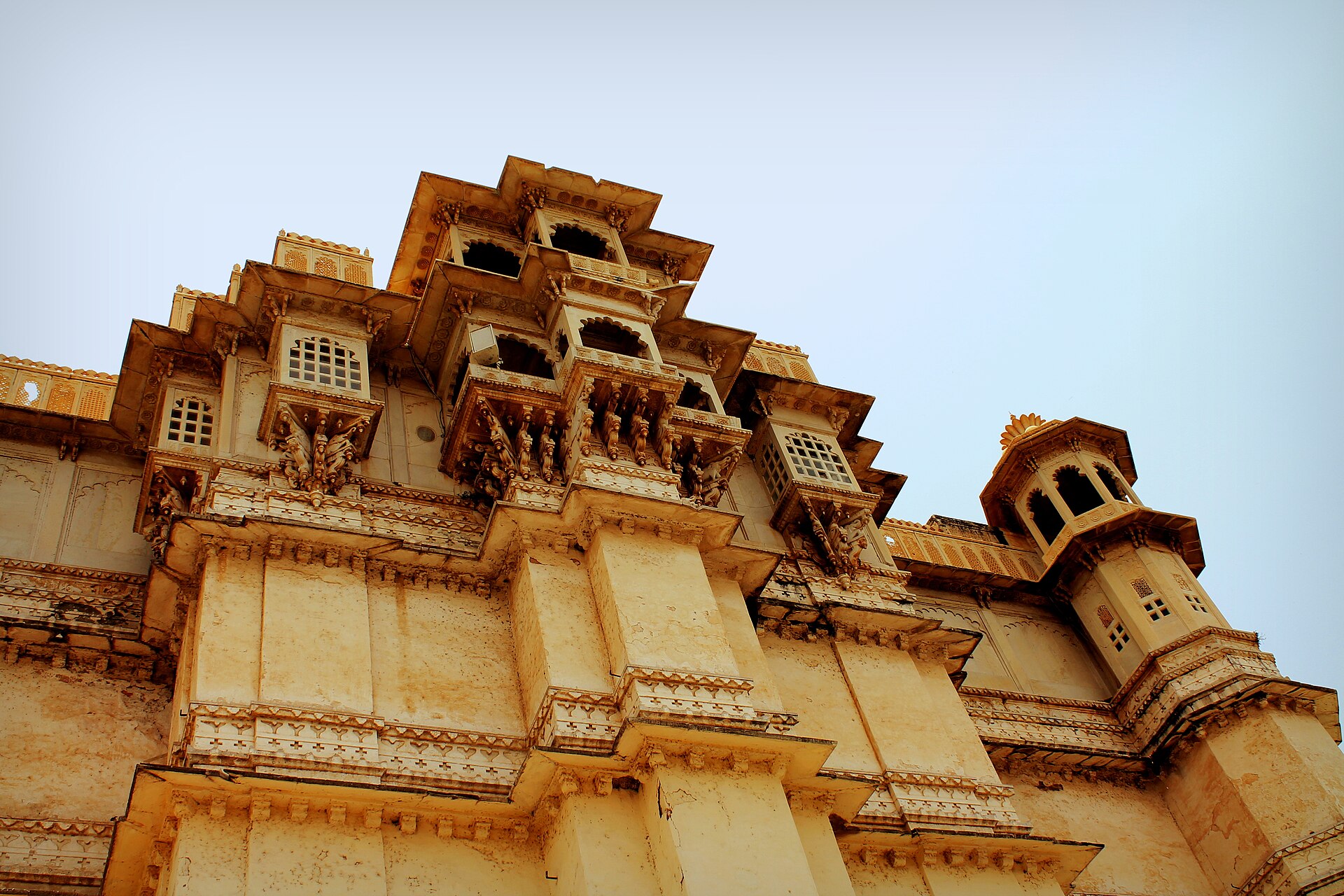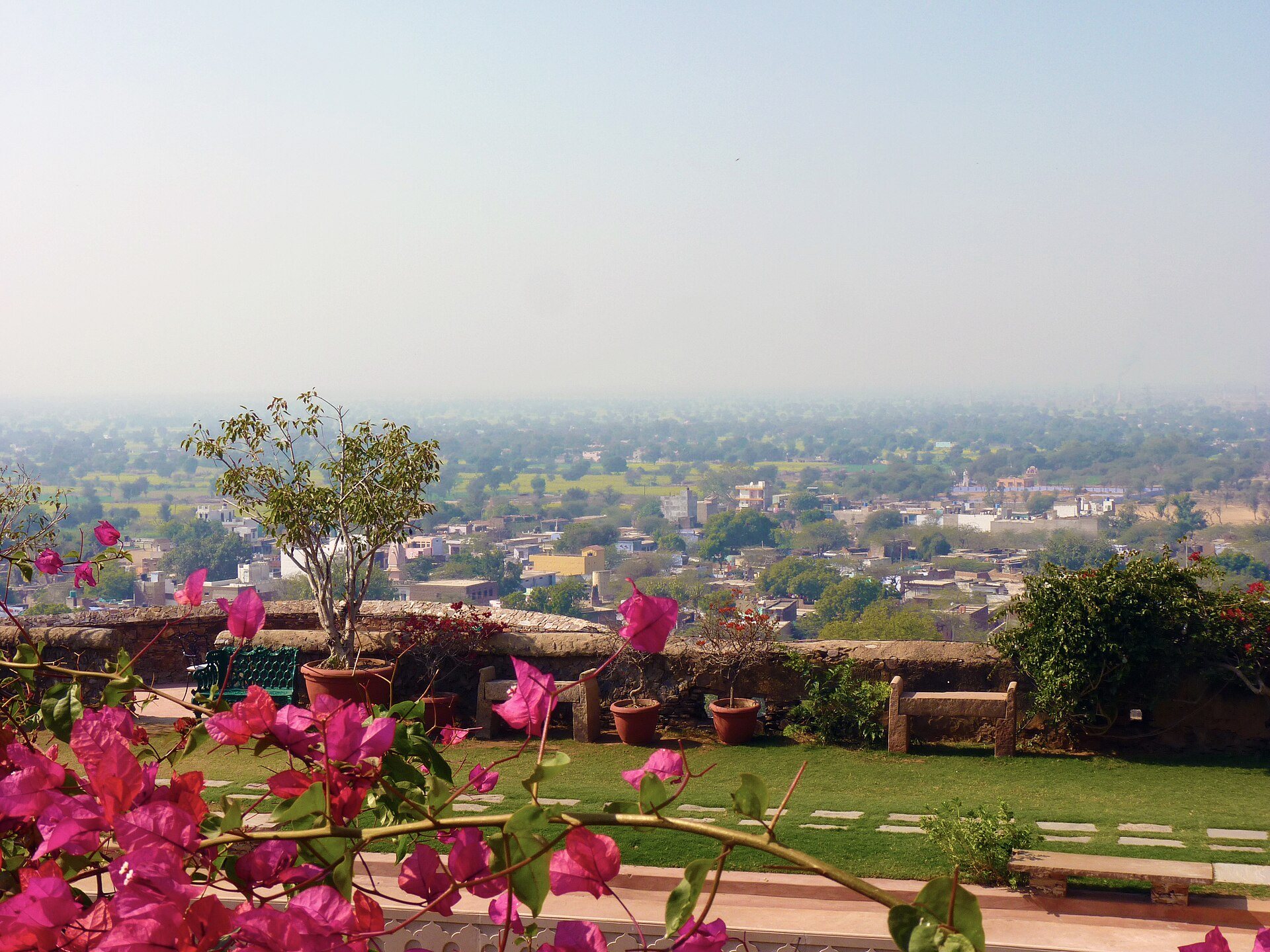
Hero photograph: View from the terrace at Neemrana Fort, by Archit Ratan (CC BY 2.0), via Wikimedia Commons
Fourteen nights is what most people actually have, and it is enough to do something excellent provided you abandon the ambition that ruins it. The mistake is not the length of the trip. It is the attempt to make a fortnight behave like a month by adding places, which converts a holiday into a logistics exercise and produces the specific exhaustion that makes people say India was overwhelming. A two-week trip supports three bases comfortably and four at a push. Everything in this piece follows from that one number.
Almost everything written about a fortnight in India is written apologetically. Two weeks is presented as the compromise — the trip you take because you could not take a month, with a note about what you will have to leave out.
That framing is the problem, not the fortnight. A guest who arrives believing they are already behind spends fourteen days trying to catch up with a country that has no intention of being caught, and goes home describing India as overwhelming. We hear that word a great deal and it is almost always a symptom of itinerary design rather than of India.
So this piece makes the opposite argument. Two weeks is not a reduced version of a month. It is its own thing, with its own logic, and when it is built properly it produces a better trip than a badly-built month does.
The whole argument rests on one piece of arithmetic, so we will do that first.
The arithmetic nobody does
Fourteen nights is not fourteen days of India. Work it through honestly.
Day one is an arrival day. If you land in the morning you have an afternoon; if you land at two in the morning, which a great many flights from Europe do, day one is a shower and a sleep and you should not plan anything for it. Day fourteen is a departure, and an evening flight still takes the day because you will be packing and checking out and watching the clock.
That is twelve real days before you have moved anywhere.
Now the travel days. People think of an internal flight as two hours. It is not. It is a transfer to the airport, which in Delhi or Mumbai is an hour you cannot compress; an airport you are asked to reach two hours early; the flight; a transfer at the other end; and a check-in. Even when everything works, a domestic flight is most of a usable day. When it does not work — and in December and January in north India it quite often does not — it is the whole day plus the next morning.
A road transfer between Rajasthani cities is four to seven hours, which is a day with a good lunch in the middle of it, and a genuinely pleasant one if the day was designed around it rather than enduring it.
So: twelve real days, minus one for each move. Three bases costs you two travel days and leaves ten. Four bases costs you three and leaves nine. Five bases costs you four and leaves eight — and by then more than a third of the trip is in transit.
That is the arithmetic. It is not complicated and almost nobody does it before booking.
What a day actually holds
The second thing people overestimate is how much a day contains, and here the error compounds with the first.
A morning at a major monument with a good guide is three to four hours, and that is the right length — long enough to understand it, short enough to still be interested. Add a drive, lunch, an afternoon site, and you have a full day. Two serious sites in a day is a lot. Three is a march.
And this is before the thing nobody builds in, which is heat, or cold, or dust, or a stomach that is still adjusting, or the simple cognitive load of a country where nothing is familiar. The first forty-eight hours in India take more out of people than they expect, and we have written separately about what the first hour is like.
Our working rule is one principal thing a day, with the afternoon loose. Guests resist it when they see the itinerary and thank us for it by day five.
The corollary is that you should build at least two genuinely empty afternoons into a fortnight, defended against the itinerary rather than filled by it. Not a spa booking, not a cooking class — empty. Those are the afternoons that get remembered, because they are the ones where something unplanned happens.
Three bases, and what each is for
Here is the shape we would recommend to almost anybody with fourteen nights and no particular agenda.
A city, for three or four nights. Somewhere with depth — Delhi, Jaipur, Udaipur, Kolkata, Mumbai — where there is enough to do that you are choosing rather than exhausting, and where you can go back to something you liked.
A landscape, for four or five nights. Backwaters, desert, hills, a tiger reserve, a river. Somewhere the pace drops and the scenery does the work rather than you.
And one thing that is not like the other two, for three or four nights. A craft region, a wildlife park, a coast, a food city. The point of the third base is contrast, because the memory of a trip is built from differences rather than from quantity.
Three bases, two moves, ten usable days. That is a fortnight that works, and it will feel longer when you look back at it than a five-base trip of the same length.
If you want four bases — and many people do, reasonably — take them from one region rather than from across the country, so that the moves are road transfers of three or four hours rather than flights. Four Rajasthani cities is a sensible fortnight. Delhi, Kerala, Varanasi and Mumbai is not, however appealing the list looks on paper.
Five fortnights that work
These are not itineraries so much as shapes. The detail is a conversation; the shape is the thing worth getting right.
The Rajasthan one, which is the classic for a reason. Delhi for two, Agra as a stop rather than a base, then three Rajasthani cities at three or four nights each, ending in Udaipur. All road, no internal flights after the first, and the drives are part of it. This is the fortnight we build most often and it is almost impossible to make bad.
The north-and-south one, which is the best introduction for somebody who wants to understand how different India is from itself. A week in the north — Delhi, Agra, one Rajasthani city — and a week in Kerala. One internal flight, and it buys you two countries. The contrast between Jaipur and Alleppey is the whole argument for India in a single trip.
The river one. Delhi, Agra, Varanasi, and then either Kolkata or a stretch of the Ganges by boat. This is the trip for somebody who wants the oldest layer, and it is a serious one — Varanasi is not an easy place and it is the most rewarding destination in the country for people who go at it properly.
The wildlife one. Delhi, a central Indian tiger reserve for four or five nights, and then either Rajasthan or Kerala depending on whether you want forts or backwaters afterwards. The thing to understand is that a tiger reserve is not a two-night proposition — four nights gives you seven or eight drives and a real chance; two gives you three drives and a story about not seeing one.
And the one nobody asks for and almost everybody loves: one region, in depth. Fourteen nights in Rajasthan, or fourteen in the south, or fourteen between Mumbai and Goa and the Deccan. Three bases, long stays, nothing rushed. This is the trip guests come back from saying they want to do the same thing somewhere else next year, which is the only review that matters.
What two weeks is not enough for
We would rather tell you this now than have you discover it on day nine.
Ladakh and the high Himalaya do not belong in a fortnight that also contains anything else. The acclimatisation alone eats days, and we have written about why the flight in is the risky part. A Ladakh trip is a Ladakh trip.
The north-east is not a fortnight add-on. Assam, Meghalaya and Nagaland are a long way from everything and the internal connections are thin. Give them their own journey.
A genuine south India circuit — Tamil Nadu's temple towns, Kerala, Karnataka, Hampi — is three weeks of material. A fortnight does two of those four well.
And the national sampler. Delhi, Agra, Jaipur, Varanasi, Khajuraho, Udaipur, Mumbai and Goa in fourteen nights is sold, it is bought, and it is the single most reliable way to make somebody dislike India. Eight bases, seven moves, five usable days.
The things worth spending the days on
If the constraint is days rather than money — and for most of our guests it is — then the question becomes which days earn their place. Four that do.
A second night anywhere you are only booked for one. This is the single highest-return change you can make to any itinerary. One night is an arrival and a departure; two nights is a day.
A morning with somebody who actually knows something. A guide is not a commodity, and three hours with a good one is worth two days of looking at things unexplained. We have written elsewhere about what distinguishes them.
A day doing something rather than seeing something. Cooking in somebody's house, a morning with a weaver or a painter, a boat. The days guests describe afterwards are disproportionately the ones where they used their hands.
And the departure buffer. If you are flying home from Delhi in late December or January, the night before your flight should be in Delhi rather than somewhere requiring a connection. Fog season is real and the mornings are when it bites.
The honest version of the trade-off
None of this is an argument that more time would not be better. It would. A month in India is a different and greater thing than a fortnight, and if you have it, take it.
But the choice in front of most people is not between two weeks and a month. It is between a well-built two weeks and a badly-built two weeks, and the gap between those is enormous — larger, in our experience, than the gap between a well-built fortnight and a mediocre month.
The failure mode is always the same and it is always additive. Somebody sees a good three-base itinerary, says it looks wonderful but could we also fit in, and the thing that made it good quietly disappears. We push back on that conversation every week, and the pushing back is most of what we are for.
The last thing, which we tell every guest building a first trip. You will come back. Nearly everybody does. So stop trying to see India, which is not a thing anybody has ever done, and go and see one part of it properly. The fortnight that works is the one that leaves you with a specific reason to return rather than a vague sense of having been.
Journeys That Take You There


Read Next