A bucket list can be completed. That is most of its appeal, and very nearly all of the trouble with it.
This is not an argument that the famous things are not worth seeing. Most of them are famous because they are extraordinary, and a house that sent people to India while routing them carefully around the Taj Mahal would be posing rather than advising. The argument is narrower, and we think harder to wave away: the list is a poor instrument for deciding how to spend a fortnight, and it is poor for structural reasons rather than as a matter of taste.
A list of nouns
Write a bucket list out and look at what kind of words are on it. They are almost all nouns, and almost all buildings — the Taj Mahal, Amber Fort, the ghats at Varanasi, a houseboat on the backwaters. Then ask anyone who has come back from India what they actually talk about. It is rarely the noun. It is the hour: the guide who moved the whole morning because the light would be better, the craftsman who kept working while he answered questions, the long drive that turned out to be the day.
So the list names the part of a journey least likely to be remembered, and leaves out the part most likely to be. That is not because the monuments disappoint. It is because a monument is something you stand in front of, and the things that last are things that happen to you. Nobody can schedule those in advance, which is exactly why no list contains them — and exactly why an itinerary built to satisfy a list leaves no room for them to occur.
Pre-interpreted before you arrive
The second cost is quieter. A celebrated site arrives already explained. You have seen the photograph, you know the angle, you have been told what to feel. The visit becomes an act of recognition rather than of looking: you check the building against the image you were carrying, the check takes about ninety seconds, and then there is nothing left to do but photograph it and move on.
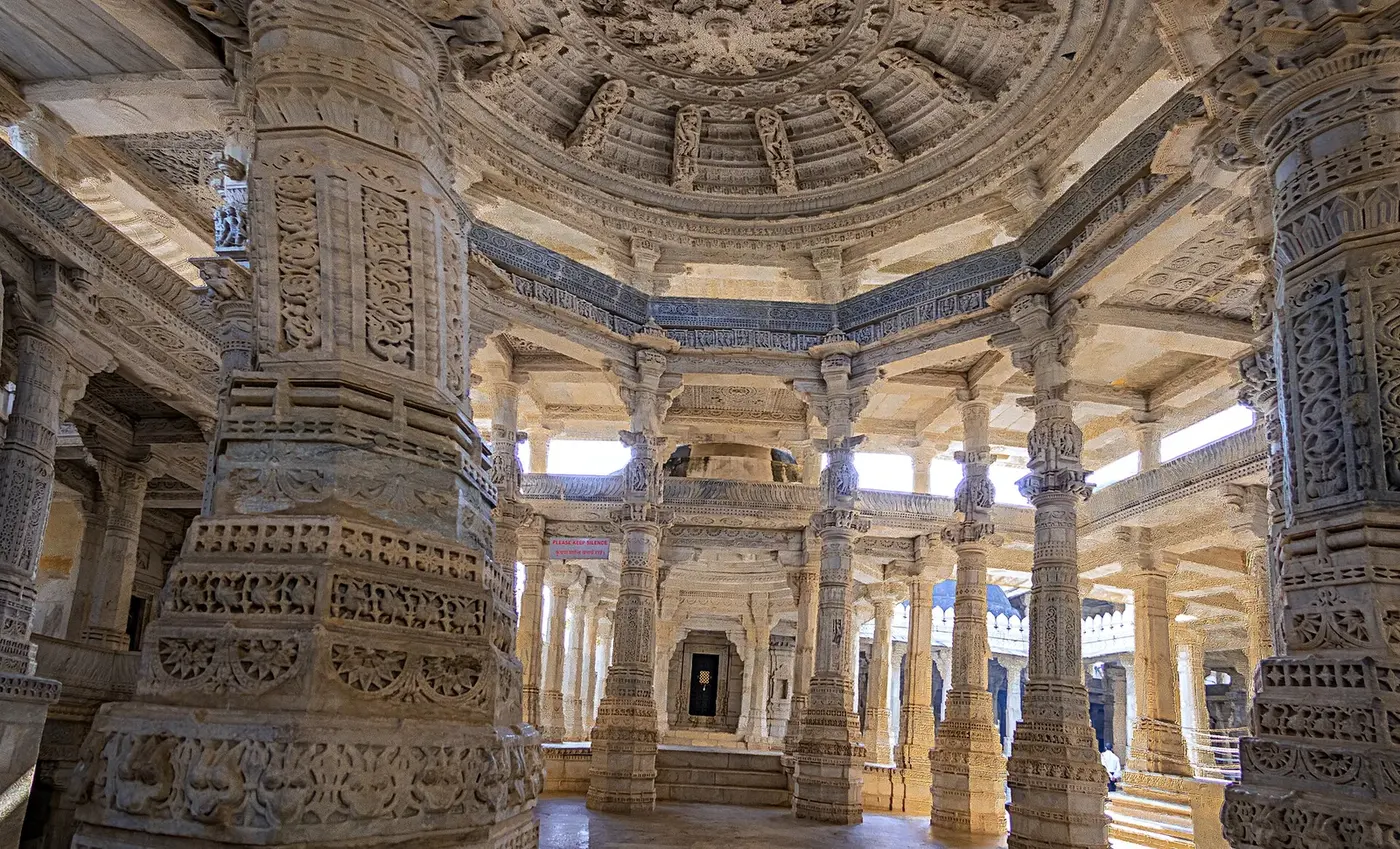
An unlisted building has nothing prepared. Walk into the Jain temple at Ranakpur, in the hills of southern Rajasthan, and there is no received image to match it against, so the only available response is to look at it — which people then do for a surprisingly long time. The same happens among the cenotaphs standing along the Betwa at Orchha. Obscurity is not what makes those places good. It is what leaves you free to see them.
What a canon does to a country
India has forty-five inscribed UNESCO World Heritage sites. The popular canon runs to perhaps nine, and every ranking, feed and round-up points at the same nine, so the canon reinforces itself: a place is visited because it is famous and is famous because it is visited.
Two things follow, and they are one mechanism seen from opposite ends. The nine carry a load they were never built to carry, and fragile things — a stepwell, a reef, a working craft quarter — do not survive concentrated volume well. At the other end, most of the country stays invisible: the north-east, Gujarat, Odisha, most of Madhya Pradesh. Not undersold, exactly. Unvisited, by people who would have loved it, because it was not on the list they were handed.
Regret is the wrong test
The bucket list runs on anticipated regret. It asks whether you would forgive yourself for going all the way to India and not seeing the Taj Mahal. Put that way there is only one answer, which is how a fortnight comes to be assembled out of things a person would have felt bad about missing.
The better question is the plainer one: will you be glad you were there? It sounds like the same question and it is not. Regret is measured against the list. Gladness is measured against the day — the hour you arrived, the season, the light, whether you had slept, who was showing you round. The Taj Mahal at seven on a winter morning, with someone who can read it, passes that test easily. The Taj Mahal at eleven in May, in a queue, with a guide on their fourth group of the day, does not. On the list those two are the same tick.
What we do instead
The celebrated things go in — when the day can be built well enough around them to be worth the morning, and at the hour at which the place can actually be seen. What does not happen is the list doing the choosing. We ask what you respond to, and the route follows the answer: two nights where a list would have allowed one, an unlisted temple because it is on the road and it is better than the thing you had heard of, an afternoon with nothing in it because the afternoon before was long.
The standard we hold ourselves to is not how many of the nine were covered. It is whether, a year later, you would still call that fortnight one of the good ones. Those are different standards, and they produce different journeys — and only one of them can be written down in advance.
Questions, Answered
Should I skip the Taj Mahal and India’s other famous sites?
No. Most are celebrated because they are exceptional, and avoiding them to make a point is its own kind of posing. The argument is about what decides the itinerary: a famous site belongs in a journey because the day around it can be built well — the right hour, the right season, the right guide — rather than because it appears on a list.
What is wrong with planning a trip around a bucket list?
A list is made of monuments, and what travellers remember is usually an encounter — a guide, a craftsman, an unplanned hour. An itinerary built to complete a list leaves no room for those. It also sends everyone to the same handful of places, which strains them while most of the country goes unvisited.
How should I decide where to go in India instead?
Start from what you actually respond to — architecture, food, wildlife, craft, landscape, or simply quiet — and let someone who knows the ground compose a route around it. The useful test is not whether you would regret missing something, but whether you will be glad you were there.