Planning Guides8 min readPublished August 4, 2026
India does not hold festivals; it is held by them. The calendar is a year-round relay of celebration — light, color, harvest, goddess, camel — and timing a journey to one changes the trip's temperature entirely: cities repaint themselves, kitchens produce the once-a-year sweets, and the traveler stops observing India and briefly joins it.
The big three for visitors: Diwali, the festival of lights (October–November; early November in 2026), when every threshold in the country glows with oil lamps — Jaipur and Udaipur are magnificent, and hotels host the rituals for guests. Holi, the festival of color (March; late March in 2027), the joyous mayhem of thrown pigment — best experienced at a hotel or haveliHaveliA traditional townhouse or mansion built around one or more internal courtyards.Read in the glossary celebration rather than the free-fire streets, a distinction your clothes will thank you for. And the Pushkar Camel Fair (November), when fifty thousand camels, traders and pilgrims fill the desert around a holy lake in the greatest surviving spectacle of old Rajasthan.
Traveling during festivals — the fine print
Festival travel asks planning discipline: hotels in festival cities sell out months ahead and rates peak; domestic flights and trains around Diwali fill with the entire nation traveling home, and the days immediately after Diwali can be smoky in the northern plains — asthmatic travelers should weight toward Udaipur, the south, or the pre-Diwali week of lights. During Holi, mornings are the mayhem and by afternoon the country showers and returns to normal; plan monument visits accordingly.
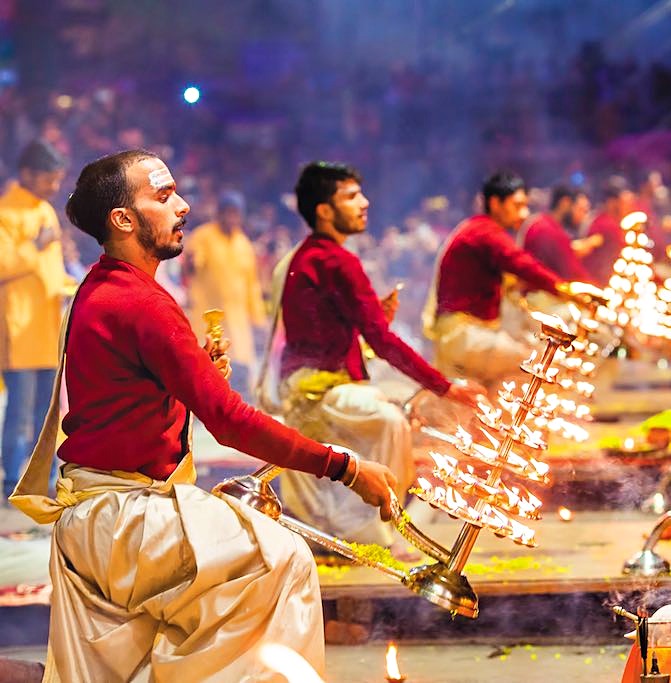
Beyond the big three, the connoisseur's calendar runs deep: Varanasi's Dev Deepawali, when a million lamps line the ghatsGhatA flight of steps leading down to a river or tank, used for bathing, worship and cremation.Read in the glossary; Kerala's snake-boat races and ten-day Onam feast (August–September); Jaisalmer's Desert Festival under February moonlight; the ecstatic Ganesh immersions of Mumbai (August–September). If your dates are fixed, we check the calendar for what India will be celebrating wherever you are — the answer is rarely 'nothing'.
Eating India: the protocol and the pleasures
Now the food — the daily festival. India's regional cuisines are effectively different national cuisines sharing a passport: Rajasthan's royal game curries and dal baati, Old Delhi's MughalMughalRelating to the Muslim dynasty of Central Asian descent that ruled most of the subcontinent from the sixteenth to the eighteenth century.Read in the glossary kebabs and korma, coastal Kerala's fish in coconut and tamarind, the vegetarian temple cooking of the south on its banana leaf. Eat regionally and the trip becomes a progress of kitchens; order 'Indian food' generically and you will eat the same three dishes for two weeks.
Street food is the crown and demands the protocol: yes — through your guide or hotel's specific recommendations, at stalls with lines and turnover, served hot off the fire, on day four rather than day one. The chaat of Old Delhi, Jaipur's kachori, Amritsar's kulchas — these are canonical experiences, and a guided food walk is the single best-value experience in urban India: fifteen tastes, zero roulette. The safe-list to eat without hesitation anywhere: anything fried before your eyes, tandoorTandoorA cylindrical clay oven fired to a very high heat, used to bake bread against its walls and to cook meat on skewers.Read in the glossary breads, dosasDosaA thin, crisp South Indian pancake made from a fermented batter of rice and lentils.Read in the glossary off the griddle, chaiChaiTea brewed together with milk, sugar and usually spices, boiled rather than infused.Read in the glossary boiled to oblivion. The skip-list: pre-cut fruit, uncooked chutneys at doubtful stalls, and anything sitting lukewarm since morning.
Begin Properly
Let a curator sketch your India
A few short questions — who is traveling, what draws you, how you like to move — and we reply with a first sketch of the journey we would design for you. No commitment; just a considered starting point.
Begin Your Private EnquiryQuestions, Answered
When are Diwali and Holi for trip planning?
Diwali falls in October–November (early November in 2026); Holi falls in March (late March in 2027). Dates shift yearly with the lunar calendar — anchor hotels early, as festival cities sell out months ahead.
Is it good to visit India during Diwali?
Magical — lamplit cities, fireworks and hotel celebrations — with caveats: peak pricing, packed domestic transport, and post-Diwali haze in the northern plains. Udaipur, Jaipur and the south wear it best.
Is street food safe in India?
Selectively, yes: busy stalls with high turnover, food cooked fresh and served hot, ideally chosen by your guide — and not on day one. Guided food walks in Old Delhi or Jaipur deliver the canon with none of the roulette.
What should tourists eat in India?
Regionally: Mughal kebabs and butter chicken in Delhi, laal maas and kachori in Rajasthan, seafood moilee and appams in Kerala, dosa and temple thalis in the south. India's regions eat like different countries — order accordingly.
What is the Pushkar Camel Fair?
Each November, tens of thousands of camels, horses, traders and pilgrims converge on the holy lake town of Pushkar — part livestock fair, part carnival, part pilgrimage, and the greatest photographic spectacle in Rajasthan's year.
From the Journal
Journeys That Answer This