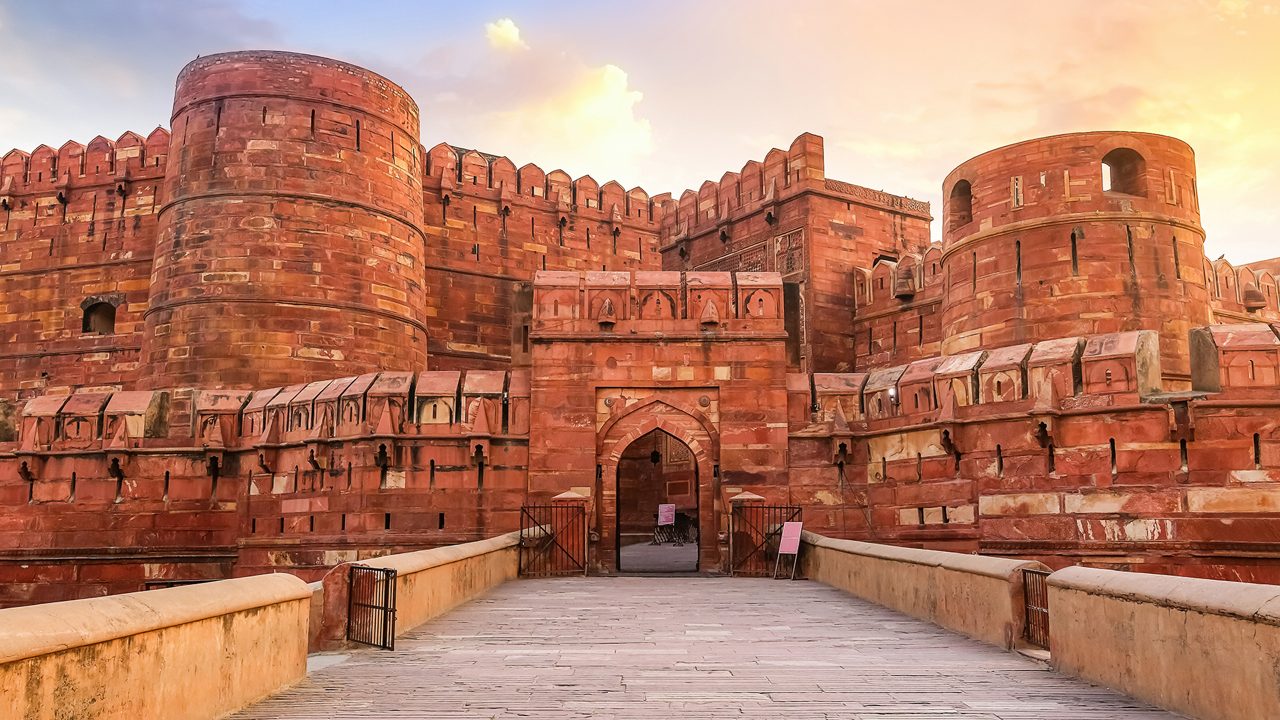
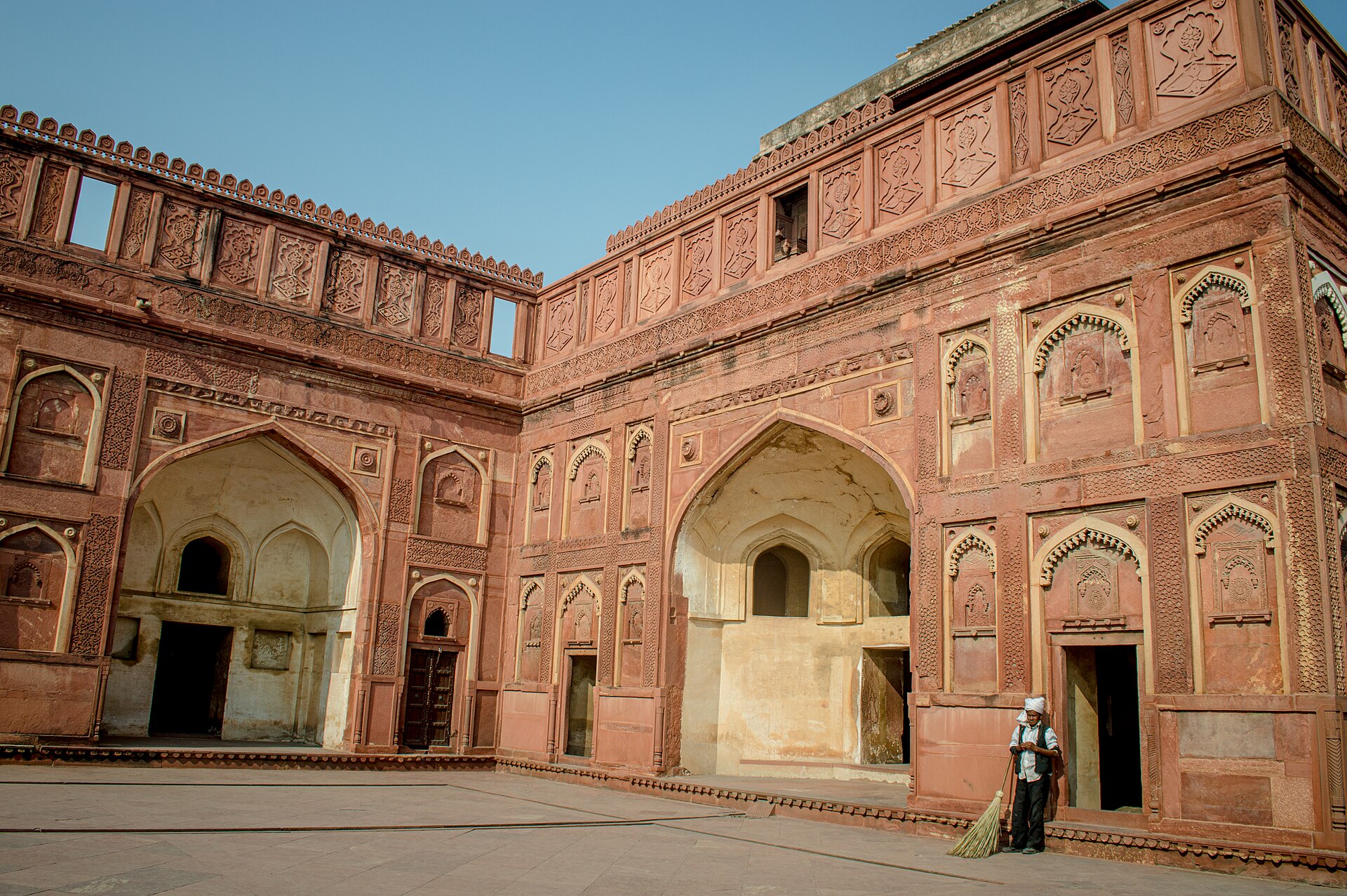
Before Delhi, this was the seat of MughalMughalRelating to the Muslim dynasty of Central Asian descent that ruled most of the subcontinent from the sixteenth to the eighteenth century.Read in the glossary power. Akbar rebuilt it in red sandstone from 1565, and Jahangir and Shah Jahan each softened it with marble, so the fort reads as three reigns arguing about taste in the same walls.
Its most affecting room is the smallest. Shah Jahan spent his last eight years confined by his son Aurangzeb in the Musamman Burj, an octagonal marble tower with one view: downriver, to the Taj Mahal he had built for his wife. He died there. Seeing the Taj from that window rearranges the monument entirely.
Visiting Well
- Go in the afternoon and keep the Taj for dawn — the fort takes hard light better, and the river view is best in the second half of the day.
- Only part of the fort is open; the northern sections remain with the Indian Army. Two hours covers the accessible palaces properly.
- Take a guide who can walk you through the succession — the building makes far more sense as family history than as architecture.
How Elevated India Arranges It
We visit in the late afternoon with a historian, finishing at the Musamman Burj as the light goes long — the Taj downriver from Shah Jahan's own window, which is the moment most guests remember over the monument itself.
Questions, Answered
Is Agra Fort worth visiting if you have limited time?
Yes — it is the counterweight to the Taj Mahal, and the two are best understood together. Allow two hours; it pairs naturally with a Taj sunrise the following morning.
Where was Shah Jahan imprisoned in Agra Fort?
In the Musamman Burj, an octagonal marble tower overlooking the Yamuna, with a clear view downriver to the Taj Mahal. He was confined there by his son Aurangzeb and died in 1666.
Journeys That Take You There
Golden Triangle: The Imperial Heritage
9 Days / 8 Nights

Cultural & Wildlife Heritage
12 Days / 11 Nights
Explore the destination guide: Agra, Uttar Pradesh ↗