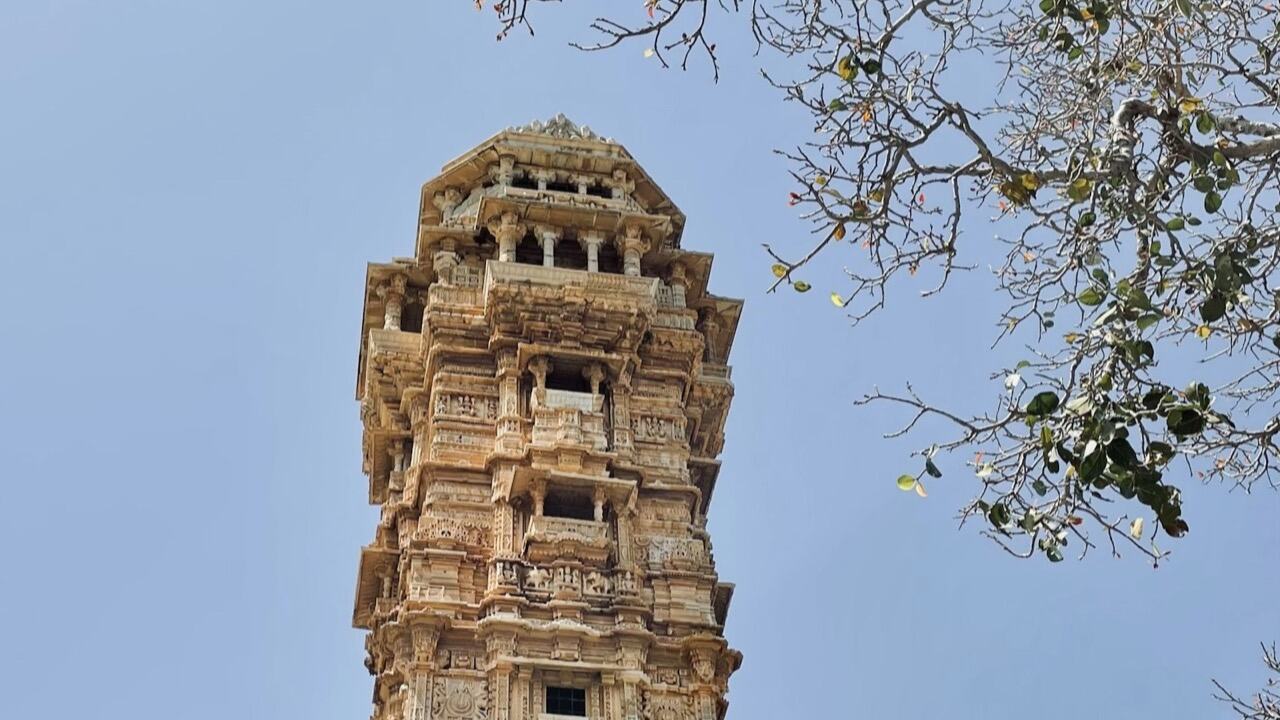
Chittorgarh covers some seven hundred acres on a plateau above the plain, which makes it the largest fort in India by a distance — you drive through it rather than walk it. It was Mewar's capital until 1568, and it was taken three times, in 1303, 1535 and 1568, each siege ending in the mass immolation the RajputsRajputA member of the warrior and landholding clans of northern India, chiefly Rajasthan, who ruled its princely states.Read in the glossary called jauhar.
That history is why the fort feels unlike any other in Rajasthan. Amber and Mehrangarh are displays of power that worked; Chittorgarh is a display of power that failed, three times, and was abandoned rather than rebuilt. The Vijaya Stambha — nine storeys of carved sandstone raised by Rana Kumbha in 1448 to mark a victory over Malwa — stands over ruins that mostly commemorate defeats.
Visiting Well
- About two hours from Udaipur, and large enough that a vehicle inside the walls is not optional.
- The Vijaya Stambha can be climbed; the stair is narrow and unlit in places.
- Allow three hours minimum. Doing it as a roadside stop between Udaipur and Jaipur does it no justice at all.
How Elevated India Arranges It
We take Chittorgarh with a guide who will tell the jauhar story properly rather than sentimentally, work the fort from the Vijaya Stambha outwards, and time the visit for late afternoon when the sandstone warms and the coach parties have gone.
Questions, Answered
Why is Chittorgarh Fort famous?
For its scale — some seven hundred acres, the largest fort in India — and for its history. Mewar's capital was besieged and lost three times, each ending in jauhar, and the fort was abandoned rather than reoccupied after 1568.
How do you visit Chittorgarh Fort?
About two hours by road from Udaipur, and you need a vehicle inside the walls; the site is far too large to cross on foot. Allow three hours, and take a guide — the ruins do not explain themselves.
Journeys That Take You There

Explore the destination guide: Udaipur, Rajasthan ↗