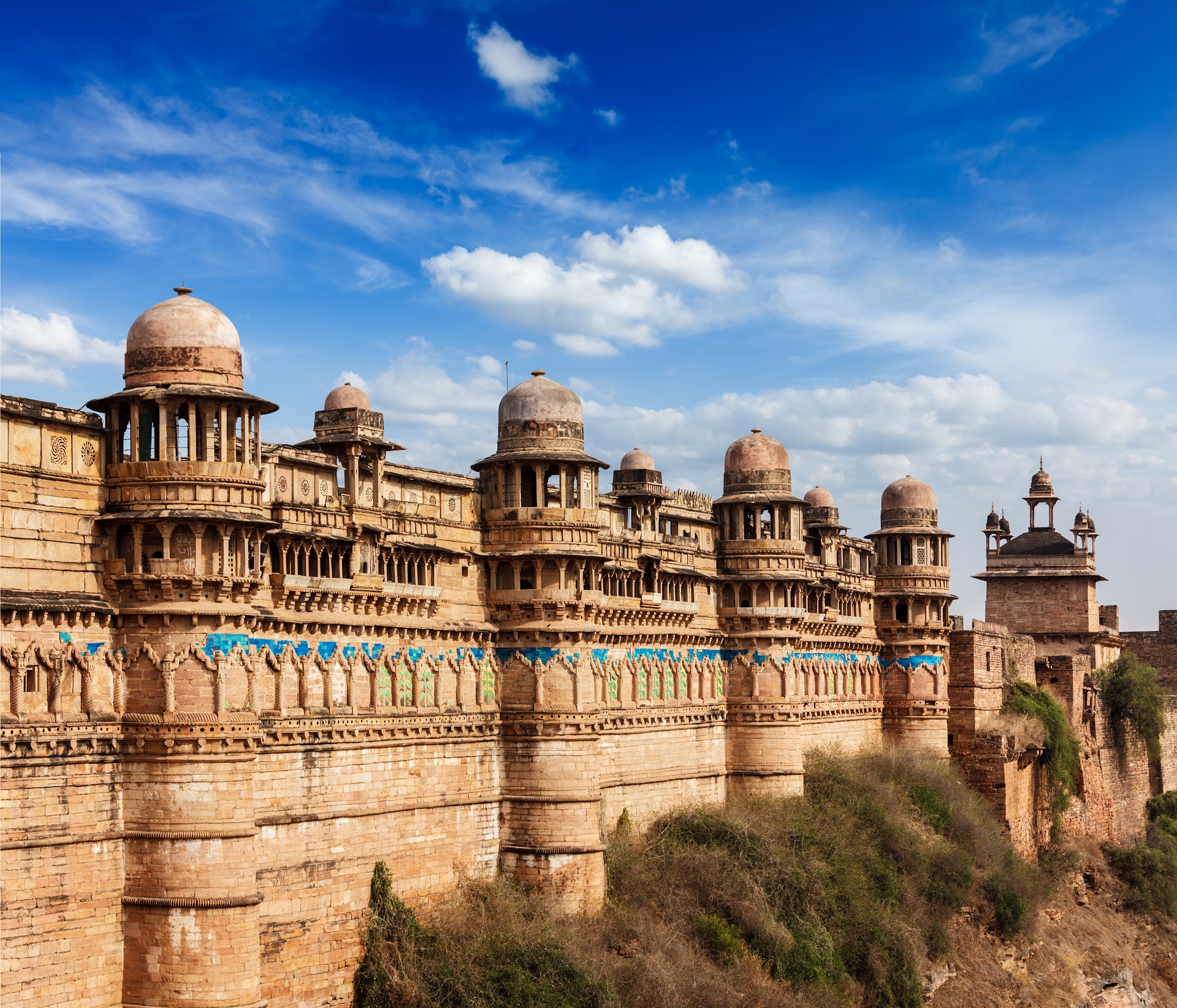
Gwalior Fort stands on a long sandstone plateau above the city, and the MughalsMughalRelating to the Muslim dynasty of Central Asian descent that ruled most of the subcontinent from the sixteenth to the eighteenth century.Read in the glossary rated it the finest hill fort in the country — Babur is said to have called it the pearl among the fortresses of Hind. The face everyone photographs is the Man Singh Palace, raised by the Tomar king Man Singh at the end of the fifteenth century and banded with the turquoise, green and yellow faience tiles that are the fort's signature, its rounded cupolas running along the eastern wall.
Behind that facade the plateau holds far more than a single palace: the eleventh-century Sas-Bahu twin temples, the tall pyramidal Teli ka Mandir, JainJainA follower of Jainism, an ancient Indian religion whose central commitment is non-violence towards every living thing.Read in the glossary figures cut into the rock of the approach, and — in the small Chaturbhuj temple — a ninth-century inscription carrying one of the oldest written zeros known anywhere, a plain circle that quietly changed mathematics.
Visiting Well
- The fort is spread across the top of the plateau; the Man Singh Palace, the Sas-Bahu temples and the museum each sit apart, so allow a half-day and a car to move between the gates rather than walking it in the heat.
- An English sound-and-light show runs at the palace most evenings after dark, using the facade itself as the screen — worth timing an overnight around.
- October to March is the comfortable window; the plateau is fully exposed, and the pre-monsoon months are punishing by late morning.
How Elevated India Arranges It
We take the Man Singh Palace first thing, while the coaches are still on the road up and the blue tiles are lit from the side, then walk the Sas-Bahu temples before the sun is overhead. Gwalior falls naturally on the drive between Agra and Orchha, so we build it in as a morning rather than a detour, and return for the evening illumination from the palace courtyard.
Questions, Answered
How long do you need at Gwalior Fort?
A half-day. The fort is a large hilltop complex — the Man Singh Palace, the Sas-Bahu and Teli ka Mandir temples and the archaeological museum are spread across the plateau — so it rewards a car between the sites and an unhurried morning rather than a quick stop.
Why is Gwalior Fort famous?
For the blue-tiled Man Singh Palace, which the Mughals rated the finest fort in India, and for a ninth-century inscription in its Chaturbhuj temple holding one of the world's oldest written zeros. Across one plateau it also gathers Hindu and Jain temples and rock-cut sculpture.
Journeys That Take You There