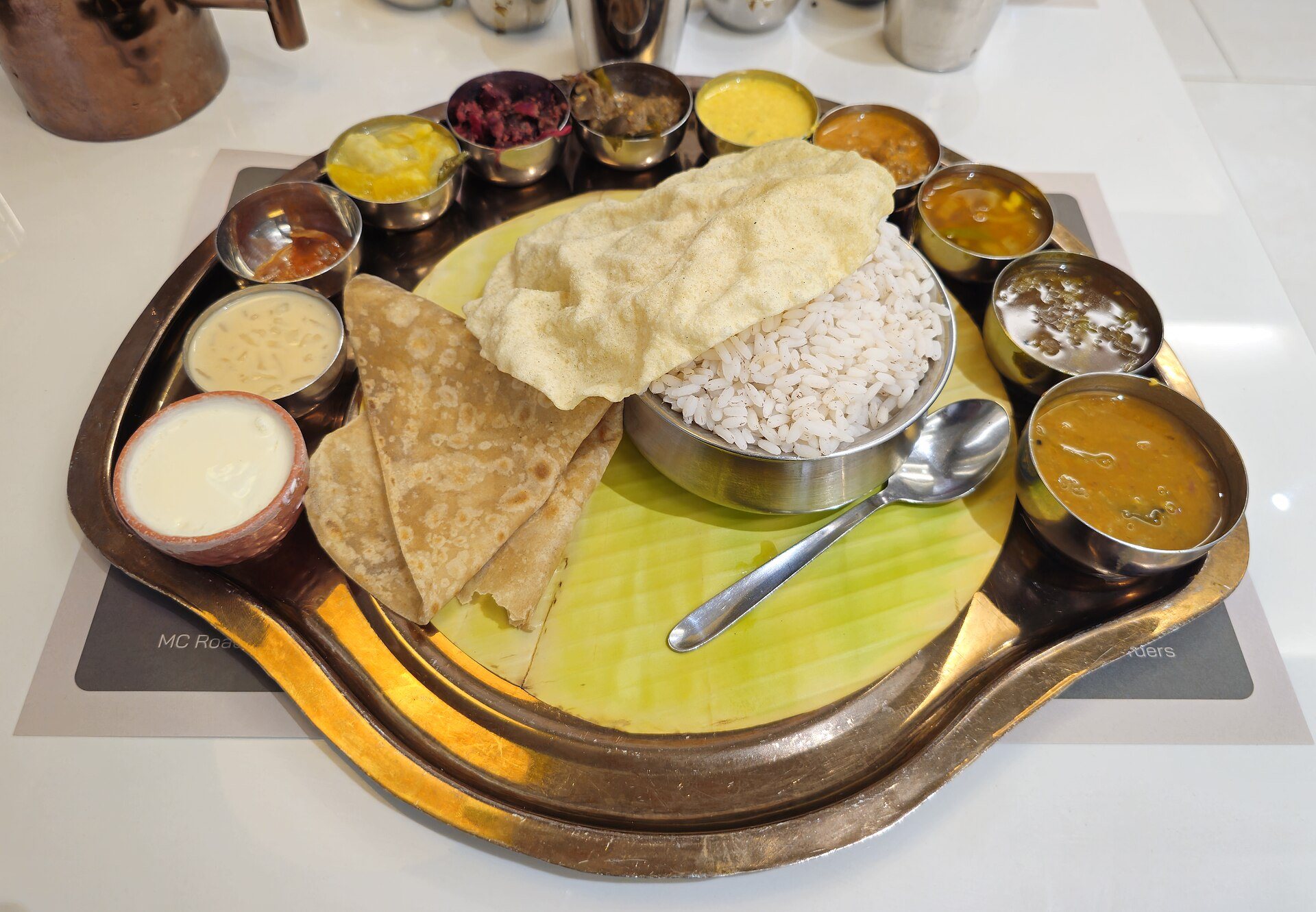
Titelfoto: A vegetarian thali, by Vis M (CC BY-SA 4.0), via Wikimedia Commons
Of everything guests write to us about before a first trip, this generates the most worry and has the least honest writing behind it. The two available genres are reassurance that everything will be fine and warnings that nothing is safe, and neither is useful.
So here is the actual position, from the regulations, from Indian clinical research, and from the carriers' own published terms. It is better news than most people expect in some places and worse in others, and the places are not the ones anyone anticipates.
One framing point before anything else. A guest travelling privately in India eats almost nothing off a menu. Meals are cooked for you, in hotel kitchens, in private houses, in camps, on trains. That is the whole proposition. It is also, as you will see, precisely the category the law does not reach — which means the thing that keeps you safe is not a regulation. It is a specific, well-briefed conversation with a kitchen, repeated at every stop.
What the law actually says, and where it stops
The Food Safety and Standards (Labelling and Display) Regulations, 2020 were notified on 17 November 2020. The chapter that matters most here took effect on 1 January 2022, and full compliance was required by 1 July 2022. A guest who last visited India in 2019 was in a different regulatory country.
Regulation 5(14) requires eight allergen classes to be declared: cereals containing gluten, naming the cereal; crustaceans; milk and milk products; eggs; fish; peanuts and tree nuts; soybeans; and sulphites. Cross-contamination may be flagged as 'may contain'.
Two details worth knowing. Sulphites are the only allergen with a numerical threshold — 10 milligrams per kilogram. The other seven are declarable at any level. And peanuts and tree nuts are collapsed into a single declaration word, 'Nut'. A packet reading 'Contains Nut' does not tell a peanut-allergic guest whether that means peanut, cashew, or both. That is a real weakness of the Indian label and worth knowing before you rely on one.
Now the part that surprises people. India does have a menu allergen rule. Regulation 9(2) requires food service establishments to show, against items on menu cards or boards, the allergen information specified in 5(14), along with the vegetarian or non-vegetarian logo. Most Western travellers assume allergen law in India stops at the packet. It does not.
And then regulation 9(3), which is where it stops being useful to you. The disclosure duty does not apply to event caterers, to premises operating fewer than sixty days a year, to self-serve condiments — or to special-order or modified meals prepared at a customer's request.
Read that last exemption against how you will actually travel. The moment the kitchen cooks for you rather than off the menu, you are outside regulation 9. The wedding in a fort courtyard is an event caterer and is exempt outright. The entire value of a good operator in India — we will have the kitchen make this specially — describes the exact category the law lets go.
That is the honest spine of this piece. India regulates the packet and the printed menu, and barely regulates the meal cooked for you. What protects you is not the regulation. It is a system, and the questions below are the system.
The coeliac section, and the thing nobody tells you
Start with the hazard that catches people, because it is specific, it is legal, and we have not seen it written about anywhere a traveller would look.
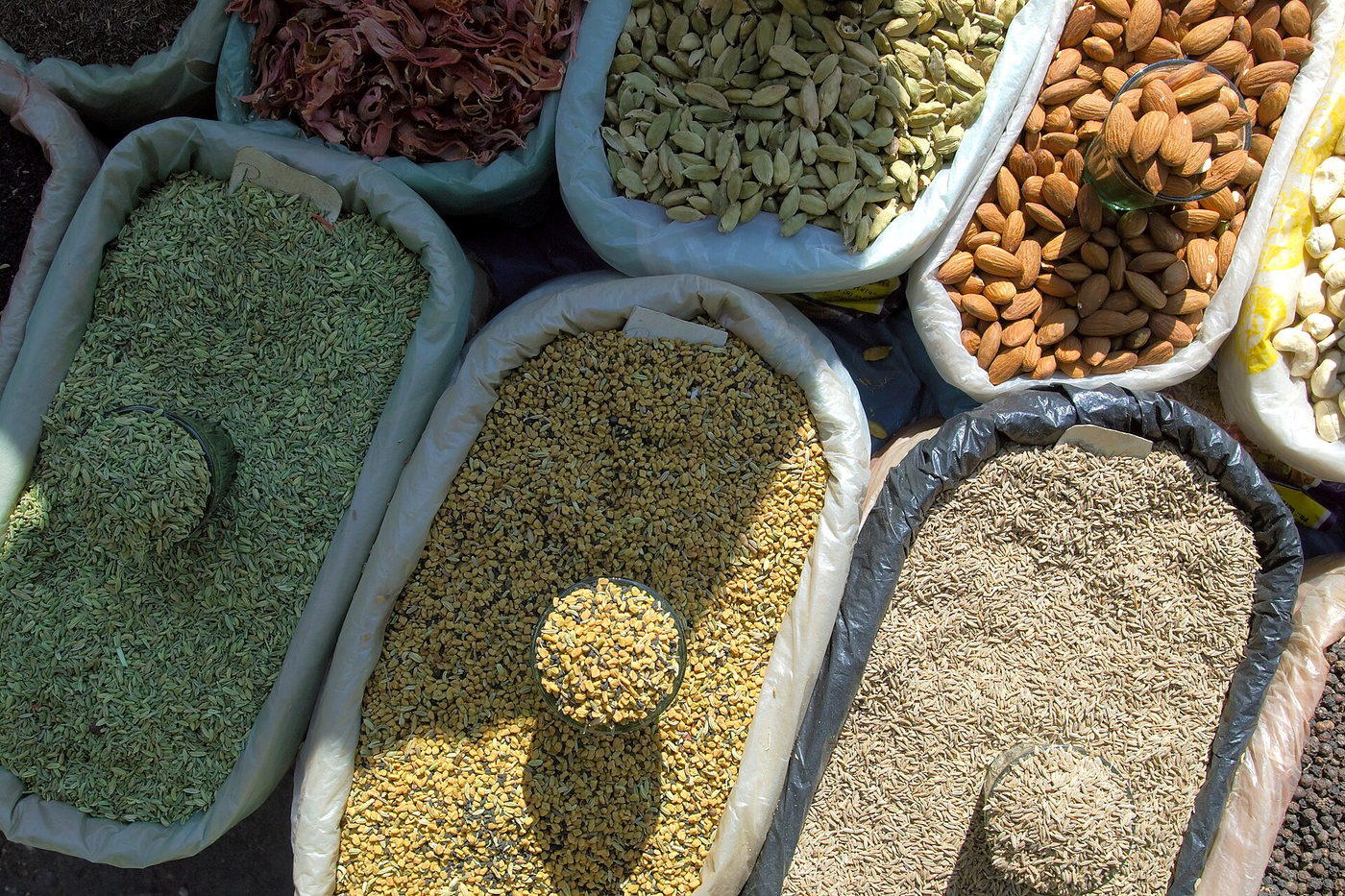
Asafoetida — hing — is the resin that gives Indian vegetarian cooking its savoury base note. The form sold in Indian shops and used in Indian kitchens is almost always compounded asafoetida, bandhaniBandhaniA tie-dye technique of Gujarat and Rajasthan in which thousands of tiny points of cloth are tied off before dyeing, leaving a field of dots.Read in the glossary hing. Indian food law defines it, at clause 2.9.29, as a mixture of asafoetida and gum arabic, edible starches or edible cereal flour. Pure hing is capped at 1 per cent starch. Compounded hing is given no starch ceiling at all.
So wheat flour in your hing is not a contamination accident. It is a named, permitted constituent, written into the standard.
Now consider where hing goes. Into dal. Into sambarSambarIndia's largest deer — a heavy, dark, shaggy animal of the forest, and the tiger's principal prey.Read in the glossary. Into pickles. Into vegetable dishes. And overwhelmingly into the tadka, the final tempering poured over the dish at the end — after the cooking anybody watched, and after the point at which anyone would think to mention an ingredient. To the cook it is not a flour. It is a spice. It will not occur to them that it is relevant.
A coeliac guest can order rice and dal, reason correctly from first principles that both are safe, and be glutened by a quarter-teaspoon of something nobody considers an ingredient.
The instruction that follows is precise and it is worth more than any amount of general caution: ask specifically whether the hing is compounded, and have the kitchen source pure resin or certified gluten-free hing for your food. Any serious kitchen can do this. None of them will think of it unaided.
Atta, maida, besan — and why the south is not the safe harbour
A smaller misconception first. Travellers sometimes arrive believing atta — wholemeal, brown, traditional — is the safe flour and maida, the white refined one, the problem. Both are wheat. So is suji or rawa, which is semolina, which means upma and most rava dosaDosaA thin, crisp South Indian pancake made from a fermented batter of rice and lentils.Read in the glossary are out. Besan is ground Bengal gram and is in principle safe.
In principle. A study at the All India Institute of Medical Sciences in Delhi analysed 794 commercially available products across the National Capital Region and found 10.1 per cent of them above the 20 milligram per kilogram threshold. That included 10.8 per cent of products labelled gluten-free and 11.8 per cent of naturally gluten-free ones. The contaminated products belonged most commonly to cereals, pulse flours, spices and bakery items.
Pulse flours and spices. Which is the besan and the hing, confirmed independently of the standard that permits it.
The uncomfortable conclusion is that a packet labelled gluten-free in India failed roughly one time in ten. India does set a legal threshold of 20 milligrams per kilogram, identical to Europe and the United States, and India is not an outlier on paper. But we could find no Indian government gluten-free certification mark. A gluten-free claim on an Indian packet is the manufacturer's own declaration against that standard.
And now the part that inverts everybody's instinct. The south eats rice; the north eats wheat; therefore the south must be the coeliac's destination. It is not, for a reason that has nothing to do with the grain.
Coeliac disease is strongly regional in India. A study of 23,331 healthy adults across three regions found disease with mucosal changes at 8.53 per thousand in the north, 4.66 in the north-east, and 0.11 per thousand in Tamil Nadu. In plain terms, coeliac disease affects on the order of one in a hundred adults in north India and is roughly eighty times rarer in the far south.
Awareness tracks prevalence. A kitchen in Delhi or Amritsar has very likely met a coeliac. A kitchen in Madurai very likely has not — and will hear the request as a preference rather than a medical condition, which is the gap in which mistakes happen.
We are not telling you to avoid the south. We are telling you that the briefing has to be more explicit there, not less.
Nuts
The structural problem here is the same shape as the hing one, and understanding that is more useful than any list.
The danger is not the nut you can see on the plate. It is the cashew that was soaked and ground into the gravy to thicken and enrich it, which is invisible, which has no texture by the time it reaches you, and which the kitchen does not think of as an ingredient in the way it thinks of chicken or paneer. Rich north Indian and Hyderabadi gravies are built this way. So are many sweets.
We deliberately are not giving you a region-by-region table of nut use, because we could find no source for one that meets the standard we hold ourselves to, and a confident-sounding regional generalisation is exactly the kind of thing that gets repeated until it is believed. The question to ask is structural: is there any ground nut or nut paste in this sauce.
On flying, read the carriers' own terms before you assume anything. Qatar Airways states plainly that it does not provide nut-free meals, and that it will serve nuts or normal meals even if there is a passenger with an allergy on the flight. That is a published position from a very good airline, and it is broadly representative. No carrier will guarantee you a nut-free cabin.
On carrying your own adrenaline, the law is reassuring and fully verifiable. Rule 36 of the Drugs and Cosmetics Rules, 1945 permits drugs forming part of a passenger's bona fide baggage, for their exclusive personal use, up to one hundred average doses, with no permit and no fee. Two or three auto-injectors are nowhere near that. Carry them in the original labelled pharmacy packaging with the prescription, and declare them if asked.
What we will not tell you is whether an auto-injector is available to buy in India, because we could not establish it from a regulatory source. Adrenaline itself is on India's National List of Essential Medicines as a 1 milligram per millilitre ampoule, designated for stocking at primary, secondary and tertiary levels; no auto-injector presentation is listed. That is suggestive and it is not the same claim, so we are not making it. The practical advice is unaffected either way: bring your own, and bring two.
On emergency access, we also decline to give you a response-time figure, because no official one exists that we could find and inventing one would be worse than useless. The verified facts are that the national emergency number is 108, that the service is free, that it is state-administered with large variation, and that advanced life support ambulances are a minority of the fleet even in a well-resourced state — 233 of 937 in Maharashtra. For a guest at risk of anaphylaxis the honest planning question is not how fast an ambulance comes. It is how far the itinerary ever gets from a tertiary hospital, and that is a question we can answer precisely for any route, before you book.
Vegan, and the green dot
This is where Indian law does something genuinely useful that almost no visitor knows about.
Indian regulations define non-vegetarian food as containing the whole or part of any animal including birds, insects, fresh water or marine animals, or eggs, or products of any animal origin. Egg is legally non-vegetarian. A packet containing egg must carry the non-vegetarian mark.
Which means the green dot is a more reliable no-egg signal than the word vegetarian is in Britain or America, where vegetarian routinely includes egg. For a vegan reading Indian packaging, a green dot excludes meat, fish and egg, and you can rely on it.
Two corrections while we are here. The non-vegetarian mark is a brown filled triangle inside a square, not a red dot — the red dot is folk memory of the pre-2020 rule. And the declaration that the only non-vegetarian ingredient is egg is permissive, not mandatory, so a brown triangle may mean egg or may mean mutton and the label need not tell you which.
And the trap. The green dot says nothing whatsoever about dairy. Milk, ghee, butter, cream, paneer, curd and whey are all vegetarian under this definition. A green dot is an egg-and-meat assurance. It is not a vegan one.
There are Vegan Foods Regulations, notified on 10 June 2022, and a standardised vegan logo becomes mandatory on 1 July 2027. Understand what they are: a claims-control regime governing when a manufacturer may call a packaged product vegan, requiring an application to the regulator, a certificate of analysis and a fee. They impose nothing on any restaurant, hotel or caterer, and will not in 2027 either. A guest who reads that India is mandating vegan labelling and expects it to help at dinner in Udaipur has misunderstood it.
The more useful fact for a vegan is geographic. India produced 247.87 million tonnes of milk in 2024-25, and per capita availability has gone from 319 grams a day in 2014-15 to 485. But the distribution is extreme: Punjab 1,245 grams a head per day, Rajasthan 1,171, Haryana 1,105 — against Tamil Nadu 384 and Kerala 197.
So a vegan's hardest terrain in India is precisely the terrain the brochures sell hardest. In Rajasthan dairy is not an ingredient choice, it is the cuisine. Kerala and the Tamil coast, where coconut does the work ghee does in the north, are where a vegan eats naturally and well rather than by subtraction. If veganism is the governing constraint of your trip, that should shape the route, not just the briefing.
Halal, kosher and Jain
On halal, the position is more specific than the headlines suggest and worth stating carefully.
For food sold inside India, halal certification is voluntary and private. The United States Department of Agriculture's own 2022 overview puts it plainly: the government neither mandates halal certification nor provides a unifying regulatory law. The certifying bodies — the Jamiat Ulama-i-Hind Halal Trust, Halal India, the Halal Council of India among them — are non-governmental. A halal logo on a packet in an Indian supermarket is a private religious attestation with no state scheme behind it.
There is a mandatory government scheme, but it applies only to exports: the India Conformity Assessment Scheme for halal meat and meat products, run by the Quality Council of India, notified by the Directorate General of Foreign Trade in 2023, with certifying bodies accredited against ISO 17065.
In November 2023, Uttar Pradesh prohibited the manufacture, sale, storage and distribution of halal-certified products in the state, with an express carve-out for food produced for export. In January 2024 the Supreme Court issued notice and granted interim protection from coercive action to the petitioner organisation and its office-bearers. It did not stay the order, and the matter has continued to be heard.
Hold the distinction, because most reporting does not. What was restricted is the certification mark on packaged goods in one state. What was not restricted is halal slaughter, halal meat, halal food in restaurants, Muslims eating halal food, or halal production for export. Headlines reading that Uttar Pradesh banned halal food are wrong. The practical consequence for a Muslim guest is narrow: in Uttar Pradesh — which contains Agra, Varanasi and Lucknow, so much of a first itinerary — there may be fewer halal-certified packaged goods on shelves. Halal meat from a halal butcher is a separate thing and is unaffected.
On kosher we will be brief and honest, because we could not establish a reliable domestic certification route. India has small, old Jewish communities, and the major airlines carry a kosher meal code. A traveller who keeps kosher strictly should plan on sealed meals rather than on local supervision, and should talk to us early so the itinerary is built around that rather than adjusted for it.
And one category Western travellers do not know to invoke, which Indian kitchens understand natively. A JainJainA follower of Jainism, an ancient Indian religion whose central commitment is non-violence towards every living thing.Read in the glossary diet excludes root vegetables — onion, garlic, potato, carrot, ginger — along with meat, fish and eggs. Every good Indian kitchen knows what Jain food is and can cook it without explanation. If you are vegan and also want to avoid onion and garlic, or if you want a kitchen to take a vegetarian request seriously as a discipline rather than a preference, saying Jain is sometimes the most efficient word in the language. The airlines carry it as a meal code too.
Flying, and the meal codes
Special meals are ordered by code, and using the code rather than a description removes a translation step. The ones relevant here are GFML for gluten-intolerant, VGML for vegan vegetarian, VJML for vegetarian Jain, AVML for Asian vegetarian, KSML for kosher, MOML for Muslim, and NLML for low lactose.
One caution. A gluten-free airline meal may contain dairy products and eggs — GFML is a gluten code, not a vegan one. If you need both, say both, and expect the airline to struggle.
Order special meals at the time of booking, not at check-in, and have them reconfirmed. On Indian domestic sectors the catering is thinner than on international ones and the honest answer is often to carry your own food for the flight, which nobody will object to.
The questions that actually work
These are what we ask on a guest's behalf at every property and with every cook. They are short, they are specific, and each one closes a gap we have actually seen.
Is the asafoetida compounded? If yes, can pure resin be sourced for this guest.
Is there any ground nut or nut paste in the gravy? Not is there a nut in the dish — is there a nut in the sauce.
What fat is this cooked in? Ghee is the default across much of north India and is not obvious on the plate.
Is the fryer shared? A gluten-free pakora from a fryer that has had bread through it is not gluten free.
Is the tadka added at the end? If so, what is in it, and can it be left off.
Does vegetarian here include egg? Usually it does not, which is good news, but ask.
Who in this kitchen will actually cook this, and will they be here tomorrow? This is the question nobody asks and it is the one that fails most often — the briefing was given to a chef who is off duty on day three.
That last one is why we brief in writing, to the property rather than to a person, and re-brief on arrival at each stop. It is unglamorous and it is the whole job.
What we will and will not promise
We will brief every kitchen in writing before arrival and again on the day, name the specific hazards for your condition rather than the general category, confirm the fat and the tempering, and build the route so that a guest at serious anaphylaxis risk is never a long way from a tertiary hospital.
We will not tell you that an Indian kitchen can be guaranteed free of cross-contamination, because no kitchen anywhere can be, and a promise like that is the thing that makes a guest relax at exactly the wrong moment.
If your restriction is severe enough that a mistake is an emergency rather than an inconvenience, say so at the enquiry stage and not in the final week. It changes the shape of the trip rather than a line on it — the properties, the regions, the length of road days, sometimes the season. Done early, that is design. Done late, it is damage control.
A note on our sources
The labelling and menu rules are from the Food Safety and Standards (Labelling and Display) Regulations, 2020, read in the regulator's own consolidated compendium. The asafoetida standard is clause 2.9.29; the gluten-free threshold is clause 2.14; the flour definitions are in the cereals chapter. The contamination figures are from the All India Institute of Medical Sciences study of 794 products in the National Capital Region. The coeliac prevalence figures are from the 23,331-adult study across Haryana, Assam and Tamil Nadu. The dairy figures are from the Ministry of Fisheries, Animal Husbandry and Dairying and the National Dairy Development Board. The import rule for personal medication is Rule 36 of the Drugs and Cosmetics Rules, 1945. The halal material is from the United States Department of Agriculture's 2022 overview, the Quality Council of India, and the reported terms of the Uttar Pradesh order and the Supreme Court's interim direction.
Four things we deliberately have not told you. Whether an adrenaline auto-injector can be bought in India. Any ambulance response time. Any Indian gluten-free certification mark, which we could not find. And a region-by-region account of nut use, for which no source exists that we would be willing to stand behind.
Reisen, die Sie dorthin bringen


Weiterlesen