 By Manu Singh
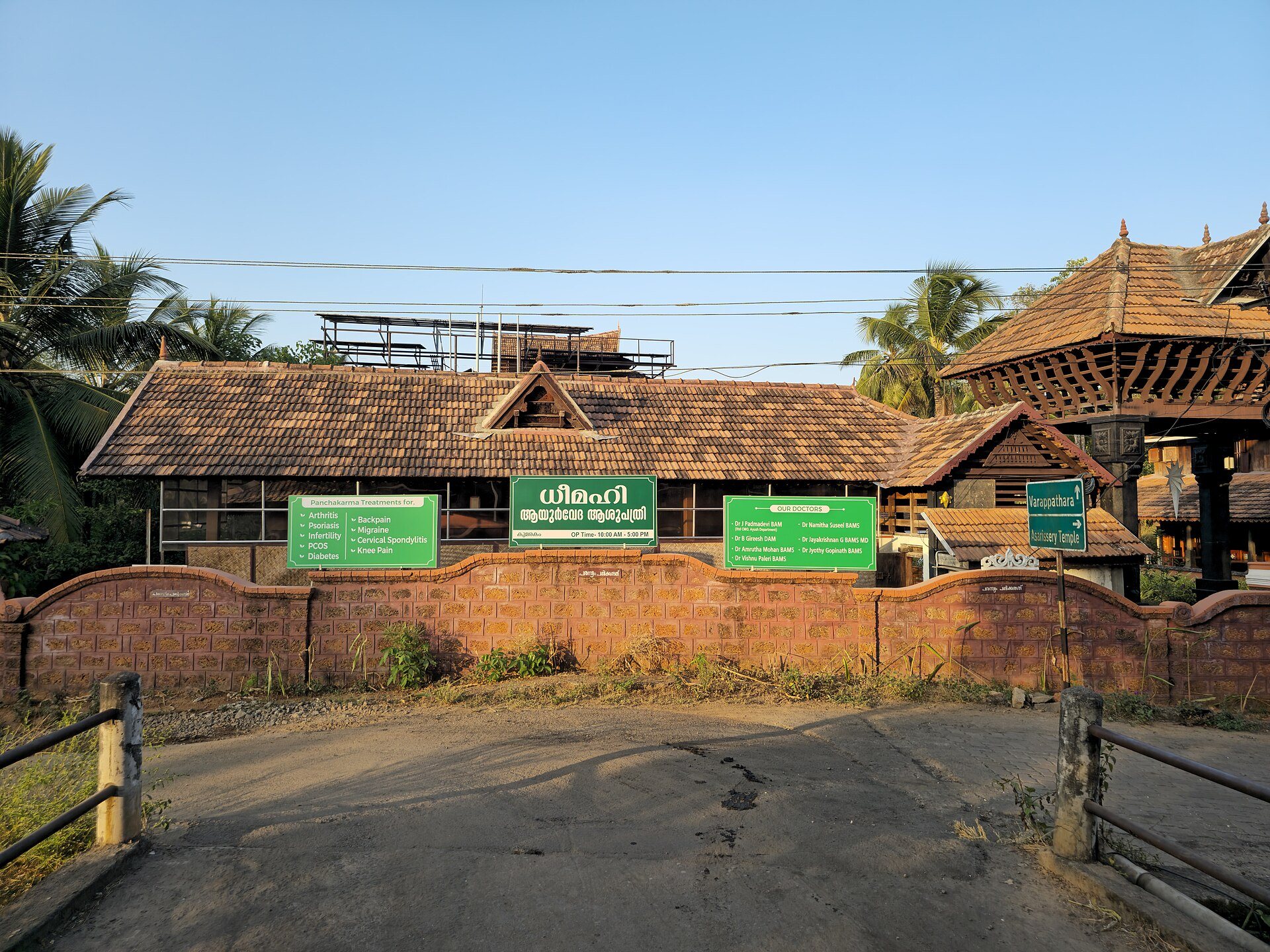
Hero photograph: Dheemahi Ayurveda Hospital, Kerala, by Vis M (CC BY-SA 4.0), via Wikimedia Commons
There are two things sold under the word Ayurveda and they have almost nothing in common. One is a supervised course of medical treatment: an examination by a physician who has studied for five and a half years, a prescribed diet, a sequence of procedures, and a graded return to ordinary food that the classical texts treat as inseparable from the treatment itself. The other is an hour of warm oil, which is a lovely thing to have and is not medicine. We have no quarrel with either. We have a quarrel with the second being sold as the first, and with guests arriving having booked a fortnight of what they believe is clinical care and finding a spa menu. This piece is the honest version — what the regulation actually says, what the classical texts actually require, and the questions that tell you in two minutes which one you are buying.
A guest wrote to us last year, three days into a booking she had understood to be a treatment course, to say that she seemed to be at a spa. She was. The hotel had not lied to her. It had used the word AyurvedaAyurvedaA traditional Indian system of medicine that treats health as a balance between three bodily humours, or doshas.Read in the glossary, which it was entitled to do, and she had supplied the rest herself.
This happens often enough that it is worth setting out properly. There are two quite different products sold under one word, the gap between them is enormous, and almost nothing in the marketing distinguishes them. What follows is the honest version: what is actually regulated, what a genuine course actually involves, and the questions that settle it before you book.
We should say at the outset that we are not debunking anything. An hour of warm oil at the end of a hard year is a good thing to buy. So is a supervised fortnight of medical treatment. The problem is only that they cost roughly the same per night and are sold with the same photographs.
The certification everybody quotes was retired seven years ago
Start here, because it is the most checkable thing in this piece and because almost the entire travel press has it wrong.
Kerala Tourism used to classify Ayurveda centres as Green Leaf and Olive Leaf. You will still see those words on hotel websites, in magazine round-ups, and in the recommendations of perfectly reputable agents. They are obsolete.
Under Government Order GO(Rt) No.27/2019/Tourism, dated 19 December 2019, the grades became Ayur Diamond, Ayur Gold House and Ayur Silver. Kerala Tourism's own page states it plainly: the second category will be awarded Ayur Gold House and the lower category Ayur Silver, instead of the existing Green Leaf and Olive Leaf categories. New-scheme certificates begin appearing on 25 February 2020.
The reason this matters is not pedantry about names. Classification is valid for three years from the date of the order, and reclassification must be applied for three months before expiry. Legacy Green Leaf certificates were being issued up to around 2018. They expired around 2021.
So a centre advertising itself as Green Leaf certified in 2026 is quoting a grade that no longer exists, under a certificate that has lapsed, from a scheme that was superseded. That is not necessarily dishonest — it may simply be a website nobody has updated — but it tells you something about how closely the property is attending to its own credentials.
And you can check it. Kerala Tourism publishes the list of classified Ayurveda centres with the order number, the grade, the date of issue and the date of expiry against each one. If a property claims a classification, ask which grade and when it expires, and look it up.
One more thing worth understanding about this scheme: it is run by the Department of Tourism, and certificates are issued by the Director of Tourism. It is not a medical regulator. Kerala's own regulatory conditions say so — classification does not substitute for licences required by other authorities. What it does require, documentarily, is a doctor's degree and registration certificates on file, and government-approved certificates for at least one male and one female therapist. That is a real floor. It is not a clinical accreditation.
NABH accredits two different things, and the website will not tell you which
The other credential you will see is NABH — the National Accreditation Board for Hospitals and Healthcare Providers. This is a genuine healthcare accreditor and its Ayush standards are real. But there are separate schemes for hospitals and for centres, and the distinction is the single most useful thing a traveller can be told.
From NABH's own FAQ: an Ayush Centre provides only outpatient services or day-care clinics. There is no bed requirement and no round-the-clock staffing requirement. An Ayush Hospital provides inpatient services, must have at least five inpatient beds, and must maintain a qualified Ayush practitioner in charge round the clock, along with a qualified nursing care provider, dedicated therapy sections and daily patient records.
Read that again with a resort in mind. A property can hold entirely genuine NABH certification as a centre while having no beds, no inpatient capability, and nobody medically qualified on the premises overnight.
A residential panchakarmaPanchakarmaThe intensive cleansing programme at the centre of Ayurvedic treatment, built around five purificatory therapies.Read in the glossary course is inpatient care. The procedures have known complications; the classical literature devotes a whole chapter to them. So NABH accredited on a spa page is not evidence of a clinical facility. The question is which scheme — and the certificate number and expiry, which NABH will verify.
Worth knowing that this is mid-transition. NABH's programme pages still list the older system-by-system standards, including the Ayurveda Hospital standard of 2016 with a ten-bed threshold, while a new unified Ayush Hospitals standard takes effect on 1 April 2026 with a five-bed threshold. Entry-level certification for both hospitals and centres runs two years.
Five and a half years, or one thousand four hundred and seventy hours
The person who examines you and the person who treats you may be two different people with very different training, and both are entitled to be there.
An Ayurvedic physician holds a BAMS: three professional phases of eighteen months each, followed by a twelve-month compulsory rotatory internship. That is four and a half years of study plus a year in post, five and a half years in total, under regulations made by the National Commission for Indian System of Medicine in February 2022. A postgraduate MD in Ayurveda takes a further three years, and Panchakarma is one of the named specialties. So a consultant panchakarma physician has eight and a half years behind them and sits on a national register.
A Panchakarma Technician holds a vocational qualification at Level 4 of the National Skills Qualification Framework, entered after the twelfth grade, of 1,470 hours. That is roughly thirty-seven full working weeks. The role is defined as delivering therapy to another professional's prescription.
Both are real. Neither is a fraud. But they are not interchangeable, and in a hotel spa the person in the room with you is almost always the second — if indeed they hold that qualification rather than a general massage one.
The useful consequence is that there is a question with a specific answer: is there a physician resident on the premises, what degree do they hold, and what is their registration number. BAMS, or BAMS with an MD, traceable on the NCISM register. Anything vaguer is an answer in itself.
What panchakarma actually is — including the part everybody gets wrong
Panchakarma means five procedures. Which five depends on which classical authority the clinic follows, and this is routinely garbled in travel writing.
The list usually printed is vamana, virechana, basti, nasya and raktamokshana — therapeutic emesis, therapeutic purgation, medicated enema, nasal administration and bloodletting. That is the arrangement usually attributed to Sushruta, and a Ministry of Ayush platform uses it too, so it is not wrong.
But Charaka's five are different, and the Charaka Samhita says so explicitly. Its list is vamana, virechana, asthapana basti and anuvasana basti — the two forms of enema counted separately — and shirovirechana, head-evacuation. On bloodletting the text is blunt: some scholars include raktamokshana among panchakarma, however this opinion is not acceptable, because it removes dosha directly without any prior effect on the vitiated dosha in the gut.
Both enumerations are legitimate. They belong to different authorities. If a centre can tell you which it follows and why, that is a good sign.
More useful than the list is the structure, which has three stages and is the same in every account.
Purvakarma is preparation, and it has four named components: deepana, stimulating digestion; pachana, dealing with what is undigested; snehana, oleation, administered internally as well as applied externally; and swedana, sudation. This is not a warm-up. Oleation and sudation are what liquefy the dosha so that the main procedure can carry them out at all.
Pradhanakarma is the main procedure, chosen by condition and by where the dosha sits.
Paschatkarma is what happens afterwards, and it is the part this piece is really about.
The graded return to food, which is where the spa version stops
After purification, a specific regimen is prescribed — samsarjana krama — to restore strength and digestive capacity. It is not advice to eat lightly for a day or two. It is a measured, counted progression.
Charaka sets it out in the Kalpana Siddhi: thin gruel, then thick gruel, then plain and then seasoned vegetable broth, then plain and then seasoned meat soup. Each item is given for three, two or one meal times depending on whether the purification was maximum, moderate or minimum. The image the text uses for why is exact — the digestive fire is rekindled gradually, the way a small spark is built into a big and stable flame.
How long it takes is a genuinely two-sided question and we will not pretend otherwise. Chakrapani's commentary, as reported in the recent literature, gives twelve meal periods for the deepest purification, eight for moderate and four for minimal — which at two meals a day is six, four and two days. The National Institute of Ayurveda's standardised protocol gives seven, five and three days. Charaka's own text counts in meals per item rather than days. The structure is certain; the duration is a range of roughly three to seven days, and it is properly counted in meals.
This is the stage that distinguishes the two products more cleanly than anything else. A centre that performs a purgative in the morning and serves the buffet that evening has not done a shortened version of panchakarma. It has omitted the stage the classical text treats as inseparable from the procedure.
So: ask whether the course has a defined end regimen, ask for it by name, and ask how many days it runs. A real centre will answer with a number tied to how deep the purification went.
How long it takes, and why nobody can give you a regulation
You will read that a real course is fourteen days, or twenty-one. We went looking for the authority behind those numbers and there isn't one. No regulation anywhere states a minimum. That is a finding rather than a gap, and it is worth knowing that the figures everybody repeats are industry convention.
But the classical arithmetic settles the question without needing a rule. Deepana and pachana reach their endpoint within two to three days. Internal oleation runs three to seven days, or until the signs of proper oleation appear. There is a rest interval between stages. Then the procedure. Then the graded re-feeding, three to seven days.
Preparation and aftercare alone therefore exceed a week, before the main procedure has been counted at all.
The honest formulation is this. A seven-night stay can contain a real, supervised, useful course of therapies under a physician. It cannot contain a complete panchakarma with proper preparation and a proper end regimen. Anyone who tells you otherwise is selling you the middle of the sandwich.
Kerala Tourism, which has every commercial reason to say the opposite, puts the floor in writing on its own consumer page: the duration of the treatment can vary from over a week to months.
You will not be sightseeing
This is the restriction guests most often fail to anticipate, and it is also the one with the clearest classical authority, so we can state it with some confidence rather than as a clinic's preference.
During the oleation stage, the Charaka Samhita prescribes what to avoid: physical exercise, sexual activity, anger and grief, loud speech, cold, direct sunlight and wind, and suppressing any natural urge. And what to observe: sleeping only at night, celibacy, warm water for every purpose, and rest.
During the cleansing therapies themselves the list is, if anything, more pointed. One should avoid excessive sitting, standing, speaking and riding, sleep during the daytime, sexual intercourse, suppression of natural urges, cooling regimens, exposure to the sun, grief, anger, and untimely or unwholesome food.
Read that list and then describe a day of sightseeing in India: several hours sitting in a car, a good deal of standing, a guide to talk to, and the sun. It is a near-complete inventory of what the text tells the patient not to do.
So no, the active phase of a real course is not compatible with seeing Kerala. The fair qualification is that gentle movement and rest are prescribed, not immobility, and that the restrictions attach to treatment days rather than to every day of a long stay. But a centre that answers the question with 'of course, do whatever you like' has told you what it is.
On alcohol we will be careful. Every serious centre prohibits it and we would expect nothing else, but we could not find a government rule or an explicit classical prohibition naming it. What is verifiable is that warm water is positively prescribed for all purposes during oleation, and that cooling regimens and unwholesome food are prohibited during cleansing. Treat the alcohol ban as clinic policy that follows from those principles, which is what it is.
The safety question, fairly
There is a real and well-documented issue with some Ayurvedic preparations, and it would be dishonest to leave it out. It would be equally dishonest to present it as an indictment of the whole system, because the data are more specific than that.
A 2004 study in JAMA analysed seventy Ayurvedic herbal products bought within twenty miles of Boston City Hall. Fourteen of them, twenty per cent, contained potentially harmful levels of heavy metals. A 2008 follow-up analysed 193 products bought from twenty-five websites and found detectable lead, mercury or arsenic in 20.7 per cent.
The detail that matters is in the second study. Products of the rasa shastra tradition — in which herbs are deliberately combined with metallic elements and minerals — were metal-positive in 40.6 per cent of cases against 17.1 per cent for the rest. Median mercury was 20,800 micrograms per gram against 34.5. So in that class of preparation the metals are an intended ingredient rather than a contaminant, which is why a blanket contamination framing is unfair and a blanket it-is-traditional framing is also unfair.
The other detail worth knowing: American-manufactured products were no better than Indian ones. 21.7 per cent against 19.5 per cent, a difference of no statistical significance. This is not a story about Indian manufacturing standards.
The consequences are documented. The US Centers for Disease Control recorded twelve cases of lead poisoning across five states between 2000 and 2003, and six cases in pregnant women in New York between 2011 and 2012, two of whom miscarried.
India's own regulation is narrower than it is usually reported. An order of 14 October 2005 made batch testing for heavy metals mandatory, effective 1 January 2006 — but for export, by self-certification, and written for purely herbal preparations, which read literally is the category that excludes the rasa shastra products the research implicates. The answer that announced it said domestic extension would follow in due course. We could not establish what followed, and we are not going to guess.
What all of this means for a traveller is narrow and practical. Panchakarma procedures and external therapies are not the issue here; internally administered proprietary medicines are. Ask what you are being given, ask whether it is purely herbal or a mineral preparation, and ask for it in writing. And if you take anything home, know what it is.
On the procedures themselves, the classical literature is its own best witness. Charaka devotes an entire chapter to the complications of improperly administered emesis and purgation, names ten of them, and apportions blame between the attendant, the drug, the physician and the patient. The tradition has always understood these as medical procedures requiring qualified supervision. It is the modern spa menu, not the classical text, that treats them casually.
The monsoon season — which turns out to be real
We went into this expecting to find that karkidaka chikitsa, the monsoon treatment season, was a marketing invention to fill Kerala's empty months. It is not.
Charaka prescribes eliminating accumulated dosha in the first month of the spring, rainy and winter seasons, and maps each accumulation to its season of elimination: what builds through the summer is cleared in Shravana, roughly July to August. The procedure-by-season table is explicit — Pravrit, the early rains from mid-June to mid-August, is the season of aggravated vata, and the therapy indicated is basti.
Karkidakam is the Malayalam month running roughly mid-July to mid-August. It sits inside that window. So the seasonal logic has a genuine classical basis, and the procedure classically indicated in it is the medicated enema.
Two qualifications keep this honest. First, three seasons are named for purification, not one — spring is the classical season for emesis and autumn for purgation. The monsoon is a classically indicated season, not the season. Second, Charaka also warns that purification needs moderate conditions and that extremes must be modified by artificial means before treatment. A heavy monsoon is arguably such an extreme.
And Kerala Tourism itself is notably unseasonal about it, pointing out that hospitals, hotels and resorts offer treatment throughout the year.
Where, besides Kerala
Kerala has the tourism classification scheme, the residential-retreat culture and the reputation, and that is a real thing rather than only a marketing one. But it is not the whole map.
Gujarat holds the Institute of Teaching and Research in Ayurveda at Jamnagar, which is an Institution of National Importance by Act of Parliament — the only Ayurveda institution with that status. Rajasthan holds the National Institute of Ayurveda at Jaipur, the first centrally funded institution of its kind to be recognised as a university. The All India Institute of Ayurveda is in Delhi and Goa.
Nationally there are 3,024 Ayurveda hospitals, 26,498 dispensaries and 371,957 registered practitioners. Within the Ayush systems as a whole, Ayurveda accounts for close to 83 per cent of hospitals.
One clarification worth making, because travel copy conflates them constantly: Tamil Nadu's great traditional system is Siddha, which is a distinct system with its own regulation, not a southern variant of Ayurveda.
The eight questions
Each of these has a specific right answer, and together they take about two minutes.
One. Is there a physician resident on site, what is their qualification, and what is their registration number? You want BAMS, or BAMS with an MD, traceable on the register.
Two. Will I be examined and given a prescribed treatment plan before any therapy begins? Classical practice requires an assessment of the patient's strength before purification, and NABH's hospital standard makes prior informed consent a core requirement.
Three. Is a diet prescribed, cooked here, and changed as the course progresses? The right answer describes a graded progression. 'There's a healthy menu' is a spa.
Four. Does the course have a defined end regimen, and how many days is it? Ask for samsarjana krama by name.
Five. Which accreditation do you hold — the Ayush hospital scheme or the centre scheme? And the certificate number and expiry.
Six. What is your Kerala Tourism classification and when does it expire? Ayur Diamond, Ayur Gold House or Ayur Silver. Green Leaf is a retired grade.
Seven. Am I an inpatient, and is there a doctor here overnight? Beds and round-the-clock cover are the dividing line.
Eight. What are the restrictions, and will I be able to sightsee? A centre running a real course will say no to the second during the active phase.
What we actually do with this
We book both kinds of thing, and we are explicit about which is which.
If what you want is a week of warm oil, good food and nothing to do, we will say so plainly and put you somewhere beautiful, and nobody needs to pretend it is medicine. That is a genuinely restorative holiday and we have no snobbery about it.
If what you want is a course, we will tell you that it needs more than a week, that it is inpatient care, that you will not see very much of Kerala while you are in it, and that it should be built as its own journey rather than appended to a tour. We will ask the eight questions above on your behalf and show you the answers.
What we will not do is let the first be sold to you as the second. That is the whole point of the piece.
A note on our sources
The classification change is from Kerala Tourism's own regulatory pages and published list of classified centres, and from the government orders named on them. The accreditation distinction is from NABH's own standards and FAQ. The qualification figures are from the National Commission for Indian System of Medicine's 2022 undergraduate regulations and the published skills-framework specification. The classical material is from the Charaka Samhita. The heavy-metal studies are the 2004 and 2008 JAMA papers and the CDC's own surveillance reports.
Three things we deliberately have not told you, because we could not verify them. Kerala's per-grade criteria — the therapist-to-guest ratios widely quoted in travel writing — are not published anywhere we could reach, so we have not reproduced them. We could not establish whether India's heavy-metal testing requirement now extends to domestic sales. And we found no classical source naming karkidakam itself, only the seasonal framework it sits inside.
Official sources
The bodies that list, manage, regulate or advise on what this article covers. Opening days, fees and rules change; this is where they are published.
- Ministry of Ayush Government of India
- Kerala Tourism Government of Kerala
Journeys That Take You There
Read Next