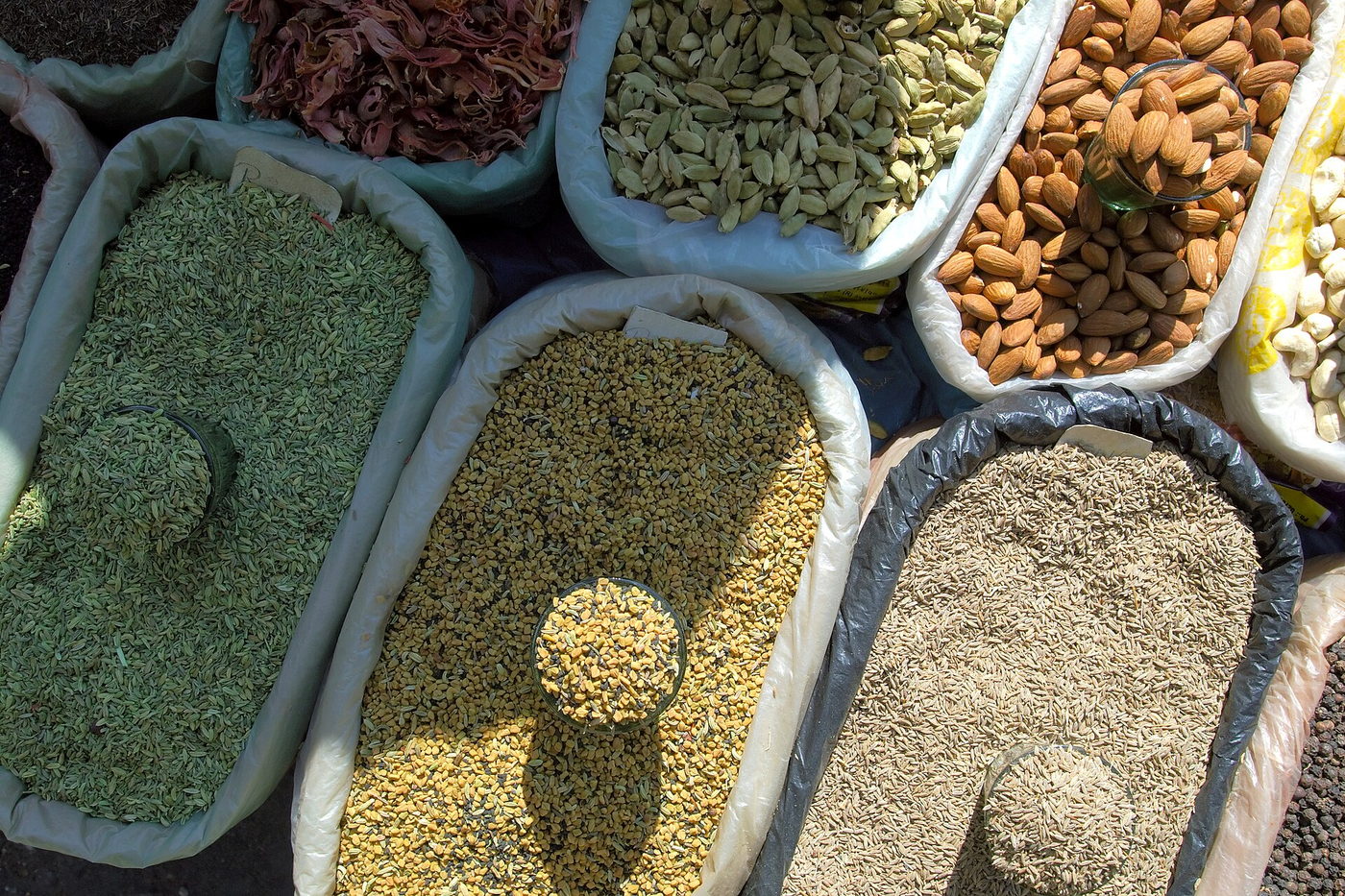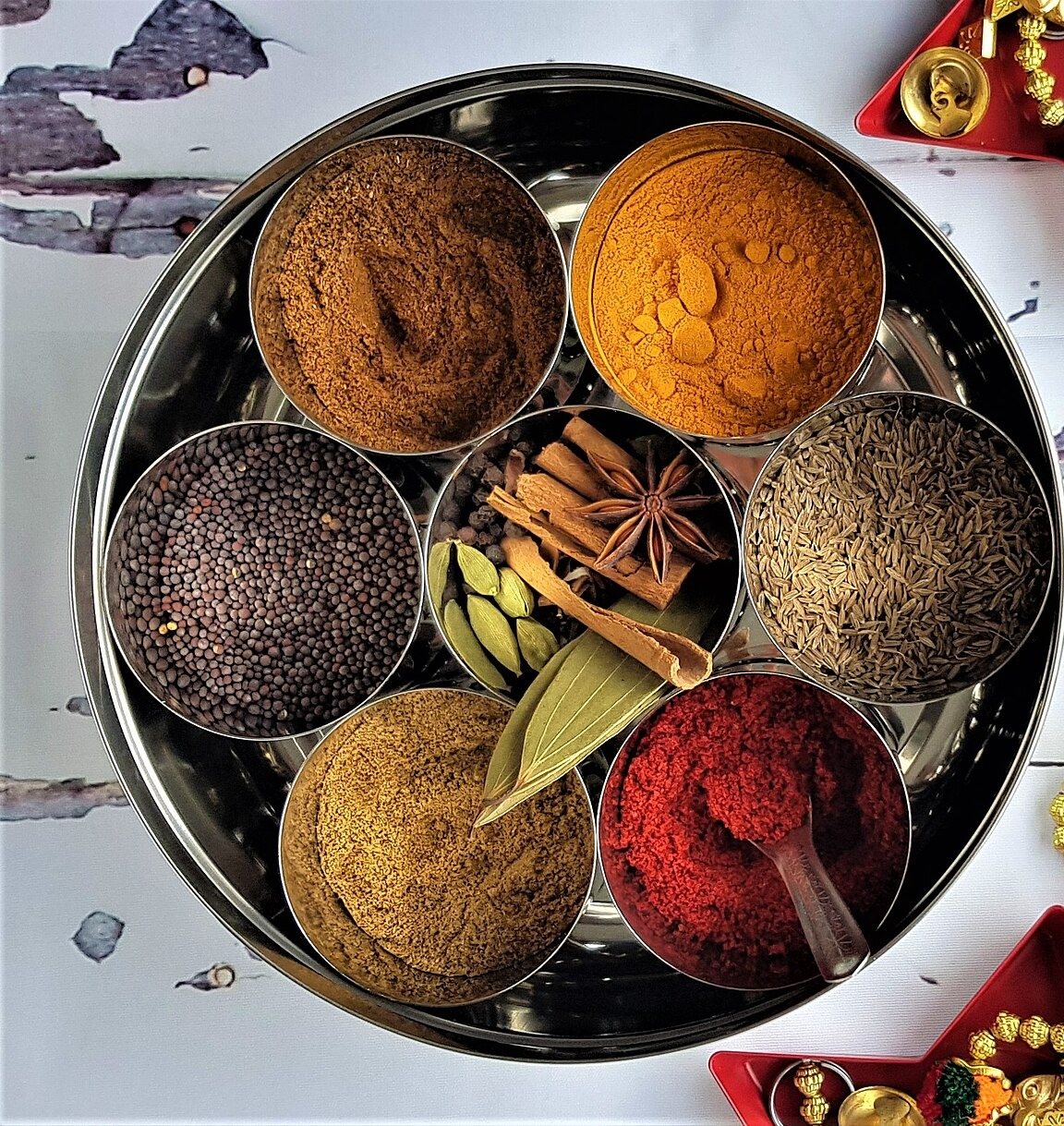
Hero photograph: Masala dabba, by Sheetal msc (CC BY-SA 4.0), via Wikimedia Commons
An afternoon cooking in somebody's house is the single most reliably good thing we arrange, and it is also the one most often sold as something it is not. The hotel version — a chef, a demonstration counter, printed recipes, a certificate — is a perfectly pleasant two hours and it is not this. The real thing takes place in a domestic kitchen, on somebody's own equipment, cooking what that household eats, and it is harder to arrange precisely because it depends on a relationship rather than a booking. What you come away with is rarely a recipe. It is an understanding of how an Indian kitchen is organised, which is the thing that makes Indian food comprehensible.
There is a thing sold everywhere in India called a cooking class, and there is a quite different thing that happens when somebody asks you into their kitchen. Both can be excellent. They are not the same, and the second is what this piece is about.
We should be fair to the first. A good hotel cooking class, run by a chef who can teach, is a genuinely useful two hours. You will learn some technique, the equipment will work, and you will eat well. If that is what somebody wants, it is easy to arrange and we arrange it.
But it is a demonstration. There is a counter, a set of pre-measured bowls, a recipe card, and an outcome known in advance. The thing we are describing is a household's afternoon, which you have been let into, and the differences start immediately.
What actually happens
You arrive at a house. There is tea first, and conversation, and it is not a preamble to the cooking — it is the beginning of being a guest, which is the frame for everything that follows.
Within ten or fifteen minutes somebody will give you something to do. It will not be glamorous. You will be picking stones out of lentils, or peeling garlic, or stirring something that needs stirring for a long time, and you will be doing it standing in a kitchen that is probably smaller and hotter than you expected while three conversations happen around you.
Nothing is measured. This is the thing that disorients Western cooks most, and it is worth preparing for. Quantities are judged by hand, by eye and by sound — the sound of mustard seeds in hot oil is a timing instruction, and if you ask how much turmeric, the answer will be a gesture. The woman doing it has made this dish several thousand times. She is not being unhelpful; she genuinely does not know the number.
The pace is the household's. If the gas cylinder needs changing, it gets changed. If a neighbour comes in, cooking stops. If a child needs something, the child comes first. You are not on a timetable and the sooner you stop looking for one the better the afternoon goes.
And then you eat what you made, sitting down, with the family, usually for considerably longer than you planned.
What you actually learn
Almost nobody goes home able to reproduce the meal, and the people who try usually produce something disappointing. That is not a failure of the afternoon.
What you learn is structure, and structure is what makes Indian food stop being a wall of unfamiliar names.
You learn what a tempering is, and — this is the one that changes how you eat for the rest of the trip — that in some traditions it goes in at the beginning and in others it is poured over at the end, and that the difference is regional and deliberate. Once you have seen it done you will notice it in every meal you eat afterwards.
You learn what is actually in a spice box, which is usually six or seven things, not forty, and that the variation between regions is in which six.
You learn the difference between a dry spice powder and a wet masala ground on a stone, and why a cuisine built on wet grinding tastes fundamentally different from one built on powders. We wrote about this in the context of Chettinad, where the whole flavour profile follows from it.
You learn the order of operations — what goes in when, and why onions take longer than anybody from outside India expects, and why the thing that looks burnt is not.
And you learn how much of an Indian meal is assembly rather than cooking: the pickle, the yoghurt, the raw onion, the papad, the two or three things made that morning and the two or three things made last month. A plate that looks like it took hours took forty minutes and a well-stocked shelf.
That is the real transfer. Recipes are available in books. The grammar is not.
Where this works best
It works everywhere, and it works differently in each place, which is an argument for doing it more than once on a long trip.
In Rajasthan, in a household in a small town rather than a city, what you learn is a cuisine built around scarcity of water and vegetables — the dried things, the gram flour, the quantities of ghee, the preparations that keep.
In Kerala, the whole structure is coconut and the sequence of a sadyaSadyaKerala's ceremonial vegetarian feast, served on a banana leaf in a fixed order of some two dozen dishes.Read in the glossary, and the fish, and a kitchen organised around things that spoil fast in heat.
In Bengal, you learn an order of courses that almost nobody outside the state knows about — bitter first, then vegetables, then fish, then sweet — and a logic to it that is explicitly digestive rather than culinary.
In the north-east, you learn a cuisine with almost no relationship to anything a visitor calls Indian food: fermentation, smoke, very few spices, and a technique set closer to Southeast Asia.
In Lucknow or Hyderabad, you learn the slow side — the dum, the sealed pot, the thing that takes four hours and is not improved by hurrying.
If a trip has room for two of these, take two in different regions rather than two in the same one. The contrast teaches more than either does alone.
Why it is harder to arrange than it looks
This is the part worth being honest about, because it explains why the real version is not simply bookable and why so much of what is sold as it is not.
A household cooking lunch for strangers is doing a favour that happens to be paid for, and the whole thing depends on the relationship between that household and the person who asked. Those relationships are built over years and they are not transferable. An operator who has one in a given town has it because somebody there trusts them; an operator who does not will send you to a commercial kitchen with a domestic-sounding name.
The test is specific and you can apply it. Ask who you are going to, by name. Ask whether they do this every day. Ask what you will be cooking, and whether it is what the family will eat that evening. A straight answer to all three is a good sign; a brochure answer to any of them tells you what you are buying.
There is also a practical ceiling. A domestic kitchen holds two or three people, not eight. If a party is larger than that, somebody is going to spend the afternoon watching, and it is better to split the group across two houses or to accept that this is a thing for part of the party.
And the household has to want to. We have arrangements we will not use in certain weeks because there is a wedding, or an exam, or somebody is ill, and the right answer is then no rather than a substitute.
Being a good guest in a kitchen
Most of this is obvious and a few bits are not.
Shoes come off, as they do in any Indian home. Ask before you photograph, including the kitchen itself, which is the most private room in the house in a way a Western visitor does not always register.
Wash your hands conspicuously and often. Nobody will say anything if you do not, and everybody will notice.
Eat with your right hand if you are eating with your hands, and it is fine to ask for a spoon. Nobody minds. What is awkward is the visitor who tries very hard and goes hungry.
Accept what is offered, and accept a small amount enthusiastically rather than refusing. We have written about this in the context of weddings and it applies doubly in a house: a polite no opens a negotiation rather than ending one, and refusing food reads as a judgement on it.
Say if you cannot eat something, and say it when the afternoon is arranged rather than when it is on the plate. A domestic kitchen cannot improvise around an allergy at the last minute, and the household will be genuinely distressed to have made something you cannot eat.
Do not offer to help with the washing up and then not help. Either help or do not.
And bring something. Fruit, sweets, something for a child. Not alcohol unless you know the household. It is a small thing and it is the difference between a transaction and a visit.
When in the trip
The middle. Not day two.
A guest who has been eating in a region for three or four days arrives with questions rather than curiosity, recognises things on the counter, and has got past the first-week wariness that makes people cautious about food in somebody's house. The same afternoon, arranged for day two, is pleasant and mostly wasted.
And ideally after you have eaten at least one meal you did not entirely understand, because that is the one you will finally understand that afternoon.
One practical note on timing within the day: this is a lunch, not a dinner. Indian households cook the serious meal at midday in a great many places, the light is better, and you will not be eating at eleven at night. Arrive late morning and expect to leave mid-afternoon, having stayed longer than you meant to.
If you take one thing from this piece, take the test. Ask who, by name. Everything else follows from the answer.
Journeys That Take You There


Read Next