India is usually explained to visitors as a north and a south. Hyderabad is the standing objection to that. The Deccan plateau developed its own courts, its own architecture, its own language in Dakhni, and its own cuisine — Persian-influenced, Telugu-inflected, and quite distinct from both MughalMughalRelating to the Muslim dynasty of Central Asian descent that ruled most of the subcontinent from the sixteenth to the eighteenth century.Read in the glossary and Tamil traditions. Under the Nizams it became, briefly, the wealthiest princely state in the world.
Golconda, and where the diamonds came from
The fort above the city is a substantial ruin and a good hour's climb, best done early. Its real significance is commercial: for centuries the Golconda mines were effectively the world's only source of significant diamonds, and the stones that passed through here include the Koh-i-Noor and the Hope. Standing on the ramparts with that in mind changes the view.
The old city
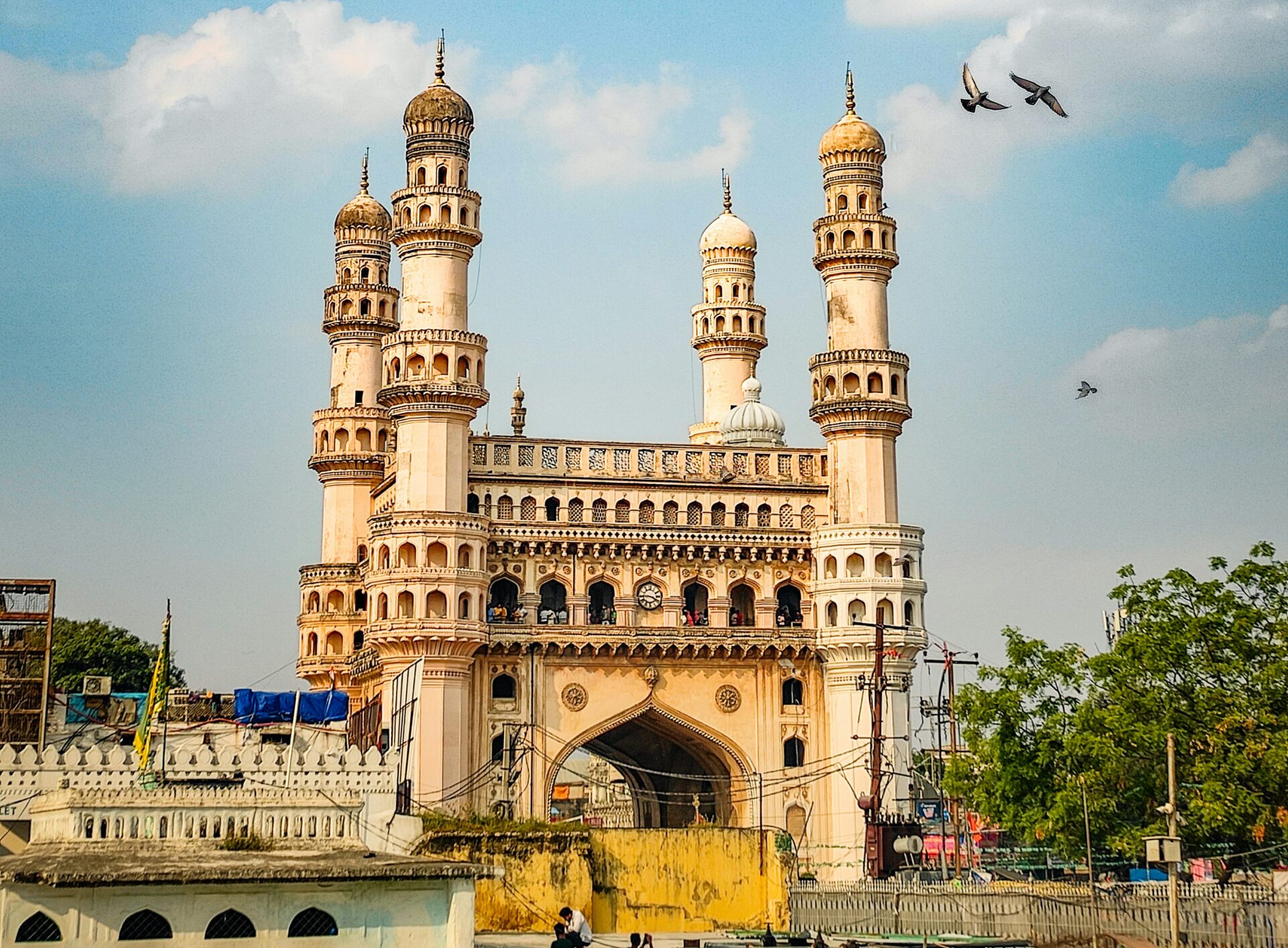
The Charminar sits at the crossroads of the old city, and the quarters around it — the bangle bazaar at Laad Bazaar, the pearl merchants, the perfumers selling attar — are dense, busy and genuinely commercial rather than arranged for visitors. Hyderabad's pearl trade is centuries old and remains serious; as with all such things, buy where someone knowledgeable takes you.
The biryani argument
Hyderabadi biryaniBiryaniA dish of rice and meat cooked together in a sealed pot, so that the rice takes up the flavour of the meat as it steams.Read in the glossary is cooked by the kacchi method: raw marinated meat and partly cooked rice sealed into a pot together and finished on slow heat, so the meat cooks in the rice's steam. It is a genuinely different dish from the Lucknawi style, where components are cooked separately and layered — and the difference is worth tasting back to back if a journey takes in both cities. Locals will have firm views. Let them.
Practicalities
Two nights is enough for the fort, the old city and one museum — the Salar Jung, an eccentric and enormous private collection, is the pick. The season runs October to February; April and May on the plateau are hot, though less brutal than the plains.
Questions, Answered
Is Hyderabad worth visiting?
Yes — particularly for travellers who have seen the Golden Triangle and want an India that fits neither the northern nor the southern template. Its Deccan culture, food, and the legacy of the Nizams are distinctive, and it is far less visited than cities of comparable interest.
What is Hyderabad famous for?
Its biryani, the Charminar and the old city bazaars, Golconda Fort and the diamond trade that made it wealthy, the pearl market, and the extraordinary accumulated riches of the Nizams.
How is Hyderabadi biryani different?
It is made by the kacchi method — raw marinated meat and partly cooked rice sealed in a pot and cooked slowly together, so the meat cooks in the rice's steam. Lucknawi biryani, by contrast, cooks components separately and layers them.
How many days do you need in Hyderabad?
Two nights covers Golconda Fort, the Charminar and the old city bazaars, and the Salar Jung Museum, with time for a proper meal.
When is the best time to visit Hyderabad?
October to February. The Deccan plateau is milder than the northern plains but April and May are still hot.
Journeys That Take You There
Read Next