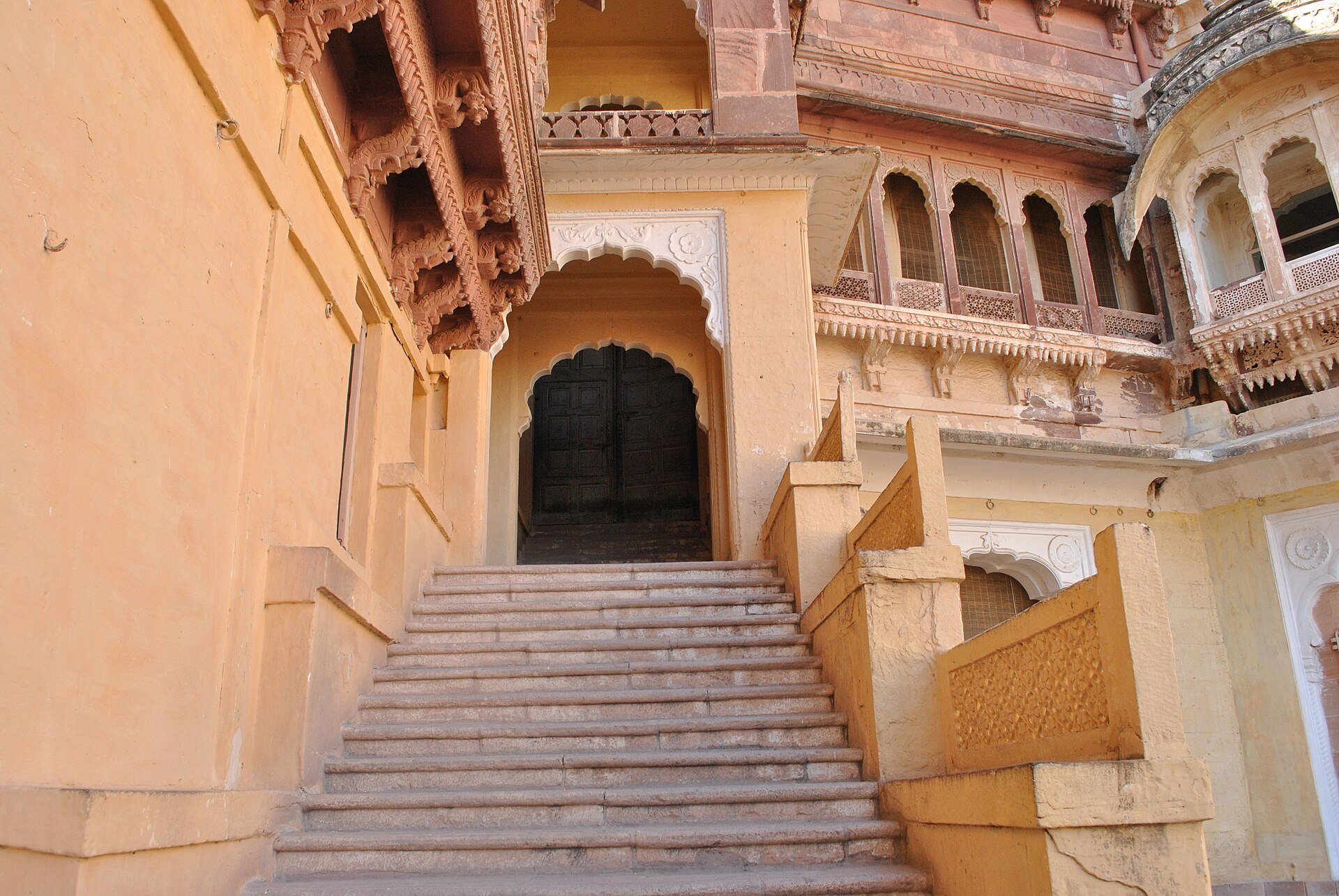
Hero photograph: Stairs in Mehrangarh Fort, Jodhpur, by Schwiki (CC BY-SA 3.0), via Wikimedia Commons
There is a separate piece on this site about what a multi-generational family should do in India. This one is only about what the bodies in the party can take, because that is the part that gets guessed at. We have gone to the clinical guidelines, the government advisories and the hospitals' own pages, and the picture that comes back is not the one travel writing paints. Age is not in the altitude risk stratification at all. The dangerous decision is the Delhi-Leh flight, not the pass above it. The documented physiological cost of a fast itinerary is thrombotic and it accumulates across four weeks. And the thing that should actually shape where you go is not stamina — it is the distance from each night's bed to a cardiac catheterisation laboratory.
We have written elsewhere about what a family of three generations should actually do in India — the places that reward everybody at once, the rhythm of a day that works for a six-year-old and a seventy-eight-year-old. This piece is about something narrower and less pleasant: what the bodies in the party can take.
It is narrow deliberately. Almost everything written about older travellers and India is guesswork dressed as advice, and some of it is medically wrong in ways that matter. So we went to the clinical guidelines, to the government advisories, to the hospitals' own pages and to the Ministry of Home Affairs' permit schedules, and we have reported what is there, including where it contradicts itself and where there is simply nothing.
Two notes before we start. Nothing here is medical advice; every clinical point is attributed to the body that published it, and the decisions belong to your own doctor. And where we could not verify something we say so, because on this subject a confident sentence with nothing behind it is worse than no sentence at all.
Altitude: the thing everybody gets backwards
Start with the fact that reframes the whole conversation.
The Wilderness Medical Society's clinical practice guidelines — the standard reference, updated in 2024 — stratify altitude risk entirely by prior altitude-illness history, target altitude and ascent rate. Age does not appear. The CDC's Yellow Book goes further and records that people aged over fifty have slightly less risk than younger travellers.
There is a minority literature arguing the opposite, and the evidence is contested. The best-documented recent study we could read, of 383 adults ascending rapidly above 5,000 metres, found age over forty associated with severe altitude illness on univariate analysis — and the association did not survive multivariable adjustment.
So the family that leaves the grandparents in Leh and takes the twenty-five-year-old up to Khardung La has it backwards on acute mountain sickness specifically. What genuinely changes with age is not susceptibility. It is the comorbidity load, and the consequence of being unwell a long way from a hospital. That is the real argument and it is a better one, and most of this piece is about it.
The threshold, for the record, is lower than people think. The Wilderness Medical Society puts increased risk above 2,500 metres; the CDC uses a sleeping altitude of 2,450 metres. Shimla, at about 2,200 metres, sits below it. Leh airport, at 3,256 metres, sits well above it.
The Delhi-Leh flight is the decision
If there is one sentence in this piece worth acting on, it is this one.
A 2023 study in the Journal of Travel Medicine compared arrival by air with ground ascent across destinations from 2,200 to 4,559 metres. Arriving by air, acute mountain sickness incidence rose 11.5 per cent per hundred metres of altitude gain. Ascending on the ground, 2.1 per cent. That is a four and a half times steeper gradient. Flying to 3,740 metres produced an 84 per cent incidence. Hiking to 3,650 metres produced 34 per cent.
Leh town sits at about 3,500 metres and the airport at 3,256. The flight from Delhi is roughly eighty minutes. The CDC says the same thing in operational language: destinations requiring rapid ascent by aeroplane above 3,400 metres put travellers in a high-risk category, with rates of altitude illness approaching fifty per cent, and a low threshold for chemoprophylaxis is advised.
The flight is the single highest-risk decision on a Ladakh itinerary, and it is the one almost everybody makes, because it saves two days.
There is official Indian guidance and it exists in three versions that do not agree. The Department of Tourism of the Union Territory of Ladakh published an advisory in September 2024 requiring all arrivals to undergo a minimum of twenty-four hours of acclimatisation before travelling higher, forty-eight hours before mountain passes, and specifically to avoid Pangong within one to two days of arrival. The same department's website prescribes forty-eight hours, with complete rest and no sightseeing on day one. A district administration order reported in 2022 made forty-eight hours mandatory following eleven altitude-related deaths in two months.
We should also say plainly that we could not find any checkpoint where this is enforced.
The guideline ascent rate above 3,000 metres is no more than 500 metres of sleeping-altitude gain per day with a rest day every three to four days. The CDC adds a usable version: avoid ascending to a sleeping altitude above 2,750 metres in a single day, and allow an extra night for every thousand metres gained.
On acetazolamide we will report rather than advise, and the reporting is itself informative. The Wilderness Medical Society and the CDC both give 125 milligrams every twelve hours for prevention, with 250 twice daily being the treatment dose. Three official Ladakh government sources give three different regimens, one of them at twice the guideline prophylactic dose. If you want a number, get it from your own doctor, and not from a hotel or a website.
Who should not go up at all
The CDC's Yellow Book has the clearest published list of contraindications: unstable angina; myocardial infarction or stroke within ninety days of ascent; severe chronic obstructive pulmonary disease; and sickle cell anaemia. Caution and individual assessment for stable angina, poorly controlled arrhythmias, non-revascularised coronary disease, mild to moderate COPD and sickle cell trait. On pregnancy it suggests not sleeping above about 3,050 metres.
The Wilderness Medical Society's own 2025 review of pre-existing conditions is newer, more specialist and notably more permissive: patients with stable, well-managed chronic illness can tolerate moderate or high altitude, while advanced cardiopulmonary disease warrants individual evaluation. It documents stable heart failure and coronary disease patients tolerating 3,454 metres. The two are both legitimate and they genuinely diverge, which is why the answer here is a pre-travel assessment rather than a rule from an article.
Three specific points from that review that almost never get written and that matter to this family. Patients on warfarin face a risk of impaired coagulation above about 2,400 metres and need monitoring, and altitude itself induces hypercoagulability. Both obstructive and central sleep apnoea worsen at altitude, and CPAP machines have altitude-dependent performance problems — so the grandparent who brings the machine is not thereby fine. And asthma should not be lumped in with COPD: the same review cites asthma patients reaching Everest-region altitudes.
The Ladakh advisory's own list is consistent with this: physician consultation for heart and lung conditions and for diabetics, pregnant women advised against sleeping above ten thousand feet, and sickle cell anaemia or severe pulmonary hypertension to avoid high altitude entirely.
The permit regime, which reshapes the itinerary before medicine does
This is the constraint nobody writes about and it is often the one that actually decides the trip.
For foreign nationals, Ladakh, Sikkim and Arunachal are not open country. The Ministry of Home Affairs' schedule of Protected and Restricted Areas governs them, and three things in it matter.
The Ladakh protected-area permit runs to a maximum of seven days, on named routes — Leh to Khardung La and on to Panamik in Nubra; Leh to Tso Moriri via Chumathang; Leh to Pangong as far as Spangmik. Permits are issued for groups of two or more, not individuals.
In Sikkim, the areas named as open to foreign nationals are Gangtok, Rumtek, Phodong, Pemayangtse, Khecheopalri and Tashiding, plus named trekking circuits. Nathu La and Tsomgo are not among them. If a Sikkim itinerary has been sold to you with Nathu La in it, check that before you travel.
The whole of Arunachal is protected area, with Tawang permits issued through the Resident Commissioner in Delhi or the Deputy Resident Commissioners in Kolkata and Guwahati.
There is an accidental grace in the seven-day Ladakh cap: it is roughly the acclimatisation-compatible length of a Ladakh trip for an eighty-year-old anyway.
Stairs and surfaces, and an honest admission
We set out to give you a verified account of the physical access at the monuments India itineraries actually visit. We cannot, and the reason is itself the finding.
The Archaeological Survey of India does not publish per-monument accessibility information. There is no register of which monuments have ramps, which have wheelchairs, or where the steps are. We checked the ASI's own estate, the official Taj Mahal site, the government's press releases on monument conservation and the accessibility campaign's own documents.
There is a programme. The Accessible India Campaign, launched in December 2015, is run by the Department of Empowerment of Persons with Disabilities rather than by the Ministry of Culture, and its reported achievements are overwhelmingly airports, railway stations and government buildings. On heritage it reports twenty-eight projects implementing barrier-free heritage sites, without naming them. The ASI's own vehicle is the Adarsh Smarak scheme, under which a hundred monuments were identified for upgraded amenities including facilities for physically challenged visitors — the list is not published, and a later description of the same scheme lists Wi-Fi, cafeterias and lighting without mentioning physical accessibility at all.
So anything you read about ramps and wheelchairs at Indian monuments — including anything in this piece — is observation and ground knowledge, not published fact. We would rather say that than pretend otherwise.
What we can verify is the exception, and it is worth naming because it shows what good looks like. The City Palace Museum in Udaipur publishes its own provision: an accessible lift requested at the information desk at Moti Chowk, a free wheelchair service, ramps, side railings on the steep stairs, an accessible restroom, electric cars from the palace gates, braille guidebooks, and a sensory guide for visitors on the autism spectrum identifying which spaces are overstimulating. And then, crucially, the honest caveat in the museum's own words: because of the different levels and narrow stairways this is not possible in all areas.
Provision, published, with its limits stated. That is the model, and it is close to unique.
On Mehrangarh in Jodhpur, the lift is the most repeated accessibility claim in Indian travel writing and we could not verify it. The Mehrangarh Museum Trust's own site does not mention a lift, an elevator, wheelchairs or steps. Visitors describe one constantly. A family relying on it should ring the Trust, not read an article.
At the Taj Mahal, three things are published and useful. The shoe covers are free with the foreigner's ticket only; Indian-ticket holders do not get them, and the alternative is the free shoe racks below the mausoleum, which means barefoot on marble — a burn risk in May and a cold shock in January. The main mausoleum costs an extra ₹200 on top of the entry ticket, which means the steps up to the plinth are a separately ticketed, optional decision a family can straightforwardly opt out of without missing the building. And the battery bus and golf cart from the ticketing area are included with the foreigner's ticket, which matters because the walk from the car park is long.
On Amber in Jaipur, one correction. The elephant rides have not been banned. Amber is administered by the Rajasthan Department of Archaeology and Museums rather than the ASI, and as of January 2025 the ride fare was fixed at ₹1,500 with a five per cent annual increase, following a High Court direction to revise the rates. About seventy-five elephants operate there. What has bitten is individual animal fitness — the Forest Department declared twenty elephants medically unfit for joy rides. Animal welfare organisations continue to campaign for motorised replacement. We mention it because families ask, and because the answer in circulation is wrong.
Where the hospitals actually are
This is the section that should decide the itinerary, and it is the one nobody writes.
Start with Ladakh, because it is the most consequential. SNM Hospital in Leh is the hospital for the whole territory. From the district administration's own health pages and the hospital's own site: 150 beds, thirteen departments, a CT scanner, and — in the hospital's own words — it may acquire the latest version of MRI in the recent future. Cardiology is not listed as a department. Neurosurgery is not listed. There is no mention of an intensive care unit on either page. The hospital's stated vision is to become a regional tertiary care centre, which is to say that by its own account it is not one yet.
Put that plainly. An eighty-year-old having a heart attack at Pangong Tso is a very long way from a catheterisation laboratory, and the nearest one is in another state.
Elsewhere the distances are verifiable from the park authorities themselves. Gir is 160 kilometres from Rajkot and 370 from Ahmedabad. Bandhavgarh is 170 kilometres from Jabalpur and 32 from Umaria. Kaziranga is 217 kilometres from Guwahati and 95 from Jorhat. These are three to six hours by road, on roads nobody would want driven fast at night, to reach a city where a tertiary hospital plausibly exists.
We are deliberately not attaching a clinical time window to that, because we could not verify an Indian guideline source for one. But three hours from a hospital is the operative fact for a family travelling with someone who has cardiac disease, and it belongs in the planning conversation rather than in a footnote.
On air ambulances, the honest answer will surprise people. India's civil helicopter emergency medical service is a pilot project, and the government's own specification for it is daylight only — standby from sunrise until sunset with a twenty-minute response — with a 300-kilometre range requirement and capacity for one patient, one medical attendant and the pilot. No family member travels.
In Ladakh the documented evacuations of civilians are flown by the Indian Air Force. A seventy-year-old Ladakhi resident was moved from Leh to Chandigarh by a C-130 in pitch darkness using night-vision goggles. That is a military capability. You cannot buy it, schedule it or insure for it.
Compounding all of this: Leh's flights operate in the morning because of afternoon mountain winds, with a unidirectional approach over higher terrain. We could not verify that at the aviation authorities, so take it as well attested rather than official — but it constrains the flight in and the flight out, and the flight out is the one that matters.
What a reader should take from this is not that Ladakh is off limits. It is that the evacuation plan everybody assumes exists does not, and the decision about whether an eighty-year-old with a cardiac history goes to Pangong should be made knowing that.
Insurance, which is the part nobody reads
The UK Foreign Office's own country advice for India says travellers need appropriate insurance for local treatment or unexpected medical evacuation, that medical facilities differ from those at home especially in remote areas, and that specialised treatment may not be available outside major cities.
Four things a policy has to do for this family. Cover treatment in private hospitals. Cover emergency transport, which is often charged separately. Cover repatriation. And carry a declaration of existing conditions — the government's own guidance is explicit that failing to declare something may invalidate the policy, and annual policies frequently carry age restrictions above sixty-five.
On cost, we will give you the comparators rather than invent an India figure. The UK government's published examples are a leg fracture requiring evacuation from Spain at over £25,000, surgery after a quad bike accident in Greece at over £80,000, and a stomach infection and evacuation from the United States at over £150,000. The Association of British Insurers reported £472 million across more than 500,000 travel insurance claims in 2024, with medical the most frequent category at 34 per cent, total medical payouts of £262 million and an average claim of £1,528 — and a largest single claim of over £1 million.
That distribution is the point. The average claim is modest and the tail is enormous, and the only number on the policy that matters to this family is the evacuation and medical limit. A million is not generous. It is the floor.
Heat, air and the shape of the year
The season is not about comfort for this party. It is about physiology.
The Meteorological Department's own climatology for Jaipur gives normal mean maxima of 40.5°C in May and 39.3°C in June — and, the figure travel writing never quotes, normal mean minima of 27.5°C and 27.2°C in the same months. The nights give no recovery. For heat stress in an eighty-year-old, the overnight minimum matters as much as the daytime peak. The department's own heat wave criteria name infants, the elderly and people with chronic disease as the vulnerable groups.
Delhi's air is the other seasonal constraint, and the official numbers are worse than most visitors expect. The Central Pollution Control Board's own nine-year comparison records that in 2024 Delhi had zero days in the Good category and eighty-four days above an air quality index of 300. On 24 December 2024 the index stood at 369 with PM2.5 at 260 micrograms per cubic metre. On 1 January 2025 it was 328 — and across the preceding decade, 1 January fell in the Very Poor band in seven years out of ten.
The official health guidance under the graded response plan's severe stage is exact: children, the elderly and those with respiratory, cardiovascular, cerebrovascular or other chronic diseases to avoid outdoor activities and stay indoors as much as possible. The Foreign Office says the same, naming October to February as the worst months.
There is a logistics consequence too, which we have not seen written anywhere. The graded response plan's restrictions on older vehicles apply across Delhi and Gurugram, Faridabad, Ghaziabad and Gautam Budh Nagar. A pre-booked car can become non-compliant mid-trip, and the airport transfer is inside the affected zone.
What we actually recommend, for a party with a grandparent who has a respiratory or cardiac condition, is to treat Delhi in December and January as a transit point rather than a destination, and to put the sightseeing days elsewhere. That is a bigger change to an itinerary than it sounds, and it is the right one.
The children, and the one thing to raise with a doctor
On altitude, the authorities disagree sharply and we are not going to resolve it for you. The CDC says children are as susceptible as adults. The UIAA's mountain medicine commission sets hard sleeping-altitude ceilings — about 1,600 metres for infants under one, a preference for below 2,500 metres for preschool children, a 300-metre daily ascent rate rather than the adult 500. The Ladakh Police page says children under sixteen are more susceptible. And on drugs the divergence is flat: the CDC and the Wilderness Medical Society publish paediatric acetazolamide doses, while the UIAA says drug prophylaxis in childhood should be strictly avoided because there are no data.
The one thing all of them agree on is the practically decisive one: young children are not reliable reporters of symptoms. Preverbal children present with loss of appetite, irritability and pallor, and in under-threes ordinary travel upset looks identical. A parent at altitude is reading a child who cannot tell them what is wrong.
On vaccination, the UK's national travel health service recommends hepatitis A, tetanus and typhoid for most travellers to India, with Japanese encephalitis, rabies, hepatitis B and others for some, and being up to date with the routine childhood schedule as the baseline. Measles appears separately in that second list, which matters because a child with one MMR dose rather than two is the common real-world gap.
And then the thing we would genuinely raise with a travel clinic, because the data behind it is striking and almost nobody writes it this way.
India records around 5,726 human rabies deaths a year on the Indian Council of Medical Research's 2024 estimate, with 9.1 million animal bites annually and dogs responsible for up to 99 per cent of transmission. Forty per cent of people bitten by suspected rabid animals are children under fifteen, and the reason is mechanical: children play with animals and are more likely to be bitten on the face or neck, and incubation depends on how close the entry point is to the central nervous system. A child's height is the risk factor.
A bite or scratch that breaks the skin — from a dog or a monkey, the species is not the variable — is a Category III exposure under the World Health Organization's classification, and Category III requires washing, vaccination and rabies immunoglobulin.
Here is the part that joins up. A nationwide survey of 534 Indian health facilities published in 2025 found anti-rabies vaccine stocked by 79.7 per cent of public facilities — but immunoglobulin by only 20.3 per cent, falling to 5.9 per cent in primary care and 1.8 per cent in urban primary health centres. And the WHO states that immunoglobulin is not indicated in previously immunised individuals: someone who has completed pre-exposure vaccination needs only two further doses after a Category III exposure.
So the component India is least likely to have is precisely the component that pre-travel vaccination removes the need for. Families assume they will simply get the shots there if something happens. The shots are usually there. The immunoglobulin, which is the part you cannot improvise, usually is not.
That is a question for a travel clinic, not a recommendation from us. But it is a question worth asking, and the data is the reason.
One more, while we are on folklore: the first aid for a bite is washing with soap and water for at least fifteen minutes. Not a rinse.
Pace, and the one hard number behind it
We went looking for documented evidence on travel fatigue in older travellers and found almost none. There is no guideline, no systematic review and no recommended rest-day ratio. We are saying that plainly, because the alternative is dressing up an opinion as a finding.
What is documented is one specific physiological consequence of consecutive travel days, and it is a better argument than anything we could have made from experience.
The World Health Organization's research into the hazards of travel found that venous thromboembolism risk approximately doubles after travel lasting four hours or more, in all modes of transport, not only flying. The absolute risk in a healthy person is low — about one in six thousand. But the risk does not disappear when the journey ends: it remains elevated for about four weeks, and those taking multiple journeys over a short period are at higher risk.
The UK's national travel health service adds the age factor the WHO summary leaves out: people over sixty are at increased risk, as are those with previous clots, clotting disorders, active cancer, heart conditions, varicose veins with inflammation, or dehydration. And one directly relevant to this party — surgery lasting more than thirty minutes performed four weeks to two months before travel increases risk. The grandparent with a recent joint replacement is in that group.
Their advice is properly fitted below-knee graduated compression socks at 15 to 30 millimetres of mercury for those at increased risk. And explicitly not aspirin: aspirin does not reduce venous thromboembolism in high-risk patients and is not recommended for preventing travel thrombosis. The aspirin-before-a-long-flight habit is folklore, and folklore a seventy-eight-year-old on other medication should not be indulging.
So here is the argument for a slower itinerary, made properly. A ten-day trip with four internal flights is not four independent exposures that each end on landing. It is a cumulative four-week elevation in a party that already contains the people most susceptible to it. That is a sourced reason for three places rather than six, and it is considerably more persuasive than saying that grandparents get tired.
On jet lag, the published rates are a useful planning input even though nothing is age-stratified. Resynchronisation runs at roughly an hour a day travelling east and an hour and a half travelling west, and east is the harder direction because the body's intrinsic rhythm is slightly longer than twenty-four hours. From the UK to India is four and a half hours east. Full resynchronisation is therefore four to five days, which on a ten-day trip is half of it. The current edition of the CDC's reference does not address age as a factor in jet lag at all — a verified absence rather than a finding.
Everything else we would say about pace is experience, and we will label it as such. Two nights minimum anywhere worth being. No travel day followed by a demanding morning. The second and third days of the trip left deliberately light, because that is when illness and jet lag land together. And one genuinely empty afternoon in every week, defended against the itinerary rather than filled by it.
What we would actually change
Six decisions, in the order we would make them.
Pick the destinations by hospital distance before picking them by interest. Gir, Bandhavgarh and Kaziranga are three to six hours from a capable hospital; Ladakh is in a different category again. That does not rule them out. It decides who goes and how long for.
If Ladakh is in the trip, do not fly straight in and go up. The flight is the risk, not the pass. Build the twenty-four to forty-eight hours the Ladakh authorities themselves specify, and treat Pangong as a day four or five proposition rather than a day two one.
Check the permits before the medicine. The Ladakh protected-area permit caps at seven days, needs two or more people, and runs on named routes; Nathu La is not open to foreign nationals on the Home Ministry's list.
Fewer flights. This is the one with a number behind it, and it is the easiest to act on.
Move Delhi out of December and January for anyone with a respiratory or cardiac condition, or reduce it to a transit. The air quality figures are published and they are not ambiguous.
And have the insurance conversation properly — declared conditions, an evacuation limit of at least a million, and a clear-eyed understanding that in the high Himalaya the evacuation everybody assumes exists is an air force aircraft flying in daylight, not a product you have bought.
None of this is a reason not to bring three generations to India. We arrange these trips constantly and they are among the best work we do. It is a reason to design the trip around the constraint rather than discovering the constraint on day six.
Journeys That Take You There
Read Next