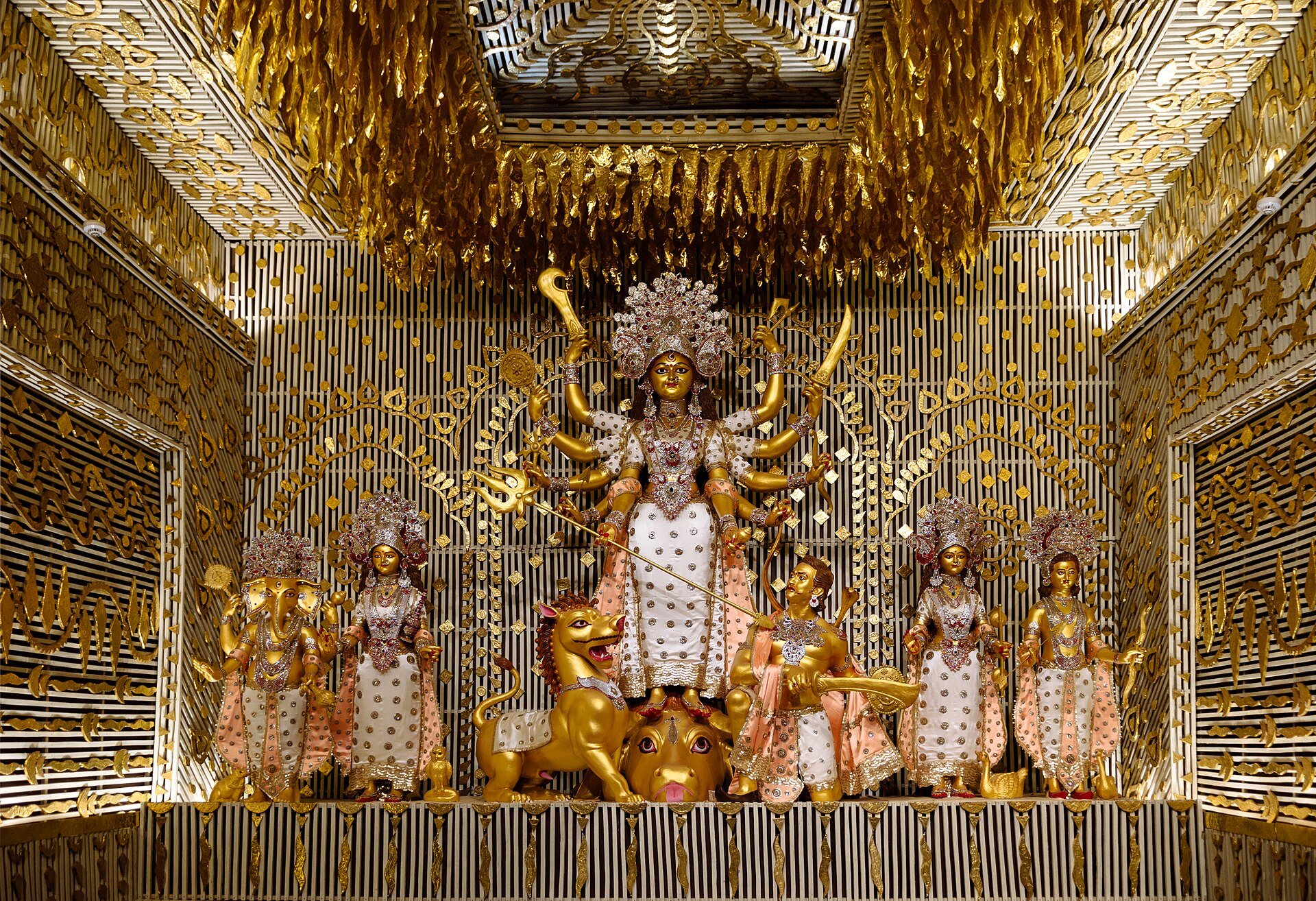
Titelfoto: Chalta Bagan Durga Puja 2019, by Subhrajyoti07 (CC BY-SA 4.0), via Wikimedia Commons
In 2019 the British Council commissioned a study of the economy around Durga PujaPujaAn act of Hindu worship — offerings of flowers, food, light or water made to a deity at a temple or a household shrine.Read in the glossary, led by Queen Mary University of London with IIT Kharagpur, for the West Bengal Department of Tourism. It looked at ten creative industries and concluded that the creative economy around the festival was worth ₹32,377 crore — about £3.29 billion — and, in its own phrasing, that Durga Puja accounts for 2.58 per cent of the state GDP and is just a weeklong festival.
It was the first study of that scale in India, and its finding is the quiet argument behind the UNESCO file. Durga Puja is not a religious festival with an art economy attached to it. It is one of the largest public art commissions anywhere in the world: thousands of commissioned installations, built to a theme, judged competitively, financed by subscription from the households of the streets they stand in, and then taken apart and put in the river.
Everything practical about visiting follows from that. You are not going to see a ceremony. You are going to see several thousand temporary buildings, in a city that has rearranged itself around them, in about four days.
The dates, and the one ambiguity
The West Bengal government holiday list for 2026 gazettes Mahalaya on Saturday 10 October, Durga Puja Maha Astami on Monday 19 October, Maha Nabami on Tuesday 20 October and Dasami on Wednesday 21 October. Two independent statutory-holiday compilations give the identical list and show these as applying to government offices and to banks under the Negotiable Instruments Act. That list implies Shashthi on Saturday 17 October and Saptami on Sunday 18 October, which a panjika-based calendar confirms.
There is a genuine conflict to handle. The same panjika places Navami on 19 to 20 October and Vijaya Dashami on Tuesday 20 October — a day earlier than the government list. Tithi overlap makes this an ambiguity rather than an error, and it is not resolvable from outside. We plan to the government dates, because they determine what is shut, and we do not assert a Dashami date without the state notification in hand.
One oddity worth flagging: Mahalaya falls seven days before Shashthi in 2026, a longer gap than usual. We can see it in the calendar; we cannot source the almanac reasoning for it, so we leave it as an observation.
A useful corroboration of the dates comes from the Metro, which announced extra weekend services for 3, 4, 10 and 11 October 2026 ahead of the Puja — consistent with Shashthi on the 17th.
What UNESCO actually did
The element is named 'Durga Puja in Kolkata'. It was inscribed in 2021 on the Representative List of the Intangible Cultural Heritage of Humanity, submitted by India, with element reference number 00703 under decision 16.COM 8.b.15. The inscription was made on 15 December 2021 at the sixteenth session of the Intergovernmental Committee of the 2003 Convention, held in Paris from 13 to 18 December. The Committee commended the festival for involving marginalised groups, individuals and women in safeguarding the element. It brought India to fourteen elements on the Representative List.
Two corrections, because both errors are repeated constantly. UNESCO did not inscribe Durga Puja; it inscribed Durga Puja in Kolkata, the city-specific element. And it is not a World Heritage Site — that is a different list, under a different convention, and it covers places.
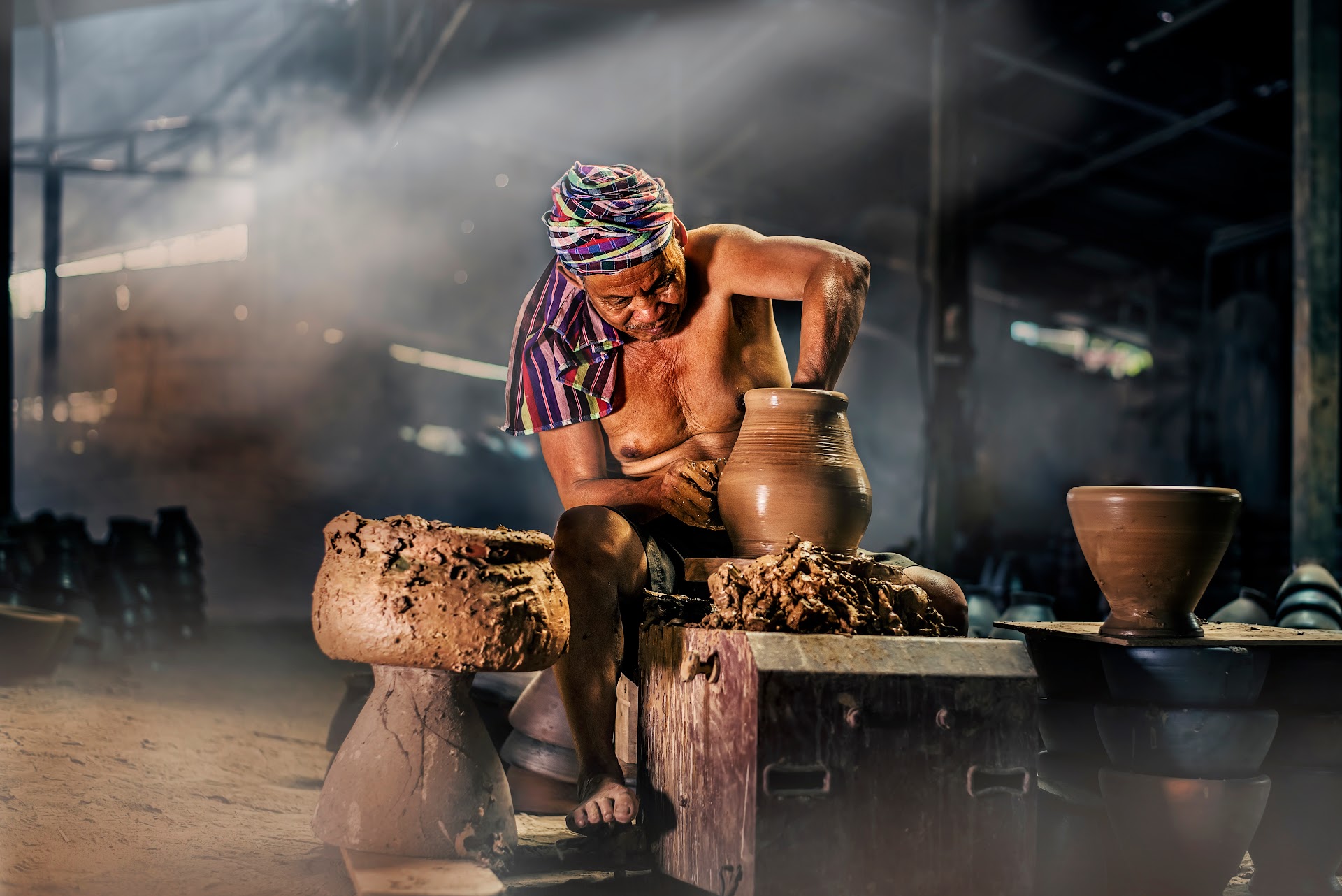
UNESCO's own description is worth quoting because it is unusually good on the mechanics: in the months before the festival, small artisanal workshops sculpt images of Durga and her family from unfired clay pulled from the Ganga; worship begins on Mahalaya, when eyes are painted onto the clay to bring the goddess to life; and it ends on the tenth day, when the images are immersed in the river from where the clay came. The element is characterised as a public performance fusing religion and art, with large-scale urban installations, traditional Bengali drumming, and veneration crossing class, religious and ethnic lines.
The scale, honestly measured
Kolkata Police typically permit around three thousand pujas citywide. For 2026, roughly ten thousand police personnel plus about twenty-one thousand temporary home guards and NCC cadets are deployed, with the Commissioner holding the coordination meeting with Puja committees at Nazrul Mancha.
Corroborating figures: about three thousand barowari — community — pujas in Kolkata in 2022, over forty thousand community pujas across West Bengal, and more than two hundred Kolkata pujas with budgets above ₹1 crore. The state grant per committee rose from ₹10,000 in 2018 to ₹1,10,000 in 2025, with a seventy-five per cent electricity concession. The 2025 immersion season covered about three thousand five hundred pujas across Kolkata, including roughly two hundred and fifty household ones.
What we will not give you is a visitor number. No credible official or statistical source for Durga Puja footfall exists; the searches return commercial blogs and promotional pages. The permitted-puja count and the immersion count are the defensible scale metrics.
The same caution applies to the economic figure, and it matters because the numbers in circulation are much larger. Use ₹32,377 crore and 2.58 per cent of state GDP, from the British Council in 2019, with the year attached. The ₹40,000 crore with three hundred thousand jobs, the ₹50,000 crore, the ₹65,000 crore — these appear in secondary compilations and news aggregation, not in a documented study, and should not be presented as research findings.
What it does to the city
Kolkata Police's 2026 requirements give a good picture of the logistics: separate entry and exit routes at every pandal, rain contingency plans, subscription collection that must not cause inconvenience or amount to coercion, permissions through the digital Sahaj portal, and coordination with civic authorities to finish infrastructure work around venues before the crowds arrive.
On the Metro, be careful with what you have read. The only 2026 notice we could verify adds weekend services on the pre-Puja Saturdays and Sundays — the Blue Line to 272 services on Saturdays from 252 and 188 on Sundays from 152, the Green Line to 236 from 212 and 125 from 111, on 3, 4, 10 and 11 October — and states explicitly that there is no change to the timings of the first and last services on either line. All-night Puja running may well be announced separately; as of this writing it had not been. Do not plan a late pandal-hopping night around a Metro that has not been announced.
Immersion happens on the Hooghly at eighteen key ghatsGhatA flight of steps leading down to a river or tank, used for bathing, worship and cremation.Read in the glossary, with Bagbazar, Baje Kadamtala, Gwalior and Nimtala named as the sensitive ones. The municipal corporation deploys sanitation workers at every ghat, runs four boats at the major ones to retrieve idol frames, installs temporary bamboo enclosures on both banks for waste containment, and places bins for flowers and offerings before immersion begins. The State Environment Department and the Namami Gange project have installed protective infrastructure.
And the Carnival is real, state-run and documented — not a tourist-board invention. It is held on Red Road over roughly a kilometre in central Kolkata, after the main Puja, with decorated tableaux carrying the idols, dhak drummers, folk artistes, dancing and singing. The 2024 edition ran on 15 October from 4.45 to 9.15 in the evening with eighty-nine puja committees, attended by foreign diplomats, film stars and the Chief Minister, under heavy police deployment with watch towers and drone surveillance. It has been held annually since 2016, suspended in 2020 and 2021, and resumed from 2022.
How to actually see it
The honest problem with Durga Puja is that the thing worth seeing and the crowd wanting to see it occupy the same square metre. The big north Kolkata and south Kolkata pujas on Ashtami night are genuinely dangerous to attempt casually, and a car is useless from Saptami onwards in the Puja districts.
What works is counter-programming. The mornings of Saptami and Ashtami are the single best window — the installations are complete and lit, the committees are present, the pandals are empty, and photography is possible. The afternoons are for the smaller neighbourhood pujas, which are often where the more interesting commissions are, because a committee with a modest budget and a good artist produces better work than a committee with a large budget and a brief.
Kumartuli, the idol-makers' quarter, is a better visit in August and September than during the Puja itself, when the workshops are empty because the work has gone out. If a guest can only come during the festival, the workshops are still worth an hour for the unsold and unfinished pieces.
And the Carnival on Red Road is the easiest high-value hour of the whole period: seated, organised, with eighty-odd of the city's best installations brought past you rather than you going to them.
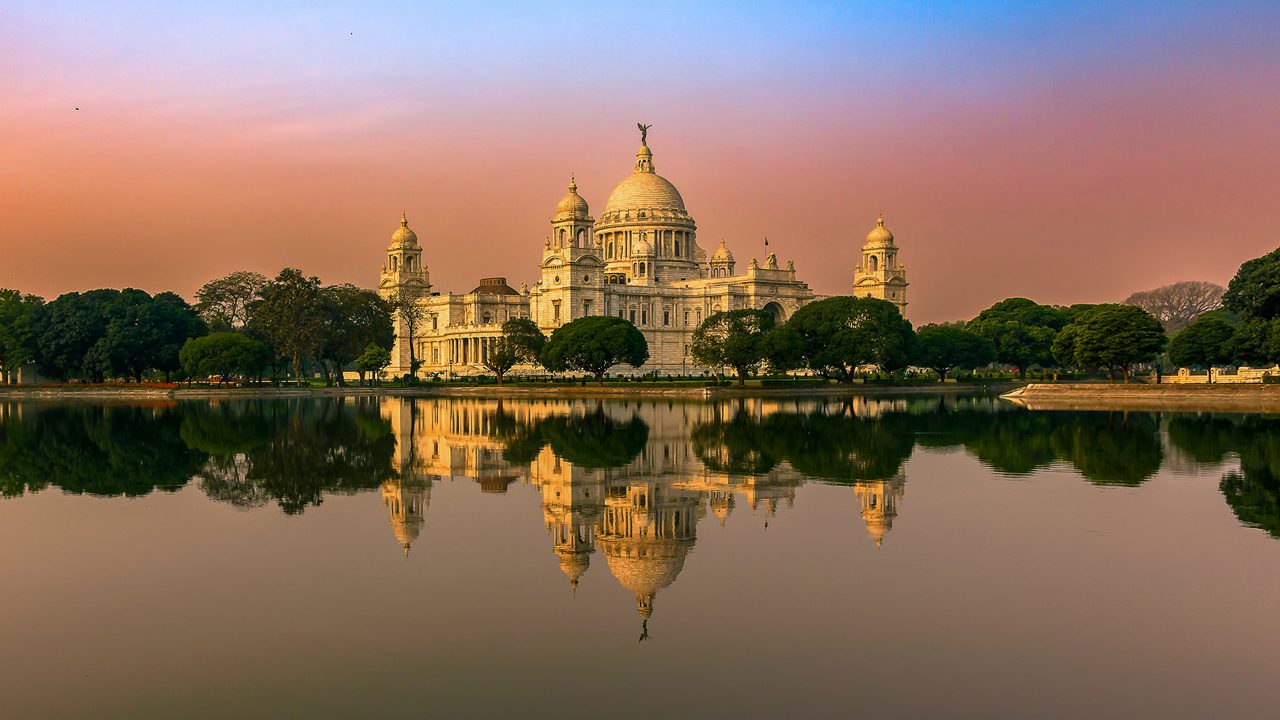
The practical rules we work to: the car is parked and walked away from, not driven between pandals. Every movement in the Puja districts is on foot or by Metro, inside the published service hours. Dasami and the immersion are watched from a fixed position at a ghat rather than followed. And the trip has a Kolkata day on either side of the festival, because the city outside the Puja — the coffee house, the bookshops on College Street, the Marble Palace, the Victoria Memorial, lunch at a Bengali kitchen worth the name — is the reason to come back, and it is unreachable in the four days when everything is in the street.
A note on the pronouns
Durga Puja is often sold to visitors as a spectacle, which it is, and as a religious festival, which it also is. The part that gets left out is that it is a civic one. The subscription is collected from households; the committee is elected from the neighbourhood; the artist is commissioned and paid; the judging is competitive and the results are argued about for a year.
A guest who understands that they are looking at a neighbourhood's annual commission, rather than at a temple, sees a different festival — and asks better questions of the people standing next to them, who are usually delighted to be asked.
Reisen, die Sie dorthin bringen
Weiterlesen