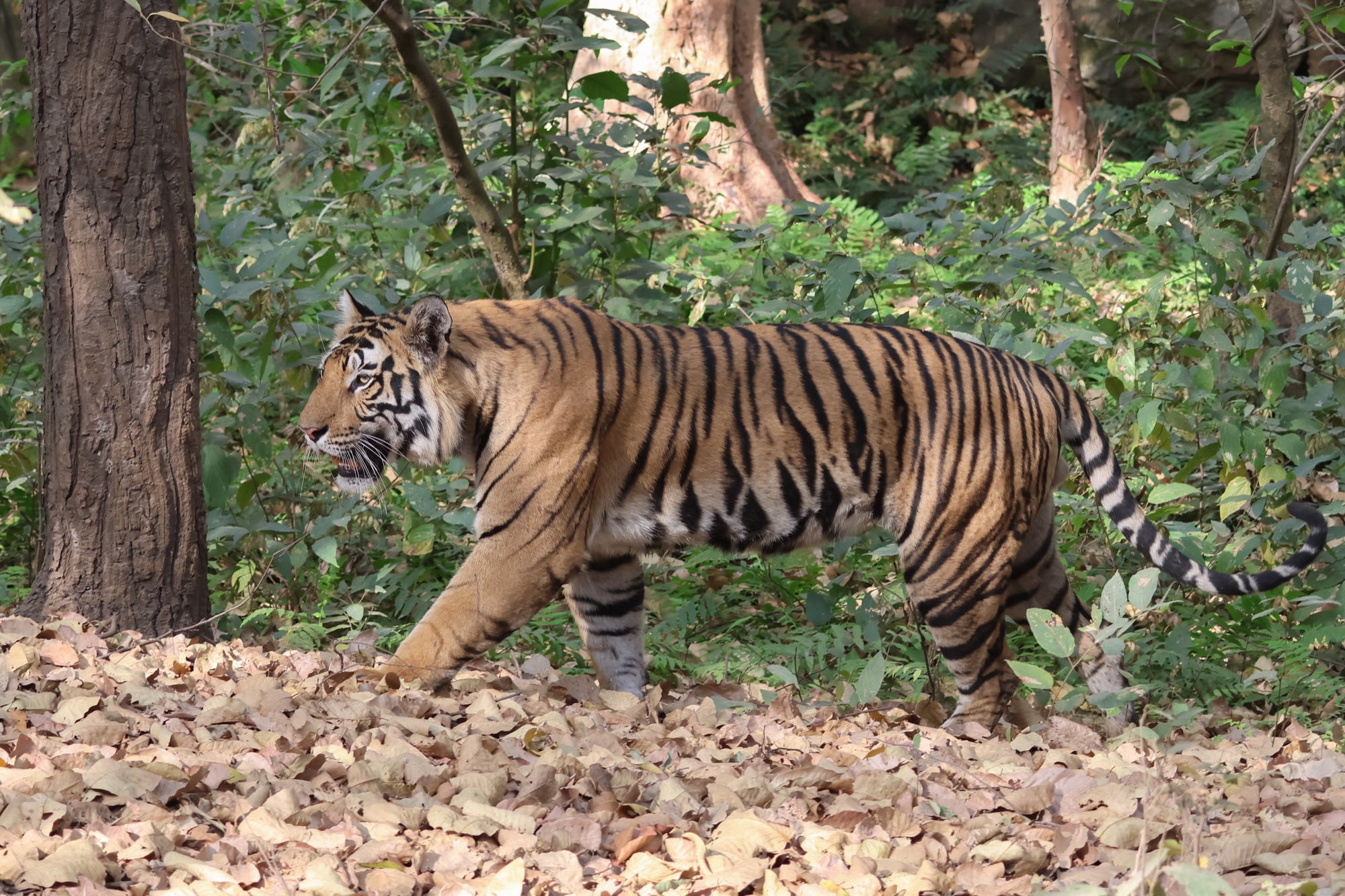
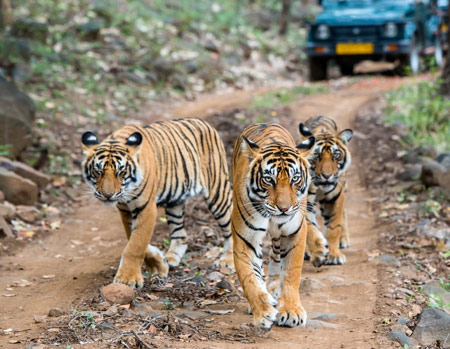
Hero photograph: Bengal tiger in Bandhavgarh National Park 01 — CC BY 4.0, via Wikimedia Commons
Bandhavgarh has the higher tiger density and the better odds on a short visit. Ranthambore has the ruined fort, far easier access from Jaipur and Delhi, and sits naturally inside a Rajasthan itinerary. Choose Bandhavgarh if the tiger is the point of the trip; Ranthambore if the trip is.
| Ranthambore | Bandhavgarh | |
|---|---|---|
| State | Rajasthan | Madhya Pradesh |
| Tiger density | High, dramatic terrain | Among the highest in India |
| Scenery | Fort, lakes, dry forest | Sal forest, cliffs, meadows |
| Access | Easy — pairs with Rajasthan | Remote — a dedicated wildlife leg |
| Best for | First safari + palace circuit | Serious wildlife focus |
| Season | Oct–Jun (closed monsoon) | Oct–Jun (closed monsoon) |
Ask us to choose, and we usually answer with a question of our own: how many nights do you have, and where else are you going? Ranthambore and Bandhavgarh are the two names that dominate any serious conversation about seeing a wild tiger in India, and the travellers who ask us to pick between them are nearly always surprised by how different the two really are. One is a ruined-fort landscape three hours from Jaipur that folds into a Rajasthan journey without costing you a flight; the other is a remote salSalA tall hardwood tree that forms the dominant forest of central and northern India.Read in the glossary forest in Madhya Pradesh with, arguably, the highest tiger density in the country, reached by an internal flight and a two-hour drive.
For someone travelling within India, that difference is a weekend either way. For someone who has flown from London, New York or Sydney with fourteen nights to spend, it is the entire decision — because Bandhavgarh's better odds are bought with nights and connections that have to come out of somewhere else.
Which reserve gives the best chance of seeing a tiger?
Bandhavgarh is the statistical favourite. Its compact core zonesCore zone & buffer zoneThe two parts of an Indian tiger reserve: a strictly protected core, where no one lives, ringed by a buffer in which limited human activity is permitted.Read in the glossary hold a famously high concentration of tigers, and over a well-planned three- to four-night stay with private morning and afternoon drives, sightings are common rather than lucky. You often hear the tiger before you see it — a chitalChitalThe spotted deer of the Indian forest — the commonest deer, and the one most often seen.Read in the glossary's sharp bark, a langurLangurThe grey, black-faced, long-tailed monkey of the Indian forest and temple town.Read in the glossary coughing from the canopy, and suddenly every jeep in the meadow falls silent. It rewards patience and repetition: the more drives you take, the more the odds compound in your favour.
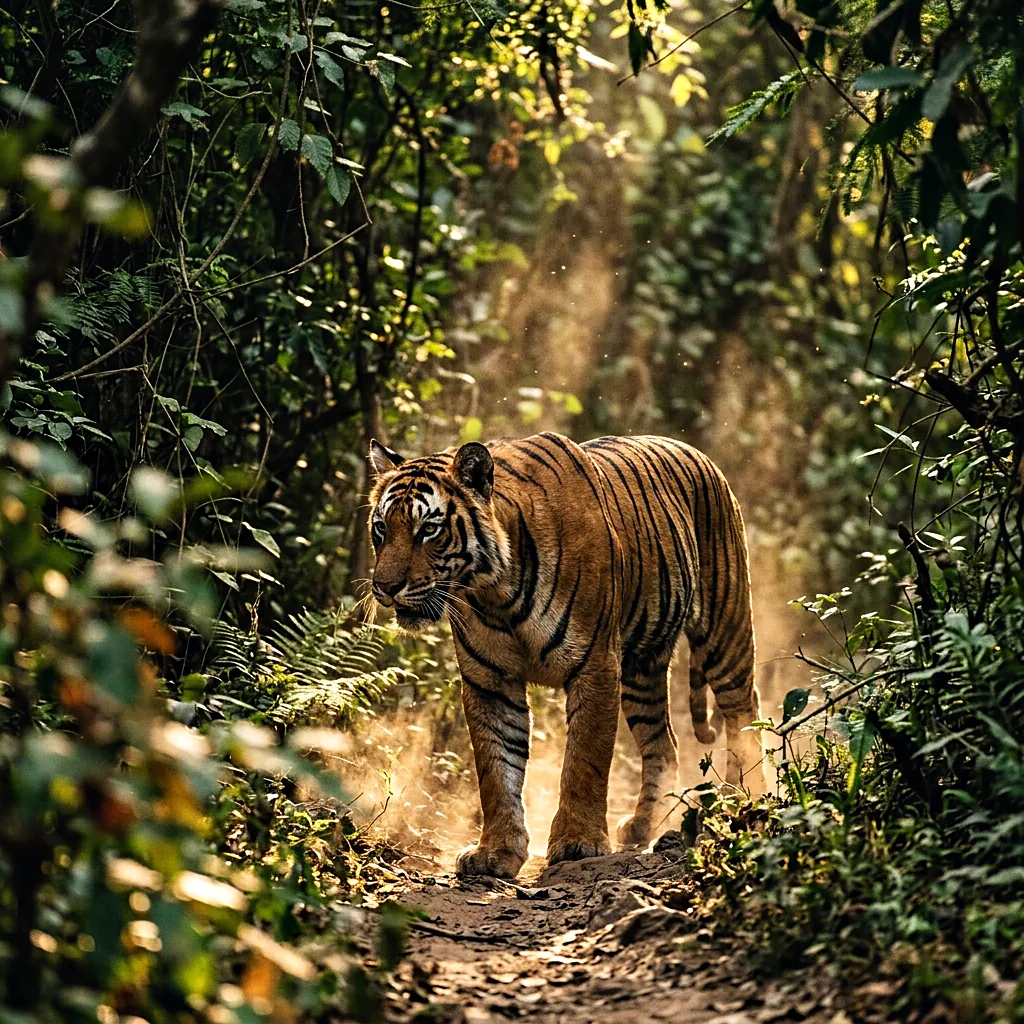
Ranthambore's tigers are fewer per square kilometre but its setting is extraordinary: a thousand-year-old fort, lakeside meadows, and banyan-shaded ruins where tigresses are often photographed against stone. Sightings are less guaranteed than Bandhavgarh but the images, when they come, are among the most cinematic in the wild-tiger world.
How do access and pairing differ?
Ranthambore wins on convenience. It sits on the Delhi–Agra–Jaipur axis, reachable by road or the comfortable train to Sawai Madhopur, which is why it pairs so easily with the Golden Triangle and a wider Rajasthan palace circuit. For a first India trip that wants both heritage and wildlife, it is the natural choice.
Bandhavgarh asks for more commitment — a flight to Jabalpur or Khajuraho and a scenic drive in — but repays it with depth and quiet. It suits the traveller for whom the tiger is the point, not a side excursion, and it combines beautifully with Kanha for a dedicated wildlife leg.
What does each one really cost you in nights?
Ranthambore costs you two to three nights and no internal flight. From Delhi it is a train to Sawai Madhopur or a drive; from Jaipur it is about three hours by road. It slots into a Golden Triangle or Rajasthan itinerary without disturbing the shape of it, which is why most first India trips that include a tiger reserve include this one.
Bandhavgarh realistically costs you four to five. You need a flight into Jabalpur or Khajuraho, usually via Delhi or Mumbai, a drive of two to four hours at the far end, and then at least three nights on the ground to make the odds worth having — a single night of drives is not a tiger safari, it is a lottery ticket. Add the return connection and you have spent close to a third of a two-week trip.
That is the honest arithmetic, and it is why we are wary of putting Bandhavgarh into a fourteen-night first trip that also wants Delhi, Agra, Jaipur and Udaipur. It fits properly at three weeks, or on a second visit, or on a journey where wildlife is the reason for coming rather than one chapter of it. Where the tiger is genuinely the point, Bandhavgarh with Kanha is a better use of those nights than either reserve bolted onto a heritage circuit.
When should you go, and how does Elevated India arrange it?
Both reserves run roughly October to June and close during the monsoon. The hot, dry months of April to June concentrate wildlife around water and offer the strongest sightings, while the cooler months from November are gentler for comfort and landscape. Core zones require booked permits and there is a real difference between a good guide and an ordinary one.
Elevated India arranges private safari vehicles, senior naturalistsNaturalistThe trained wildlife guide who accompanies guests on safari, reading tracks, alarm calls and behaviour to find animals.Read in the glossary, and the leading lodges at each reserve, and secures the specific core-zone permits that materially change your odds. Whether tiger country is the heart of your journey or a two-night thrill inside a larger itinerary, we design the reserve, the season and the number of drives around the result you are hoping for.
Questions, Answered
Is Ranthambore or Bandhavgarh better for seeing tigers?
Bandhavgarh generally offers higher tiger density and more reliable sightings over a three- to four-night stay, while Ranthambore offers fewer but more scenic encounters against its historic fort and lakes. Bandhavgarh suits a dedicated wildlife trip; Ranthambore pairs easily with Rajasthan and the Golden Triangle.
When is the best time for a tiger safari in India?
Indian tiger reserves are open roughly October to June and close for the monsoon. April to June brings the strongest sightings as animals gather at water, while November to February is cooler and more comfortable. Elevated India arranges private drives, naturalists and core-zone permits at both Ranthambore and Bandhavgarh.
How many nights does a tiger safari in India actually take?
Ranthambore takes two to three nights and no internal flight — it is a train or a three-hour drive from Jaipur and sits inside a Rajasthan itinerary without reshaping it. Bandhavgarh realistically takes four to five once you count the flight to Jabalpur or Khajuraho, the drive in, and the three nights on the ground that make the sighting odds worth having. On a fourteen-night first trip that also wants Delhi, Agra and Rajasthan, Ranthambore is usually the right answer; Bandhavgarh earns its place at three weeks or on a dedicated wildlife journey.
Which is better, Ranthambore or Bandhavgarh?
Neither is simply better — it depends on what you want. Bandhavgarh has one of the highest tiger densities in India and a wilder, less-visited feel, so it suits a dedicated wildlife trip and serious photography. Ranthambore offers fewer but more scenic encounters against its historic fort and lakes, and pairs easily with Rajasthan and the Golden Triangle. We match the reserve, season and lodge to your priorities.
Journeys That Take You There
Read Next