 By Manu Singh
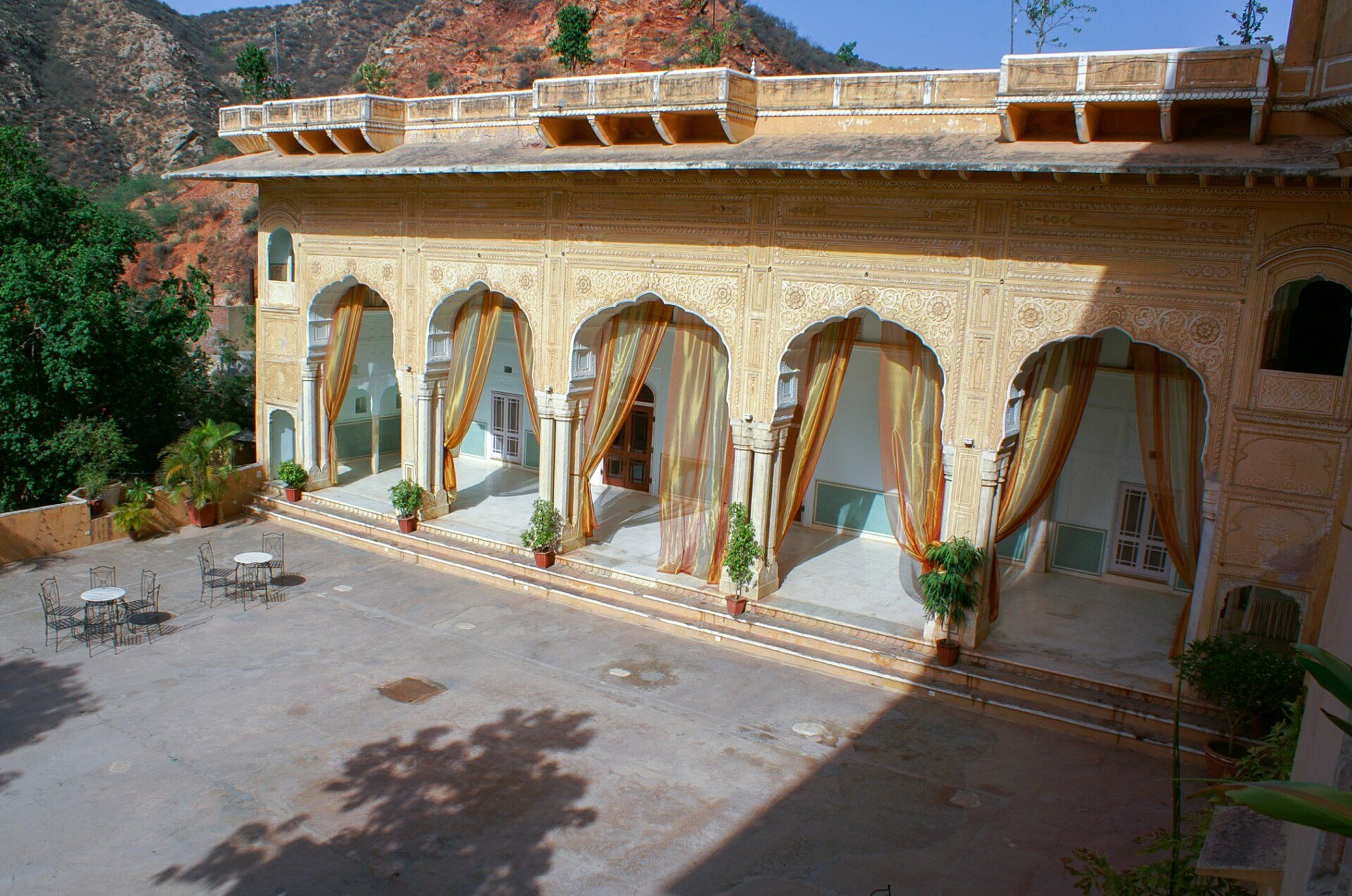
Hero photograph: The courtyard at Samode Palace, Jaipur, by Walter Schärer (CC BY-SA 3.0), via Wikimedia Commons
The single supplement is the question solo travellers ask first and the one the industry answers worst, usually with an apology and no explanation. The explanation is simple arithmetic and it is worth having, because once you can see which parts of an India trip are bought by the party and which by the head, you can see exactly where the gap comes from and which of it can be closed. Some of it can. Most of what gets sold as a solution does not work in India for structural reasons we can show you. And one small fact is worth noticing on its own: India's tourism ministry publishes the age, sex, nationality, purpose and length of stay of every foreign arrival, and has never once counted whether they came alone.
This is the first question a solo traveller asks us and it usually arrives apologetically, as though it were an awkward thing to raise. It is not awkward. It is the single largest variable in the cost of travelling alone and nobody explains it properly.
So here is the explanation, with the published numbers it rests on, and an honest account of which parts of it can be reduced and which cannot.
There is no single supplement at an Indian hotel
Start with something you can verify yourself in five minutes.
We read the published policy pages of six Oberoi properties for this piece — Amarvilas at Agra, Rajvilas at Jaipur, Udaivilas at Udaipur, Vanyavilas at Ranthambhore, the Cecil at Shimla and the Oberoi at Gurgaon. Between them they set out taxes, child occupancy, extra beds, cancellation windows, early departure, advance purchase terms and festive supplements in some detail.
Not one of them contains a single-occupancy clause. There is no single rate and no single supplement anywhere on any of them.
That is not an omission. It is the structure. An Indian luxury hotel sells a room. The rate is for the room, and occupancy appears in the terms only as a question about children and extra beds. There is no per-person hotel rate for a supplement to be a supplement to.
Which means the single supplement is not something a hotel levies or an operator chooses to charge. It is what happens to a per-room cost when it is divided by one person instead of two. Nobody decided it. It is arithmetic, and the first useful thing to know is that there is no villain in it.
What is bought by the party, and what by the head
Once you see the trip as two lists, the whole thing becomes legible.
The guide is bought by the party. Rajasthan Tourism publishes the approved guiding fee schedule, banded by party size, and the first band is one to four people — charged identically. A state-level guide for a full day is the same fee whether there is one of you or four. The bands only step up at five people, and again at sixteen.
We cite that for its shape and not for its level: those are the state's approved rates for licensed guides, and they are not what a specialist private guide costs in the luxury market. But the band structure is the argument, and it is the government's own.
The car is bought by the party, because it is hired as a vehicle for a day rather than as seats. So is the driver. So are most permits and most private access arrangements. And so, as we have seen, is the room.
What is bought by the head is shorter. Monument admission: the Taj Mahal is ₹1,100 for a foreign visitor, plus a further ₹200 to enter the main mausoleum. Meals. A berth on a train. Flights.
So the sentence that explains everything is this. The room, the car, the driver and the guide are bought by the party. The ticket, the meal and the berth are bought by the head. And on a classic north India itinerary the first list is substantially the larger number.
That is why arriving alone moves the total more than people expect. It is also why the gap narrows on itineraries that are lighter in vehicle time and heavier in per-person cost — which is a genuinely useful thing to know when designing a solo trip, and we will come back to it.
The trains, where the premium is published
India's luxury trains sell by the person rather than by the room, which makes them the one part of the market where the premium is visible in black and white. All of these figures are published by the operators themselves.
The Palace on Wheels tariff, on a Government of Rajasthan domain, publishes single and double occupancy as two complete per-person rates for the same cabin. For the October 2026 to March 2027 season, a deluxe cabin is USD 1,501 per person at single occupancy against USD 976 per person at double. In the September and April shoulder it is USD 1,328 against USD 864.
That is a premium of roughly 54 per cent in both windows — almost exactly constant across seasons, which tells you it is a structural rule rather than a demand-led one.
The MaharajasMaharajaA ruling Indian prince — literally 'great king'; a maharani is his queen, or a princess ruling in her own right.Read in the glossary' Express publishes a single supplement line against each cabin class, and here the shape is more interesting than the level. On the published tariff for The Indian Splendour, the supplement is about 75 per cent of the twin-share fare on a Deluxe cabin, about 90 per cent on a Junior Suite, and exactly 100 per cent on both the Suite and the Presidential Suite.
Read that gradient. At the top of the train the solo traveller is not paying a supplement at all. They are buying both berths, because at that grade the cabin is simply not sold by the half.
The Golden Chariot publishes a single supplement at 76 per cent of the twin-share fare on its five-night itineraries.
We give these because they are the only published, verifiable single-traveller premiums in Indian luxury travel. No reputable industry body publishes a typical range for luxury single supplements — we looked, including at the trade associations that would be the obvious place for it, and there is no such figure. Anyone quoting you a standard percentage is quoting a feeling.
Why sharing does not solve it here
The conventional answer to a single supplement is a share scheme: pair the solo traveller with another, split the room, split the supplement. In India this works less often than people expect, and the reason is structural rather than cultural.
On the trains it is settled by the published occupancy rule. A Palace on Wheels cabin is a two-adult unit — the tariff states that a cabin has occupancy of two adult passengers only, with an additional mattress available for infants or children under twelve. There is no third berth to sell and no flexible configuration to exploit.
On the land itinerary the obstacle is the shape of the product. The whole proposition of a private India trip is that the car, the guide and the day belong to you. A share arrangement that preserves the room saving but gives away the private vehicle has traded the expensive thing for the cheap one, and usually guests conclude it was a bad trade about four days in.
We are not against small-group departures and we run them. But we would rather tell you plainly that they are a different product than imply they are the same trip at a discount.
What actually reduces the gap
Four things do, and they are worth more than any amount of negotiating.
Design the itinerary around the arithmetic. Fewer, longer stays reduce the number of transfer days, and a transfer day is almost entirely a party cost — the car, the driver, the road hours — borne by one person. A trip of three bases over two weeks carries a materially smaller solo penalty than the same fortnight across six.
Put weight on the parts that are per-person anyway. A cooking afternoon in a private house, a morning with a master craftsman, a river hour at dawn: these cost close to what they would cost a couple, because what you are buying is a person's time and a place's permission rather than a vehicle. Build the trip out of these and the gap shrinks on its own.
Travel the shoulder. The single traveller is a very welcome guest in October or in late February, and considerably less flexibility exists in the last fortnight of December. That is not a discount to be negotiated so much as a window in which the conversation is different.
And ask us to ask. Hotels do not publish single rates, which means there is nothing to look up — but there is something to request, property by property, and the answer depends on the week, the house and whether we have sent them anyone recently. That is a relationship question, not a tariff question, and it is a large part of what we are for.
What the industry does not know about you
There is a small fact here that we find genuinely telling.
India's Ministry of Tourism publishes a great deal about every foreign arrival. The age bands. The sex. The nationality. The purpose of visit — leisure, diaspora, business, medical, education. The port of entry. The duration of stay. In 2022, 57.99 per cent of arrivals were male and 42.00 per cent female; by 2025 the split had moved to 55.0 and 44.9. In 2025, 18.8 per cent of arrivals were over sixty-five.
It has never counted whether any of them arrived alone. There is no travel-party or group-size table in India Tourism Statistics. We went looking for one.
The best available measure of solo travel is a British consumer survey. The travel association ABTA's annual research found 16 per cent of people had holidayed alone in the twelve months to August 2023, against 11 per cent the year before, 13 per cent in 2019 and 6 per cent in 2011. That is a real and substantial long-run rise. It is also a UK sample of around two thousand, so the year-to-year wobble is close to noise, and it says nothing about India specifically.
So the honest position is that solo travel has grown a great deal over fifteen years on the one measure anybody publishes, and that nobody has counted it in India at all. Which tells you something about how long the industry has treated the solo traveller as an exception to be priced rather than a guest to be designed for.
Practical things worth knowing
A few constraints a solo traveller meets in India are inventory constraints rather than hospitality ones, and it helps to know which is which.
Taj Mahal night viewing runs on only five nights a month — the full moon and two nights either side — between eight and midnight, in eight batches of a maximum of fifty people. A single ticket is as likely to be refused as a pair. This is capacity, not preference.
Taj Mahal tickets are now online only, booked in the traveller's own name. We handle this, but the name on the ticket has to be yours.
And on safety we will not repeat ourselves here, because we have written a candid guide to travelling India as a solo woman and it says what we think. The commercial piece and the safety piece are different questions and we would rather answer each properly than blend them into reassurance.
A note on our sources
The absence of a single-occupancy clause is from the six Oberoi property policy pages, read on 6 October 2026. The guiding-fee bands are from Rajasthan Tourism's published schedule of approved rates. The monument charges are from the Archaeological Survey of India's own Taj Mahal site. The train figures are from the Government of Rajasthan's Palace on Wheels tariff and the Maharajas' Express and Golden Chariot published tariffs; the percentages are our arithmetic on their published figures and we have said so. The arrivals data is from India Tourism Statistics and the Ministry's Annual Tourism Snapshot. The solo travel figures are ABTA's own Holiday Habits research.
Two things we could not establish. Any published range for typical luxury single supplements, from any reputable body — there is none, and we are not going to invent one. And any Indian property that publishes a reduced or waived single rate, which is unsurprising given that none publishes a single rate at all.
Hotel policy pages are live documents and change without notice. The figures above were read on 6 October 2026 and should be re-checked against the property before anyone relies on them.
On the ground
Planning guidesWhat a Trip to India Really Costs in 2026 · Is India Safe? An Honest Assessment for American Travelers
Journeys That Take You There

Read Next