By Manu Singh — Co-Founder & Director · The Travel Maestro
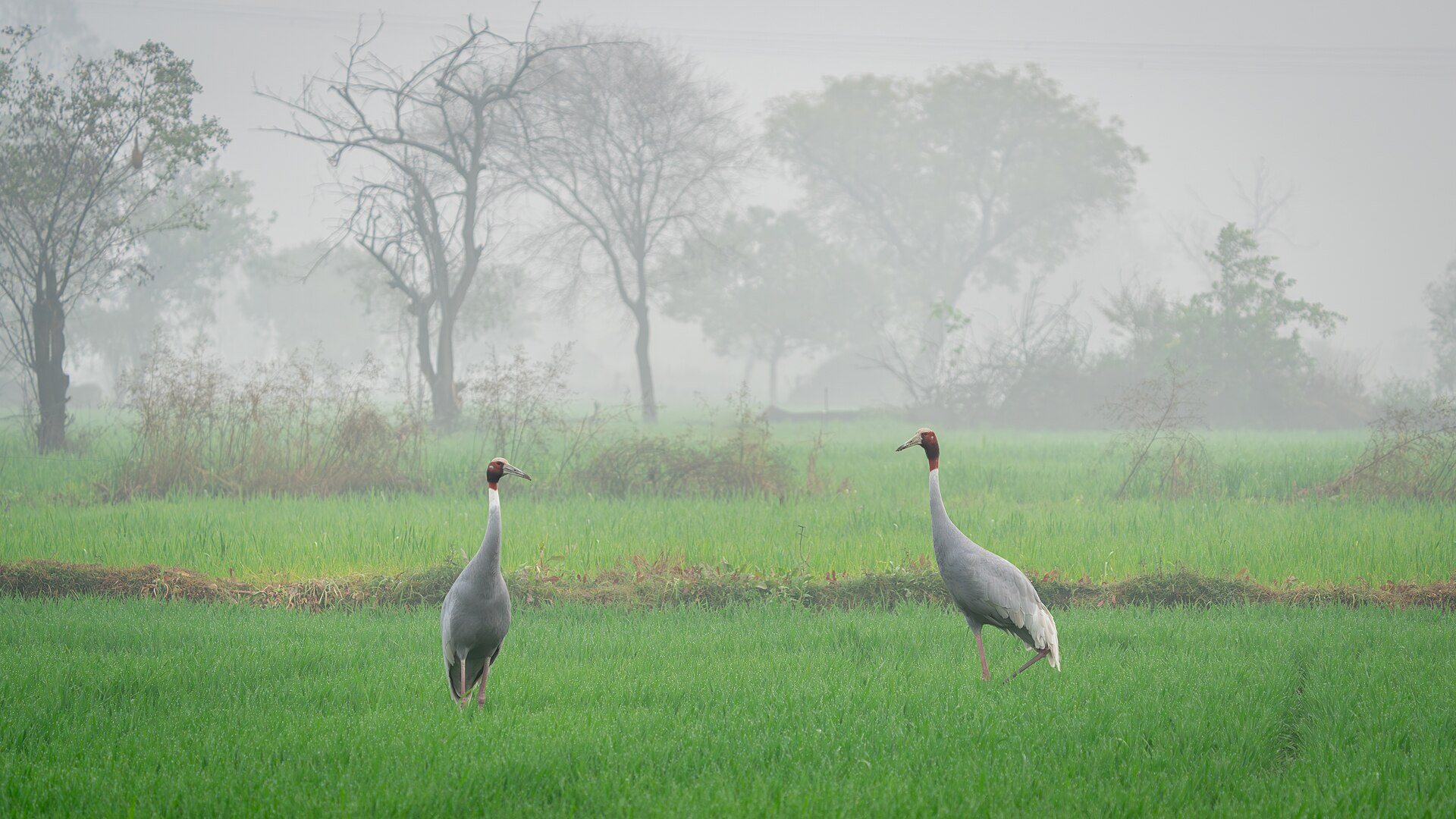
Hero photograph: Sarus cranes on a foggy morning outside Bharatpur, by Nagarjun (CC BY 4.0), via Wikimedia Commons
Peak season in Rajasthan is December and January, and almost everybody arrives underdressed for it. The misconception is specific and correctable: visitors expect a desert and get a plateau in winter, with clear skies that produce a fifteen-degree swing between dawn and mid-afternoon. The numbers below are the Meteorological Department's own thirty-year normals rather than anybody's impressions, and two of them will surprise even people who have been several times. We have also set out what a heritage hotel and a tented camp are actually required to provide, which is less than the photography implies and is the real reason to bring your own layers.
Of all the things guests get wrong about an Indian winter, this is the most common and the easiest to fix. They arrive in Rajasthan in December with linen and one jumper, and they spend the first three evenings cold.
The reason is a category error. The word desert does the damage: people picture heat and pack for it, and the Thar in December is not hot after four in the afternoon. What they are actually visiting is a high, dry, clear-skied plateau in midwinter, and clear dry air is precisely what makes a night cold.
So we have gone and got the numbers rather than describing the sensation. Everything below is from the India Meteorological Department's 1991 to 2020 climatological normals, city by city, and two of the figures invert what almost everybody believes.
What the nights actually do
Here are the mean daily minima and maxima for December and January, from IMD's own thirty-year normals.
Mount Abu: 3.8 and 21.8 in December; 2.9 and 19.6 in January. Udaipur: 8.8 and 26.0; 7.6 and 24.5. Bikaner: 9.2 and 26.0; 7.7 and 23.1. Jodhpur: 11.1 and 27.5; 9.6 and 25.1. Jaipur: 9.9 and 25.1; 8.4 and 22.5. Sawai Madhopur, for Ranthambore: 9.5 and 24.7; 7.8 and 22.8. Jaisalmer: 11.0 and 25.8; 9.3 and 23.4. And Delhi, where most people arrive: 8.4 and 22.8; 7.5 and 20.1.
Now read it again and notice the thing that nobody expects.
The two mildest January nights on that list belong to Jodhpur and Jaisalmer — the two far-western desert cities. The two coldest belong to Udaipur and Bikaner. Udaipur, the lake city in the Aravallis that every itinerary treats as the soft, warm, romantic stop, has January nights averaging 1.7 degrees colder than Jaisalmer's.
A guest who packs warm for the camel camp and light for the Lake Palace has it precisely backwards.
The second number that matters is the swing between night and day, and here Udaipur leads again: a mean diurnal range of 16.9 degrees in January and 17.2 in December, the largest of any Rajasthan plains station on the circuit. Jaisalmer's is the smallest at 14.1. Mount Abu, at nearly 1,200 metres, runs 18.0 degrees in December.
That is the whole packing argument in one figure. You are not dressing for a temperature. You are dressing for a fifteen- to seventeen-degree change that happens twice a day, every day, for the length of your trip.
On records we will be careful, because most of what circulates is unsourced. We could verify an all-time low of minus 2.2°C at Jaipur on 31 January 1905, and Delhi's January record of minus 0.6°C on 16 January 1935. For Jodhpur, Udaipur, Jaisalmer, Bikaner, Mount Abu and Sawai Madhopur we could not verify a record low at any government source, so we are not giving you one.
On Mount Abu, which everybody asks about: its average January night is 2.9°C. That is a thirty-year mean of daily minima, which necessarily means a good many nights at or below freezing — and IMD's own cold-wave threshold for hill stations is zero degrees. But we could not verify a single dated sub-zero reading at a government source, and the minus-one figures in circulation are news reports. Take it as a hill station that is genuinely cold at night, and do not quote a number.
Why the clear weather is the problem
There is a tidy irony buried in the data, and it is worth understanding because it governs how you pack.
Delhi has the smallest December and January diurnal range of any station on our list — 14.4 and 12.6 degrees — and it has that precisely because it is foggy for two days in three. The fog caps the afternoon maximum and the nights stay comparatively mild.
Rajasthan's clear skies do the opposite. Dry, transparent air returns less longwave radiation to the ground, so the surface sheds heat to space overnight and keeps shedding it. Water vapour is the atmosphere's dominant absorber in the longwave; with little of it and no cloud, the ground cools fast and far.
So the beautiful weather is the cause. The reason December in Rajasthan photographs so well — that hard clear light, the shadows on the fort walls — is the same reason you need a coat at seven in the morning.
We should also kill a piece of pub physics while we are here. The explanation you will hear is that sand has a low heat capacity and therefore loses its warmth quickly. We could not find that in any meteorological or peer-reviewed source. The documented mechanism is clear skies and very dry air, and that is enough.
Fog, and which airports can land in it
The second thing visitors get wrong is assuming fog is a Delhi problem they can fly around. It is mostly a Delhi problem, and the exception matters.
IMD's normals give Delhi 19.2 days with fog in December and 21.6 in January. Jaipur averages between one and two and a half; Udaipur and Jodhpur fewer still. That is a very large difference and it is real.
But Rajasthan does get very dense fog when it gets it. IMD's own press releases record visibility of 25 metres at Jaipur on 30 December 2023, and 25 metres at Bikaner on 18 January 2024, with Churu and Ganganagar at 50. IMD classifies anything below 50 metres as very dense.
Which brings us to the equipment, and the counter-intuitive part. From the Airports Authority's own aeronautical publication: Jaipur's runway 26 is CAT IIIB — the same category as Delhi. Jodhpur is CAT II. Udaipur is CAT I only.
What that means in practice: a CAT IIIB approach lets a suitably equipped aircraft with a specifically qualified crew land in 50 metres of visibility. A CAT I approach needs 800. So Udaipur, which almost never has fog, is the airport least able to cope with it, and Jaipur, which gets it occasionally, is equipped like the capital.
Two honest caveats. Fifty metres is a floor, not a guarantee — Jaipur has recorded 25, and below 50 nothing lands anywhere in India. And low-visibility procedures reduce the rate of aircraft movements even when the airport is open, so the schedule thins and delays propagate.
Some perspective, because the Delhi fog story is told as though nothing has changed. A study with IMD co-authors covering six winters from 2011 to 2016 counted 653 hours of dense fog at Delhi, with 567 flights delayed, 398 diverted and 351 cancelled. After CAT III operating guidelines came in from 2014, delays fell by 88 per cent, diversions by 55 and cancellations by 36. It is a materially smaller problem than it was a decade ago.
On trains: the Ministry of Railways has provisioned 19,742 fog pass devices — GPS handsets that alert the driver to signals and crossings about 500 metres ahead — and it deliberately restricts the number of trains between stations in fog. So reduced line capacity in winter is official policy rather than incidental delay. We could not find any official count of trains cancelled, and we are not going to publish one of the numbers that circulates.
The practical rule we give guests: build a buffer night before any international departure out of Delhi in late December and January, and do not schedule a tight domestic connection in the morning. The mornings are the problem; by midday it has usually burned off.
What your hotel is actually required to provide
We expected this to be undocumented and it is not, and what the documents say is more useful than anything a brochure will tell you.
The Ministry of Tourism's classification guidelines for heritage hotels — properties in structures built before 1950 — state that arrangements for heating or cooling must be provided for guest rooms in season. That is mandatory across all heritage categories. Bathrooms must have running hot and cold water, and there must be a plentiful supply of high-quality linen, blankets and towels. For Heritage Grand specifically, at least half the rooms must be air-conditioned, or heated in hill stations.
For tented accommodation, which is what a desert camp is, the guidelines are more specific still. Room temperature should be between 20 and 28 degrees. Blankets are mandatory, and in non-air-conditioned rooms must be provided as per seasonal requirement. Air-conditioning or heating in half the rooms is desirable for Standard camps and necessary for Deluxe.
And then the two provisions that are worth knowing before you book. Twenty-four-hour hot water is listed as desirable rather than mandatory, and the guidelines explicitly accept that hot water can be provided in buckets. There is no requirement for a generator or power backup at all.
Here is the caveat that makes all of this useful rather than reassuring. Classification in India is voluntary. These requirements bind hotels that seek and hold Ministry of Tourism classification. A palace hotel that is not classified, or whose classification has lapsed, is bound by none of it. So the correct statement is that the Ministry requires heating arrangements in classified heritage hotels — not that palace hotels are heated.
There is a number worth holding against all this. The World Health Organization's housing guidelines propose 18 degrees as a safe indoor temperature in cold seasons, as a strong recommendation. An unheated heritage room in Jaipur in January tracks the outdoor minimum of about 8 degrees overnight. The tented-accommodation floor is 20. The safe threshold sits between them, which is precisely the gap this piece exists to close.
What we do about it, practically, is ask. Before we place a guest in a particular room in December we establish what heating that room actually has — a wall unit, an oil-filled radiator, a brazier, or nothing — and whether the hot water is continuous. Old palaces have enormous rooms with stone floors and single glazing, and a beautiful room can be a cold one. If that sounds fussy, consider that the alternative is discovering it at eleven at night.
One safety note from India's own disaster management authority, because it is directly relevant: maintain ventilation when using a kerosene heater, a coal brazier or similar. Guests are quite often given one in an old building.
The safari morning, which is the coldest thing you will do
If there is one moment this piece is written for, it is a first-light game drive at Ranthambore in January.
The mean daily minimum at Sawai Madhopur in January is 7.8 degrees, and the daily minimum falls around dawn. You will be in an open vehicle, moving, which means wind chill on top. And you will be back for lunch at around 23 degrees.
That is a fifteen-degree change in a single morning, and the clothing that works for one end of it is useless at the other. We are not giving you a safari start time, incidentally, because no government source publishes one — every timing in circulation comes from operators, so take it from the one you are actually booked with.
The same logic applies to a desert night. Jaisalmer's January minimum of 9.3 degrees sounds mild on paper. In a tent, after dark, in moving air, with the stone and sand around you radiating away what heat they have, it is not.
The air, which nobody warns you about
We have written separately about Delhi's winter air quality using the pollution board's own data. What almost nobody says is that leaving Delhi does not leave the particulates behind.
The Rajasthan State Pollution Control Board, in a study conducted by IIT Kanpur, measured Jaipur across the winter of 2017-18. The overall average PM10 concentration in winter was 256 micrograms per cubic metre against an acceptable level of 100. PM2.5 averaged 114 against a standard of 60. Levels of PM2.5 and nitrogen dioxide ran 42 to 60 per cent higher in winter than in summer at every location measured.
At Jodhpur, the board's own monitoring for 2023-24 put December PM10 between 131 and 226 micrograms per cubic metre on the manual stations, and January between 143 and 187. The annual average air quality index was 122 — unhealthy for sensitive groups. Sulphur dioxide and oxides of nitrogen stayed within standards all year, so this is a particulate problem rather than a gas one.
And it is local. The source apportionment for Jaipur's winter load puts soil and road dust at 18 to 41 per cent, secondary aerosols at 17 to 23, biomass burning at 19 to 32, vehicles at 11 to 17, and waste burning at 6 to 8. This is domestic and agricultural burning in cold, stable air — not Delhi's smoke drifting south.
Two practical consequences. If anybody in the party has asthma or another respiratory condition, this matters, and it compounds with the cold: cold dry air narrows the airways, which is the Asthma and Lung UK guidance, and Jaipur's winter PM2.5 at nearly twice the standard is acting on the same people in the same month. And a good mask is a reasonable thing to carry in December, which is not advice anybody enjoys giving about a luxury holiday and is nonetheless true.
On the sun, which is the opposite problem: no Indian government body publishes a UV index for Rajasthan, so we will not give you a number. What is worth knowing is that ultraviolet depends on solar elevation, altitude, ozone and cloud — not on air temperature. A cold, brilliantly clear day at Mount Abu at nearly 1,200 metres is a day to wear sunscreen, and people do not, because it does not feel like it.
What we would actually tell you to bring
Layers rather than a coat, because the day is a fifteen-degree journey and you will take things off by eleven and put them back on at four.
A proper warm layer — merino, down or fleece — rather than a thick jumper, because the thing that works is a packable layer you will actually carry rather than a heavy one you leave at the hotel. A down gilet or light down jacket does more work here than anything else in the case.
A windproof outer layer, specifically for the open vehicle. The air temperature at dawn is survivable; the air temperature at thirty kilometres an hour is not.
A scarf or shawl, which is the single most useful object on an Indian winter trip and does four jobs: warmth at dawn, sun on the neck at noon, shoulders covered at a temple, and something over the nose and mouth on a bad air day. Buy one when you arrive; they are better and cheaper here.
A hat, which the disaster management authority's own cold-wave guidance names explicitly, and mittens rather than gloves if it comes to it, for the same reason they give — fingers share heat.
Warm socks and closed shoes for the evenings. Palace courtyards are stone, and you will be in them after dark.
Sunscreen and sunglasses, for the reasons above.
A mask, for the reasons above.
And one thing people never think of: something to sleep in that is warmer than what you would wear at home in summer. If the room is not heated, the bed is where you will notice it.
What not to bring: a serious winter coat. Nothing on this circuit requires one except Mount Abu, and even there the afternoons run close to twenty degrees. The failure mode is not insufficient insulation; it is having one thick thing instead of three thin ones.
And the thing to say to the person booking
Two questions, asked before you pay rather than on arrival.
Is this room heated, and how — a wall unit, a radiator, or nothing? And is the hot water continuous, or is it heated at set times?
Both are reasonable questions, both have definite answers, and in our experience neither is volunteered. A guest who asks them in October is never cold in January.
Journeys That Take You There
Read Next