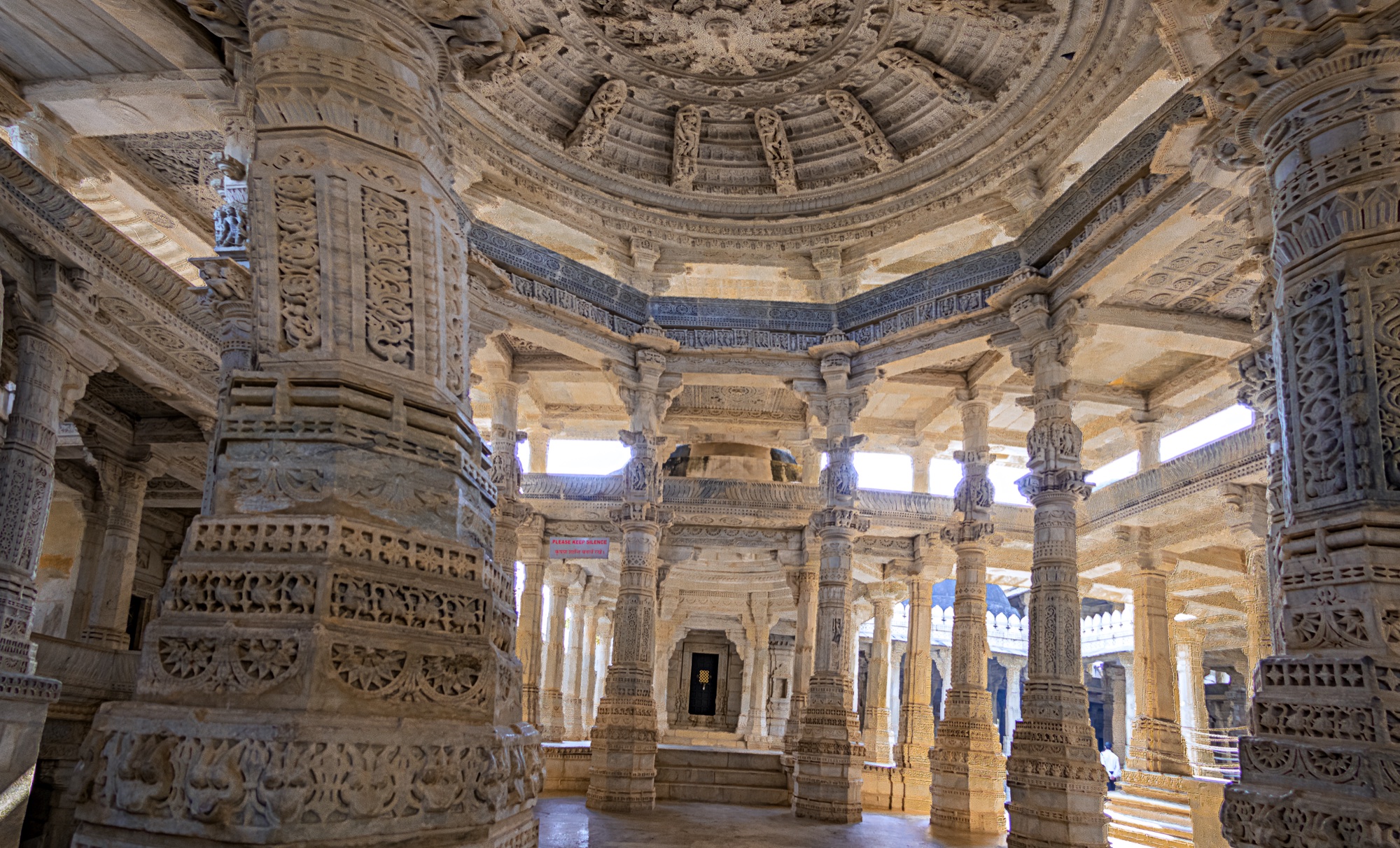
Hero photograph: Pillars of Ranakpur Jain Temple 01 — CC BY-SA 4.0, via Wikimedia Commons
There is a temple in a wooded valley in the Aravallis that is, by a reasonable measure, the finest carved interior in India — and it sits directly on the road between Udaipur and Jodhpur, which most Rajasthan itineraries drive along anyway. A great many of them do not stop. That remains one of the more puzzling omissions in Indian travel.
What it actually is
The Chaumukha temple at Ranakpur was begun in the fifteenth century, built in pale marble on a plan of extraordinary complexity: four faces, twenty-nine halls, eighty domes, and one thousand four hundred and forty-four pillars. The often-repeated claim that no two pillars are carved alike is the sort of thing one expects to be an exaggeration, and it broadly survives inspection. The effect inside is not the heaviness of most stone architecture but something closer to lace — light passing through carved screens, domes opening above domes.
Why Jain temples look like this
The density of the carving is not decoration for its own sake. JainJainA follower of Jainism, an ancient Indian religion whose central commitment is non-violence towards every living thing.Read in the glossary patronage traditions channelled merchant wealth into temple building on a scale and at a level of finish that few other communities matched, and the results — here, at Dilwara on Mount Abu, at Palitana in Gujarat — represent one of the great sustained achievements of Indian craftsmanship. Understanding that changes the visit from admiring a pretty building to reading an argument in stone.
How to visit
It is a living temple, so tourist access is restricted around worship — in practice, visitors are usually admitted from late morning, and it is worth confirming the day's timings rather than assuming. Leather of any kind, including belts and camera straps, must be left outside. Dress modestly. Photography is generally permitted in the halls but not always everywhere, and the light is best in the middle of the day when the sun reaches down through the domes.
Pair it with Kumbhalgarh
Half an hour away stands Kumbhalgarh, a fifteenth-century hill fort whose perimeter wall runs for some thirty-six kilometres — among the longest continuous walls anywhere. Together the two make a full and genuinely memorable day between Udaipur and Jodhpur, and they turn a transfer that most guests endure into the part of the week they talk about afterwards.
Questions, Answered
Is Ranakpur worth visiting?
Yes. The Chaumukha Jain temple is among the finest carved interiors in India, and it sits on the road most Rajasthan itineraries already take between Udaipur and Jodhpur, so including it costs very little time.
How many pillars does the Ranakpur temple have?
One thousand four hundred and forty-four carved marble pillars. The traditional claim that no two are identical broadly holds up in person.
Can non-Jains visit Ranakpur temple?
Yes. It is an active place of worship, so visitor access is generally restricted to a window from late morning onward. All leather items — including belts and camera straps — must be left outside, and modest dress is expected.
How far is Ranakpur from Udaipur?
Roughly two to three hours by road, directly on the route toward Jodhpur, which makes it a natural stop rather than a detour.
Should I combine Ranakpur with Kumbhalgarh?
It is the obvious pairing. Kumbhalgarh fort is about half an hour away and its perimeter wall is one of the longest in the world. Together they make a full day between Udaipur and Jodhpur.
Journeys That Take You There


Read Next